You've practiced your pitch until you could recite it in your sleep. Your product knowledge is rock solid. But when you finally dial that number, your stomach tightens as the receptionist answers, and you hear yourself speaking too quickly, stumbling over words. Before you know it, you're being shut down with, "Sorry, they're in a meeting," or "Just send an email."
Sound familiar?
For many sales reps, especially those new to inside sales jobs, getting past gatekeepers feels like trying to break through a fortress wall with nothing but persistence and a script that sounds increasingly desperate with each rejection.
Traditional aggressive cold calling tactics are meeting increasing resistance. Today's gatekeepers are well-trained to recognize and block sales attempts, while C-suite executives are too informed and time-constrained to respond to unsophisticated pitches.
As one sales veteran noted on Reddit, "If you have to use conditioning, persuasion or manipulation to sell your product, there's something wrong with your product." This perspective reflects a growing sentiment among both buyers and sellers: authentic, value-driven approaches outperform manipulative tactics.
The permission-based opener isn't just another technique—it's a fundamental shift in approach that transforms cold calls from unwelcome interruptions into the beginning of productive conversations.
When you ask for permission to continue a conversation, several powerful psychological principles activate:
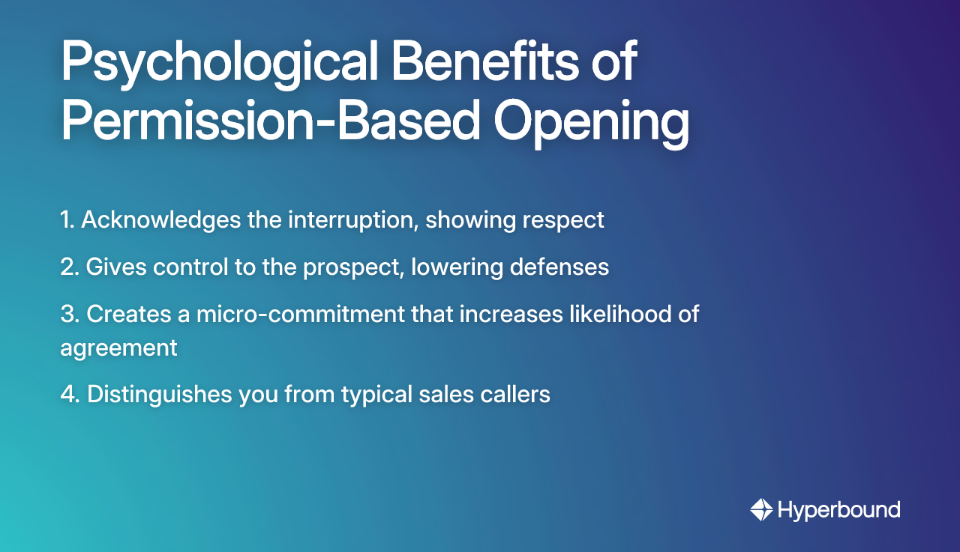
This approach immediately establishes you as a professional who respects boundaries—a crucial first impression when calling high-value prospects or C-suite executives.
A successful permission-based opener consists of three essential components:
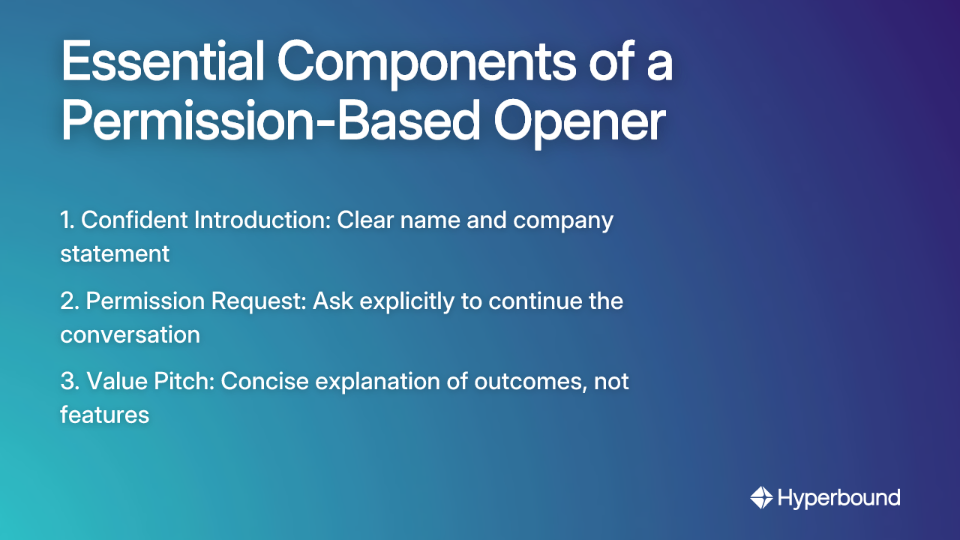
Begin with a clear, confident introduction stating your name and company. Your tone matters tremendously here:
Example: "Hi Lisa, this is Michael from Acme Solutions." (Simple, clear, and direct)
This is the heart of the approach—asking explicitly for permission to continue:
"I know I'm catching you in the middle of your day, but may I take just 27 seconds to explain why I'm calling, and then you can decide if it makes sense to continue?"
Notice several key elements:
If you receive permission, deliver a concise value proposition that focuses on outcomes, not features. Many sales reps struggle to convey the benefits of features instead of just listing them.
Strong value pitch formula: "We help [specific persona] achieve [desirable outcome] by solving [specific pain point]."
Example: "We help sales directors like you increase team productivity by 22% by eliminating the administrative tasks that keep your reps from their standing desks and on the phones with prospects."
The Help-Seeking Approach: "Hi [Name], I'm [Your Name] from [Company]. I'm hoping you might help me. I'm trying to connect with the person who handles [specific responsibility] at your company. Could you point me in the right direction?"
This approach positions the gatekeeper as an ally rather than an obstacle, using relationship selling principles to build rapport.
The Referral Approach: "Hi [Name], I'm [Your Name] with [Company]. [Mutual Connection] suggested I reach out to [Decision Maker] about how we helped their team solve [specific problem]. Is [Decision Maker] available briefly?"
Mentioning a mutual connection significantly increases your chances of getting through.
The Research-Based Opener: "Hi [Name], this is [Your Name] from [Company]. I noticed your recent announcement about [relevant company news]. Many of our successful customers in your industry are facing similar challenges with [specific issue]. May I share a quick insight about how they're addressing it?"
This demonstrates you've done your homework and aren't making a generic pitch.
The Industry Trend Opener: "Hi [Name], this is [Your Name] from [Company]. We've been tracking a significant trend in [industry] where companies are struggling with [specific issue]. Using our RICE method, we've helped organizations like yours prioritize solutions. Can I take 30 seconds to explain how this might apply to your situation?"
Even with a perfect permission-based opener, you'll encounter objections. The key is handling them conversationally rather than combatively.
Ineffective Response: "Sure, what's your email address?" (This concedes defeat)
Effective Response: "I'm happy to send you something, and to make sure I don't waste your time with irrelevant information, could you tell me which aspect of [brief value proposition] would be most relevant to your current priorities?"
This transforms a brush-off into a discovery opportunity. Even if you still end up sending an email, you'll have gained valuable information to personalize your cold email follow-up.
Ineffective Response: "Our solution is better because..." (Triggers defensiveness)
Effective Response: "That's helpful to know. Many of our pitch outcomes actually started with companies using [Competitor]. What aspects of their solution are working well for you, and where do you see room for improvement?"
This acknowledges their current choice while opening the door to discuss potential gaps.
Ineffective Response: Continuing to talk (Disrespects their time)
Effective Response: "I completely understand. Would it be better if I called back on [specific day/time], or would you prefer to schedule a brief 15-minute call when it's more convenient for you?"
This respects their schedule while keeping the door open for future conversation.
Ineffective Response: "But you haven't heard what I'm offering yet." (Creates confrontation)
Effective Response: "I appreciate your directness. Many of our prospects initially felt the same way until they learned how we helped companies like [reference similar company] achieve [specific result]. Would you be open to a brief example before deciding?"
This provides context that might change their perspective without being pushy.
When you inevitably reach voicemail, apply the permission-based philosophy:
Example script: "Hi [Name], this is [Your Name] from [Company]. We've developed a unique approach that's helping [companies in target industry] reduce [specific pain point] by up to [specific percentage]. I'd love to share a quick case study of how this worked for [similar company]. I'll try you again [specific time], or feel free to reach me at [phone number]. Again, this is [Your Name] at [phone number]."
The transition to permission-based opening requires both practice and the right mindset:
The permission-based opener works because it aligns with how people prefer to be approached in any context—with respect for their time, agency, and needs. When you lead with permission rather than presumption, you transform from an unwelcome interruption into a potential problem-solver.
By mastering this approach, you'll not only get past more gatekeepers and connect with more decision-makers, but you'll also establish the foundation for authentic relationships that can lead to long-term business partnerships. In a world where prospects are increasingly resistant to traditional sales tactics, permission-based opening isn't just effective—it's essential.
Remember: The goal isn't just to get past the gatekeeper; it's to start a conversation worth having.
A permission-based opener is a cold calling technique where you begin the conversation by asking for the prospect's consent to continue before launching into your pitch. It typically involves acknowledging the interruption and requesting a brief, specific amount of time (e.g., "27 seconds") to explain your reason for calling, which empowers the prospect and lowers their defensive barriers.
Permission-based openers are more effective because they build immediate rapport by showing respect for the prospect's time and giving them control of the conversation. This psychological shift from an unwelcome interruption to a consensual dialogue makes prospects more receptive, creates a micro-commitment, and distinguishes you from typical aggressive sales callers.
The best way to handle this objection is to agree while using it as a chance to qualify the prospect further. Instead of simply taking their email, respond with: "I'm happy to send something over. To make sure it's relevant, could you tell me which part of [your value prop] is most important to you right now?" This turns a dismissal into a discovery opportunity.
Position the gatekeeper as an ally rather than an obstacle by using a help-seeking approach. A script like, "Hi [Name], I'm hoping you can help me. I'm trying to find the right person who handles [specific responsibility]. Could you point me in the right direction?" This builds rapport and makes the gatekeeper more likely to assist you.
To sound more confident, focus on your delivery: speak at a measured, deliberate pace, use a downward inflection at the end of your sentences to project certainty, and maintain a conversational tone. Practicing your script, especially with AI role-playing tools, can help you master this tone and reduce nervousness in a risk-free environment.
If a prospect says they are busy, respect their time immediately. Acknowledge their statement and offer a clear alternative, such as, "I completely understand. Would it be better if I called back on [specific day/time], or would you prefer to schedule a brief 15-minute call when it's more convenient?" This keeps the conversation alive while respecting their schedule.
Yes, the philosophy of permission-based openers can be adapted for voicemails by creating curiosity without giving away your entire pitch. Leave a brief message (under 30 seconds) that mentions a compelling result you've achieved for a similar company and state a clear action step, like, "I'll try you again on Thursday afternoon, or feel free to call me back at [number]."








Use Cases
Legal