You're standing at the edge of a crowded room, heart racing, palms sweating. The familiar thought crosses your mind: "Just one drink to take the edge off." It's a common scenario—using alcohol as a social lubricant to ease the discomfort of social interactions.
"I've used it as a crutch for a while, and it did the job, but I wouldn't recommend it as I now have a mild drinking problem," shares one Reddit user. This sentiment echoes across forums where people discuss their struggles with social anxiety and the temporary relief alcohol provides.
The problem? While getting tipsy might temporarily quiet your inner critic, it creates a dangerous dependency cycle. As another user bluntly puts it: "Plenty of Alkies start this way."
This guide offers an alternative path: building genuine sober confidence and social skills without relying on mind-altering substances. You'll learn natural techniques to manage anxiety, read social cues effectively, and develop authentic connections—no alcohol needed.
The Problem with "Social Lubrication"
Alcohol works as a social lubricant because it's a central nervous system depressant that temporarily reduces inhibitions and self-consciousness. When you're feeling tipsy, your brain's fear center (the amygdala) becomes less reactive, making you less concerned about judgment.
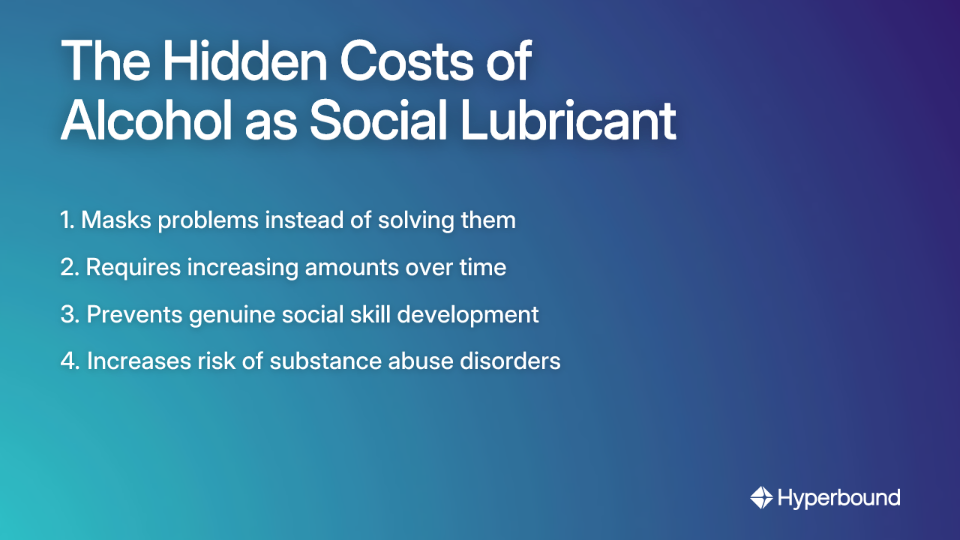
But this quick fix comes with significant downsides:
- It masks rather than solves the problem: Alcohol doesn't teach you how to read the room or engage in meaningful conversation. It simply numbs your awareness of your anxiety.
- Diminishing returns: Over time, you need more alcohol to achieve the same effect, potentially leading to dependency.
- It prevents skill development: Relying on this crutch means you never learn to manage anxiety naturally or develop genuine social skills.
- Health consequences: Beyond the risk of alcohol dependency, the Mayo Clinic notes that people with untreated social anxiety are at higher risk for substance abuse disorders.
Understanding Social Anxiety: More Than Just Shyness
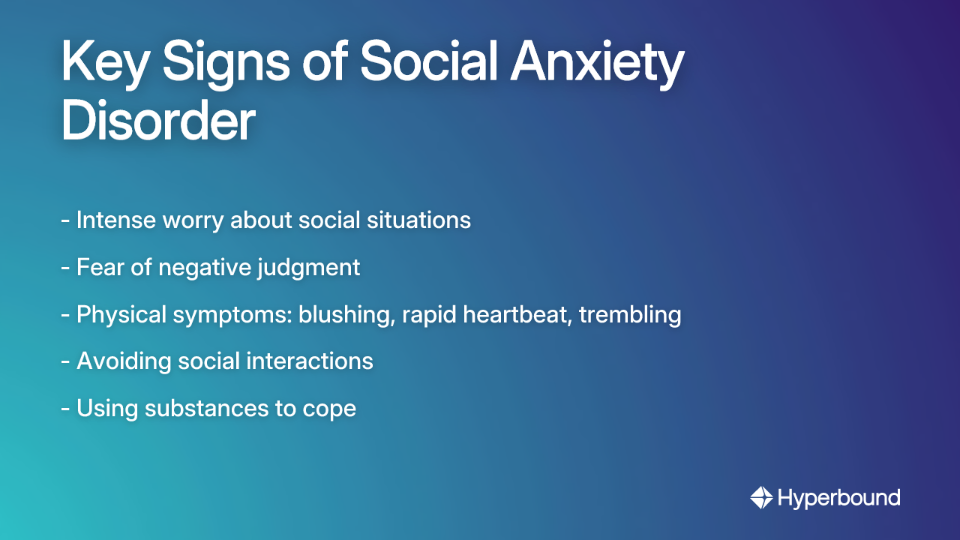
Social anxiety disorder (SAD) is characterized by intense fear of social situations where you might be judged, embarrassed, or humiliated. According to the Mayo Clinic, it affects approximately 7% of adults and typically begins during the teenage years.
Common symptoms include:
Emotional and cognitive:
- Intense worry about social situations days or weeks in advance
- Fear of being judged negatively
- Concern about embarrassing yourself
- Overwhelming self-consciousness
Physical:
- Blushing or flushing
- Rapid heartbeat
- Trembling or shaking
- Sweating
- Nausea or stomach discomfort
- Dizziness
Behavioral:
- Avoiding social situations
- Remaining quiet or hiding in the background
- Analyzing your performance after social events
- Using alcohol as a relaxant before interactions
Understanding that these symptoms stem from neurobiological processes—not personal weakness—is the first step toward managing them effectively.
Your Core Toolkit: Natural Techniques for Immediate Relief
When anxiety strikes in social settings, having a set of practical tools can help you regain your composure without reaching for a drink. These strategies provide immediate relief through natural means.
A. Powerful Breathing Exercises
Many anxiety management guides recommend deep breathing, but as one Reddit user points out: "Does anyone else with anxiety have a problem with the slow breathing tip bc when you're anxious you can't take deep breaths?" This is a common challenge, so here are different approaches to try:
1. The 4-7-8 Technique: This structured breathing pattern activates your parasympathetic nervous system:
- Exhale completely through your mouth
- Inhale quietly through your nose for 4 seconds
- Hold your breath for 7 seconds
- Exhale forcefully through your mouth for 8 seconds
- Repeat 3-4 times
2. Lengthened Exhale: If holding your breath feels uncomfortable during high anxiety:
- Simply inhale through your nose for 4 counts
- Exhale through your mouth for 6 counts
- Focus on making your exhale longer than your inhale
3. Diaphragmatic (Belly) Breathing: This technique encourages using your diaphragm rather than shallow chest breathing:
- Place one hand on your stomach and one on your chest
- Breathe in slowly through your nose, feeling your stomach expand (not your chest)
- Exhale slowly through slightly pursed lips
B. Grounding Techniques (When Breathing Is Too Difficult)
When panic makes breathing exercises challenging, try this powerful grounding technique recommended by anxiety sufferers:
The 5-4-3-2-1 Method:
- Name 5 things you can SEE around you
- Identify 4 things you can HEAR
- Notice 3 things you can FEEL (your feet on the floor, the texture of your clothing)
- Recognize 2 things you can SMELL (or like to smell)
- Acknowledge 1 thing you can TASTE
This technique helps anchor you to the present moment by engaging all your senses, making it an effective alternative to traditional breathing exercises.
C. Pre-Social Event Preparation
"I would recommend eating & meditation before going to events," suggests one Reddit user. This practical advice highlights two important components of anxiety management:
1. Nutritional Support
- Avoid caffeine, which can heighten anxiety
- Eat balanced meals before events to stabilize blood sugar
- Limit or avoid alcohol, which can worsen anxiety after the initial calming effect
- Stay hydrated with water
2. Mindfulness Practice: Even 5-10 minutes of meditation before a social event can calm your nervous system. Try:
- Body scan meditation: Progressively relax each part of your body
- Loving-kindness meditation: Direct positive wishes toward yourself and others
- Guided meditations using dedicated mindfulness apps
Rewiring Your Brain: Cognitive & Exposure Techniques
While the above techniques provide immediate relief, these longer-term strategies help rewire your brain's response to social situations.
A. Challenge Negative Thoughts
Social anxiety thrives on automatic negative thoughts like "Everyone will think I'm boring" or "I'll definitely embarrass myself." Healthline recommends questioning these thoughts:
- Identify the thought: "I'll have nothing interesting to say."
- Challenge it: "Is this actually true? Have I ever had successful conversations before?"
- Find evidence against it: "I've had good conversations with coworkers about our shared interests."
- Create a balanced thought: "I might feel nervous at first, but I have knowledge and experiences to share."
B. Gradual Exposure Therapy
Avoidance reinforces anxiety. Instead, gradually face your fears through systematic exposure:
- Create a fear hierarchy: List social situations from least to most anxiety-provoking
- Start small: Begin with a scenario that causes mild anxiety, like making eye contact with a cashier
- Practice repeatedly: Stay in each situation until your anxiety naturally decreases
- Progress gradually: Move to slightly more challenging scenarios as you build confidence
For example, if large parties trigger anxiety, your hierarchy might be:
- Attend a small gathering with close friends for 30 minutes
- Join a structured social event like a class or workshop
- Attend a larger party with a trusted friend
- Initiate conversation with one new person
- Attend a social event alone
Building Authentic Social Skills
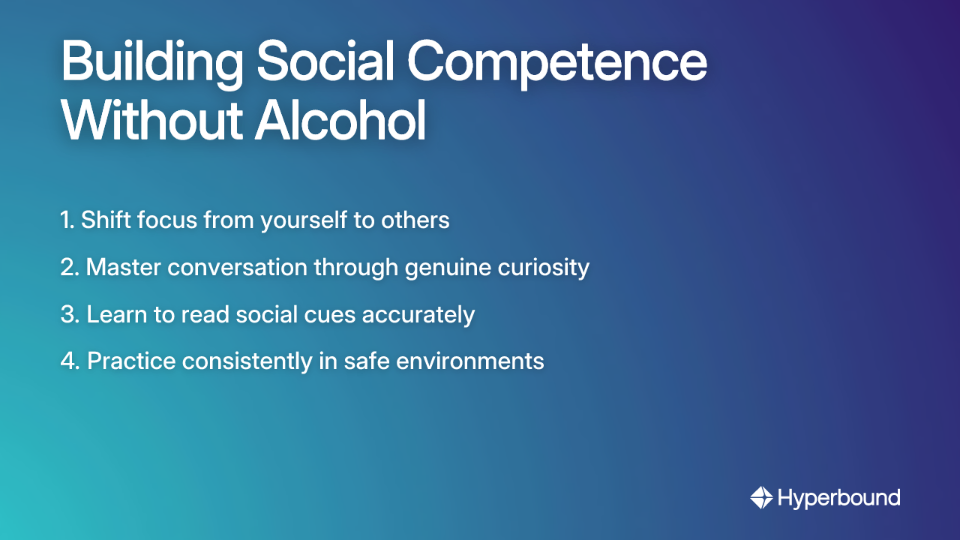
Beyond managing anxiety, developing genuine social competence is crucial for creating meaningful connections without alcohol's artificial boost.
Shifting Focus Outward
One powerful insight from social anxiety research is that excessive self-focus amplifies anxiety. As experts in mindfulness explain, redirecting your attention outward can break this cycle.
Instead of monitoring your own performance ("Am I being awkward?"), practice curiosity about others. This not only reduces anxiety but improves your social interactions naturally.
Mastering Conversation Without Liquid Courage
"Having interest in others... is what makes one good at holding conversations," notes one Reddit user, highlighting a fundamental truth about social connection that doesn't require alcohol.
Try these sober conversation strategies:
- Ask open-ended questions: Instead of "Did you like the movie?" (which invites a one-word answer), ask "What did you think about the ending?" This creates space for deeper exchange.
- Practice active listening: Rather than planning your next comment while someone is speaking, fully engage with what they're saying. Respond thoughtfully to show you've truly heard them.
- Follow the TED principle: Share thoughts, experiences, or desires related to the conversation topic to deepen the connection naturally.
- Embrace comfortable silences: Not every moment needs to be filled with words. Relaxed silence is part of natural conversation flow.
Embracing the Journey to Sober Confidence
Developing social butterfly energy without alcohol isn't an overnight transformation—it's a journey of small, consistent steps:
- Practice self-compassion: Be patient with yourself through awkward moments. They're part of everyone's social experience.
- Celebrate small wins: Successfully introducing yourself to someone new deserves recognition, even if the conversation wasn't perfect.
- Maintain perspective: Most people are focused on their own presentation rather than judging yours.
- Seek professional support: If social anxiety significantly impacts your life, consider working with a therapist. Cognitive-behavioral therapy has proven particularly effective for social anxiety, with success rates as high as 75% according to the Mayo Clinic.
Conclusion: Beyond the Crutch
While alcohol might seem like an easy social lubricant, it ultimately prevents the development of genuine connection skills and authentic confidence. As one Reddit user wisely noted after developing a drinking problem: "The best is to be able to connect without any substance, it's just something that you need to work and learn and train."
By implementing the natural techniques outlined in this guide—from immediate anxiety management strategies to long-term skill development—you can build genuine social competence that doesn't disappear when the alcohol wears off.

The journey toward sober confidence might be challenging at times, but the reward—authentic connections built on real skills rather than chemical interference—is infinitely more valuable than any temporary relief alcohol might provide.
Remember: true confidence isn't the absence of nervousness, but the ability to move forward despite it. With practice and patience, you can learn to navigate social waters skillfully, read receptive cues accurately, and connect meaningfully—all without relying on mind-altering substances as your guide.
Want to see Hyperbound in action?
Try it now