
You invest in online sales coaching. You run the workshops, buy the tool licenses, and watch your reps complete the modules. Then you check the numbers three months later — ramp times are still too long, win rates haven't moved, and your managers are still drowning in ad-hoc coaching requests they don't have time for.
Sound familiar? You're not alone.
The core problem with traditional online sales coaching is that it's expensive, nearly impossible to scale consistently across a distributed team, and notoriously hard to measure in terms of actual business impact. Sales Enablement leaders are routinely outnumbered — one enablement professional supporting 50 to 100 reps — while research consistently shows that 80% of training content is forgotten within 30 days without active reinforcement. Meanwhile, VPs of Sales and CROs are frustrated by long ramp times that inflate Customer Acquisition Cost and stagnant win rates with no clear data connecting training investments to revenue outcomes.
The good news: the landscape has changed meaningfully. A new generation of platforms is making online sales coaching scalable, consistent, data-driven, and tied to real performance outcomes. But not every platform solves the same problem — and picking the wrong one for your team's current stage is an expensive mistake.
This guide isn't a simple ranking. It's structured around the distinct coaching needs B2B sales teams have — from AI roleplay practice to conversation intelligence, methodology training, and self-paced learning — so you can self-identify the right category before diving into specific tools.
Coaching Focus: Mastering sales conversations through realistic, repeatable, and measurable AI roleplay practice.
If there's one theme that runs through every sales leader's frustration with traditional coaching, it's this: reps don't get enough safe practice before they're live with real buyers. Senior reps are too busy to run mock calls. Managers only have time to coach 5–8% of their working hours. And generic e-learning doesn't translate to live call performance.
Hyperbound solves this directly. It's the Revenue Activation Platform — a purpose-built system that analyzes what actually makes your top reps win, then turns those insights into realistic AI roleplays and coaching workflows that drive measurable behavior change.
The key differentiator is realism. A common concern about AI simulation tools is that "success in AI simulations doesn't guarantee success in real sales calls." Hyperbound addresses this head-on: its AI buyer personas are built from analysis of 2M+ hours of real B2B sales conversations — not generic scripts. The result is simulations that mirror the awkward silences, redirects, and curveball objections reps will face in actual deals.
Key Features:
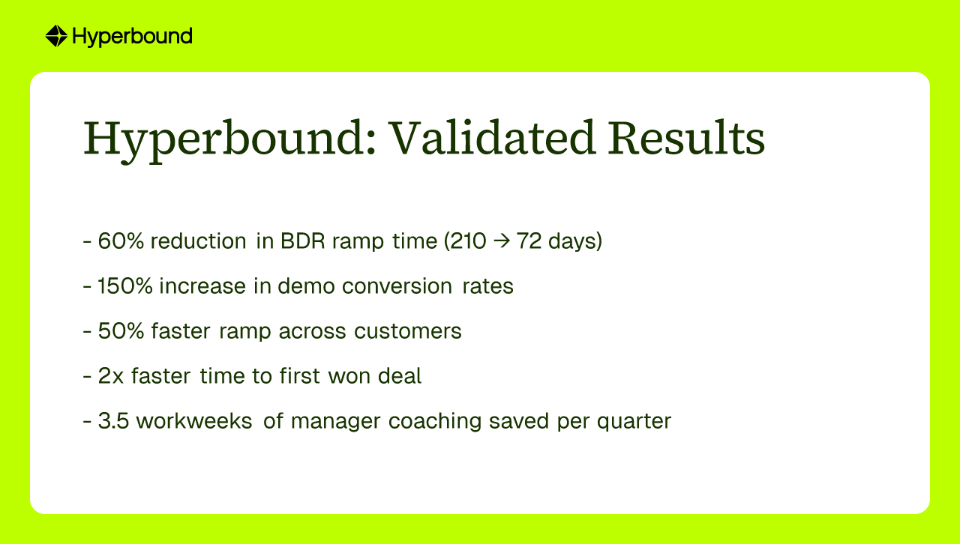
Validated Proof Points:
Best For: SDR/BDR onboarding, AE skill development, distributed or remote sales teams, and any organization that needs to scale coaching without scaling headcount.
Coaching Focus: Analyzing 100% of real customer conversations to surface coachable moments and understand what top performers do differently.
There's genuine value in the "prefer real call coaching over simulated training" camp — and Gong is where that argument is strongest. Gong records and transcribes every sales call, then uses AI to surface insights: talk ratios, keyword trends, sentiment, competitor mentions, and deal risk signals. Managers can leave time-stamped feedback and build libraries of elite call examples.
Chorus by ZoomInfo offers similar conversation intelligence capabilities at a lower price point, with strong CRM integration.
The limitation: these tools tell you what is happening on calls. They don't give reps a safe environment to practice fixing it. Insights don't build muscle memory — repetition does. Many teams use Gong alongside a practice platform like Hyperbound: Gong diagnoses the pattern, Hyperbound gives reps the at-bats to correct it.
Best For: Enterprise and mid-market teams needing deep call analytics to inform coaching strategy.
Pricing: Gong runs approximately $1,200–$1,600/user/year plus a platform fee. Chorus is approximately $100–$150/user/month.
Coaching Focus: A comprehensive sales readiness platform combining learning modules, content management, conversation intelligence, and video roleplay in one system.
Mindtickle is the go-to for large enterprise enablement teams that need to manage all aspects of sales readiness — structured onboarding, ongoing training, certification, and performance analytics — within a single platform. It's a broad solution: coaching, content, and readiness all under one roof.
Where it differs from a purpose-built tool like Hyperbound is depth of simulation. Mindtickle is a readiness platform where AI roleplay is one feature among many. Hyperbound is purpose-built for AI roleplay and coaching with significantly deeper simulation fidelity — AI personas that dynamically respond, challenge objections, and go off-script in ways that mirror real buyers.
For organizations that need a unified platform for all their enablement workflows at scale, Mindtickle is a strong contender. For organizations whose primary bottleneck is rep practice and ramp, a specialized tool wins on depth.
Best For: Large enterprise organizations managing complex, multi-program enablement initiatives.
Pricing: Custom pricing based on team size and scope.
Coaching Focus: Connecting sales coaching to the performance of sales content — pitch decks, case studies, talk tracks, and playbooks.
Highspot solves a specific and real problem: reps use the wrong content, or they use the right content wrong. It combines content management, guided selling playbooks, and pitch practice (including video scoring) to ensure reps know what to show, when to show it, and how to present it.
Where Highspot excels is in content-driven sales motions. Where it's limited is in the unscripted, conversational moments — the live objection, the executive pushback mid-demo, the competitor question that derails a discovery call. Those moments require dynamic practice, not static content delivery.
Best For: Teams with a content-heavy sales motion that need visibility into which assets actually drive deals forward.
Pricing: Approximately $50–$80/user/month.
Coaching Focus: Providing real-time suggestions and workflow automation directly within a rep's Salesforce environment during and after calls.
Cirrus Insight is designed for teams deeply committed to the Salesforce ecosystem. Its Live Meeting Coach surfaces relevant talking points during active calls, while its automation layer handles follow-up tasks, email sequencing, and CRM data entry post-call.
This is genuinely useful for in-the-moment support — but it doesn't address the underlying skill gaps. Prompting a rep with the right question in the moment is different from training them to instinctively know how to navigate that conversation. Foundational coaching and practice still need to happen separately.
Best For: Salesforce-centric sales teams looking for workflow efficiency, real-time guidance, and reduced manual CRM admin.
Pricing: Approximately $14–$21/user/month.
Coaching Focus: Teaching a high-level sales framework through expert-led online workshops, cohort programs, and certification — changing how reps think about every conversation.
Methodologies like Challenger and SPIN Selling represent the gold standard for strategic selling frameworks, particularly for complex, multi-stakeholder B2B deals. These programs shift how reps approach discovery, handle economic buyers, and build commercial insight into their messaging.
The challenge is the forgetting curve. Workshop learning degrades rapidly without reinforcement — and that's exactly where dedicated practice platforms become critical. The most effective teams pair methodology training with a platform like Hyperbound that lets reps practice and get scored on the specific Challenger or MEDDIC behaviors they've been taught, turning a knowledge event into a durable skill.
Best For: Tenured AE teams navigating complex, multi-stakeholder deals who need a framework upgrade.
Pricing: Varies significantly by provider and program scope.
Coaching Focus: Free or low-cost online courses covering sales fundamentals, process, and theory.
For individuals or early-stage teams with limited budgets, HubSpot Academy and LinkedIn Learning offer extensive libraries of video-based content with quizzes and certifications. HubSpot Academy in particular has well-structured courses on inbound sales, prospecting, and CRM basics that are genuinely valuable for reps new to B2B sales.
The honest limitation: these platforms teach concepts. They don't provide a way to practice applying them in realistic scenarios. Completing a course on objection handling is not the same as successfully handling an objection from a skeptical CFO. For foundational knowledge-building, they're excellent. For skill development, they're the starting point — not the destination.
Best For: Individuals, early-stage teams, or budget-constrained organizations building foundational sales knowledge.
Pricing: Free (HubSpot Academy); LinkedIn Learning included with LinkedIn Premium or available via enterprise license.
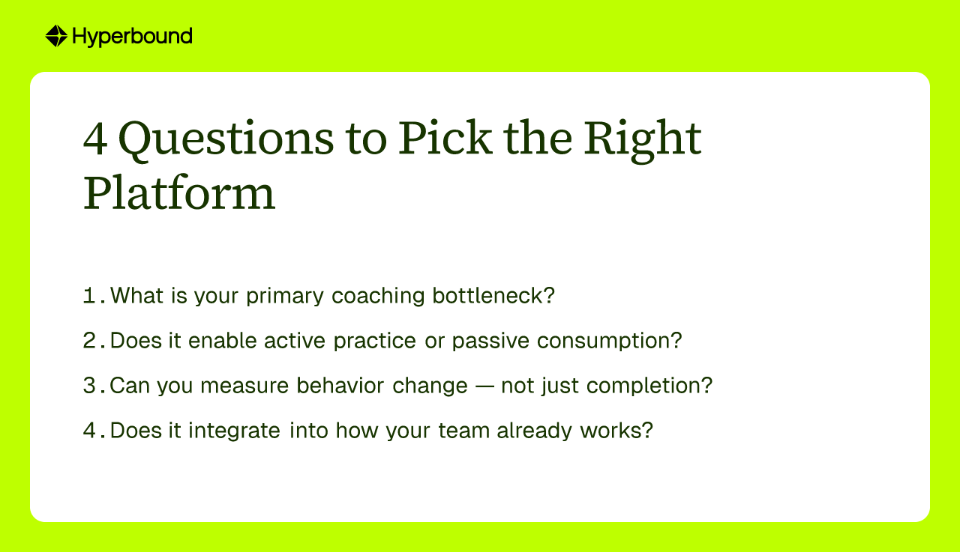
With seven distinct tools across five coaching categories, the question isn't "which is the best platform?" — it's "which type of platform does my team actually need right now?" Use these four questions to zero in on the right answer.
This is the most important question and the one most buyers skip. Watching a video and completing a quiz is passive learning. True skill development requires active, deliberate practice — realistic repetition with feedback. When evaluating any online sales coaching platform, ask: Can a rep practice a live conversation here, get scored on it, and improve? If the answer is no, you're building knowledge, not capability.
Completion rates are a vanity metric. The right platform connects training activity directly to performance outcomes: changes in objection handling scores, improvements in demo conversion rates, reductions in ramp time. If your current tools can only tell you what percentage of reps finished the module — but not whether it changed how they sell — you're flying blind. Vanta's 60% ramp reduction and Nivoda's 150% demo rate increase are the kind of outcomes that justified the investment. Look for vendors who can show you outcome data, not just feature lists.
The best coaching platform is one reps actually use. That means it needs to live where they already spend their time — embedded in Salesforce, surfaced in Slack, connected to Gong, accessible through Seismic or Highspot. A tool that requires reps to log into a separate system and remember to practice is a tool that sits unused. Look for deep CRM, LMS, and calendar integrations that make practice a natural part of the workflow, not an extra task.
The gap between knowing what to do and actually doing it in front of a real buyer is where most online sales coaching investments are lost. Data alone doesn't close deals. Insights don't build skills. And passive learning doesn't survive contact with a skeptical prospect.
The best B2B sales teams in 2026 aren't just reviewing calls — they're building a culture of continuous practice, where every rep has the reps they need to show up confident, consistent, and ready to win.
If your team is still relying on ride-alongs, ad-hoc manager coaching, and generic e-learning modules to develop reps, you're leaving ramp time, conversion rates, and revenue on the table.
Online sales coaching refers to the use of digital platforms and tools to train, develop, and improve the skills of sales representatives remotely. This can range from self-paced video courses and methodology workshops to advanced platforms that use AI for roleplay practice, conversation analysis, and real-time guidance. The goal is to provide scalable, consistent, and measurable training that impacts key sales metrics like ramp time, win rates, and pipeline generation.
AI improves sales coaching by providing scalable, objective, and personalized practice and feedback that was previously impossible to deliver consistently. AI-powered platforms like Hyperbound can simulate realistic sales conversations, allowing reps to practice their skills in a safe environment without taking up manager time. AI can also analyze real sales calls (like Gong) to identify patterns or score practice sessions against a specific methodology, providing instant, data-driven feedback to accelerate skill development and behavior change.
Conversation intelligence tools analyze past, real-world sales calls to tell you what happened, while AI roleplay platforms provide a safe environment to practice and improve how to handle future calls. A conversation intelligence platform like Gong or Chorus records and transcribes 100% of your team's calls, using AI to surface insights, identify trends, and find coachable moments. An AI practice platform like Hyperbound uses those insights to create realistic simulations, allowing reps to actively practice and master specific skills, like objection handling or discovery, before they engage with a real buyer. Many teams use them together: Gong diagnoses the problem, and Hyperbound provides the reps to fix it.
The effectiveness of a sales coaching platform should be measured by its direct impact on core business metrics, not just user activity or course completion rates. Instead of tracking "modules completed," focus on tangible outcomes. Key metrics to measure include reduction in new hire ramp time, increase in conversion rates (e.g., demo-to-close), improvements in win rates, and faster time to the first won deal. For example, Hyperbound customers measure success through outcomes like a 60% reduction in BDR ramp time and a 150% increase in demo conversion rates.
The most important factor is choosing a platform that enables active practice rather than just passive learning. While watching videos or reading playbooks builds knowledge, true skill development comes from active, deliberate practice with feedback. Before selecting a tool, ask if it allows a rep to practice a live conversation, get scored on it, and improve. Platforms that build this "muscle memory" are far more likely to drive lasting behavior change and impact revenue than those focused solely on content consumption.
To ensure adoption, the coaching tool must be integrated directly into the sales team's existing daily workflow. A platform that requires reps to log into a separate system for training will likely go unused. The best solutions embed themselves where reps already work — inside their CRM (like Salesforce), communication tools (like Slack), or content hubs (like Highspot). By making practice and coaching a natural part of the workflow rather than an extra task, you significantly increase the likelihood of adoption and consistent use.








Use Cases
Legal