
New hires usually show up pumped, full of energy — then you hand them a 40-page onboarding doc and a folder of training videos. By day three, that energy has evaporated. Sound familiar?
This isn't just a morale problem. It's a revenue problem.
In complex B2B sales, new reps take an average of 9.2 months to reach full productivity. Every day they're still ramping is a day of sunk salary cost, a day of pipeline burned while they're still learning to pitch, and a day of compounding Customer Acquisition Cost (CAC) with zero return. And if the onboarding experience is poor enough, 20% of new hires will leave within the first 90 days — taking all that investment with them (replacing a failed hire can cost up to $240,000) and leaving you back at square one.
For remote sales teams, the stakes are even higher. There's no hallway to overhear a good call, no office to casually shadow a top performer, no spontaneous coaching moment over lunch. The informal learning infrastructure that propped up traditional onboarding simply doesn't exist. You need to replace it with something intentional.
Here's the proof that it's possible: Vanta's CRO, Stevie Case, reduced new BDR ramp time from 210 days to just 72 — a 60% reduction — while simultaneously growing the BDR team 4x and generating 5x more pipeline. This article breaks down the exact four-phase remote sales team coaching model that makes results like this achievable.
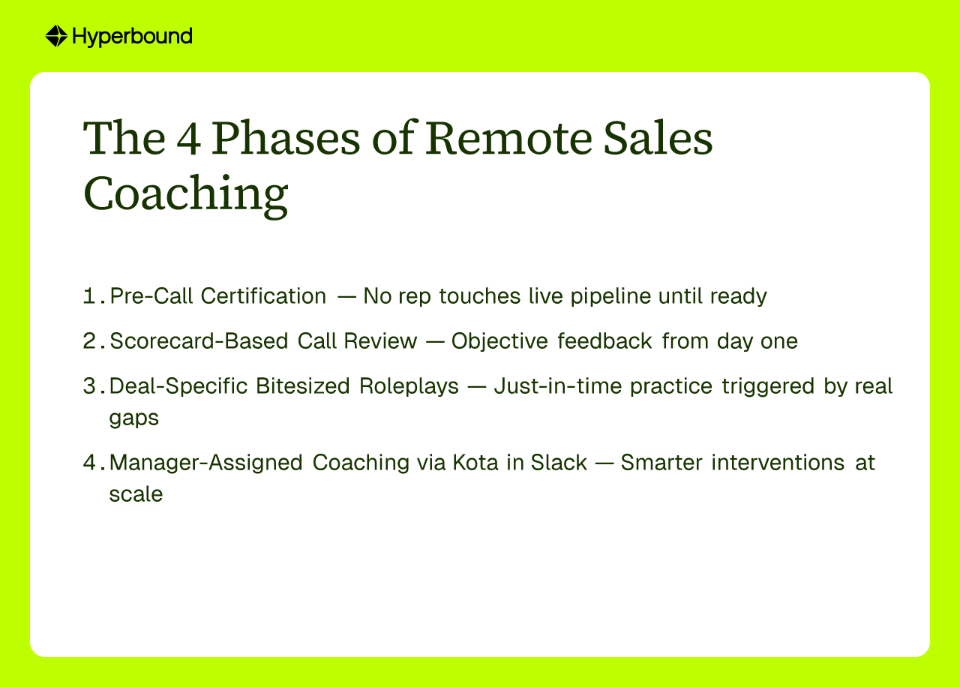
The old model of sales onboarding was essentially a knowledge transfer: here's the product, here's the pitch, here's the CRM, good luck. It worked — barely — when you could physically observe reps in action and course-correct in real time.
Remote onboarding killed that model. You can't evaluate a rep outside of scheduled calls. You can't catch the subtle coaching moment hiding in a conversation you weren't on. Managers already spend only 5–8% of their time coaching, and that number drops further when everything is asynchronous.
What remote teams need instead is a continuous improvement loop: Practice → Perform → Activate. Reps practice before they're exposed to live prospects, their real calls are scored against objective criteria, gaps are addressed with targeted practice, and managers are surfaced the right coaching interventions at the right time — without adding hours to their week. Structured onboarding alone can reduce ramp time by 37%. Build in active coaching, and you can do far better.
Here's how to operationalize it in four phases.
The most expensive place for a new rep to practice is on an actual prospect. One fumbled discovery call doesn't just lose a deal — it can permanently damage a relationship with an account you spent money to acquire.
The fix is moving from knowledge transfer to skill verification. Before a rep touches the pipeline, they must demonstrate they can handle the conversations, not just say they understand the playbook.
How to implement it:
This phase alone closes the most damaging gap in remote onboarding: reps burning real pipeline while still learning to pitch.
Even after certification, new reps need a constant feedback loop. The problem with most remote sales team coaching is that feedback is slow, subjective, and inconsistent. A manager says "good call" on Monday and can't remember why by Thursday's 1:1.
Scorecards replace gut feeling with objective, repeatable criteria — and they work equally well on simulated calls and live calls.
How to implement it:
Generic training has a shelf life of about 30 days — and 80% of it is forgotten within that window. The antidote is just-in-time coaching: practice that is triggered by a specific gap, targeted to a specific deal, and delivered in minutes — not a scheduled training session next Tuesday.
This is where remote sales team coaching starts to feel like a true performance system rather than a glorified LMS.
How to implement it:
The first three phases generate a lot of signal. Phase 4 is about making sure that signal actually reaches managers — and that managers can act on it without it becoming another full-time job.
Sales managers are already outnumbered, coaching only a fraction of the calls they should be. The solution isn't asking them to do more. It's making every coaching decision smarter.
How to implement it:
Vanta, a leader in security and compliance automation, had a ramp problem. At 210 days, their new BDR onboarding timeline was a significant brake on growth. Scaling the team meant the problem would only compound.
Here's what operationally changed when they adopted a structured coaching approach:
The results, reported by CRO Stevie Case: ramp time dropped from 210 to 72 days — a 60% reduction. That unlocked the capacity to grow the BDR team 4x and generate 5x more pipeline. The team didn't get better because they hired differently. They got better because they coached differently.
Ready to implement this framework? Use this checklist to audit your current process and identify where the gaps are.
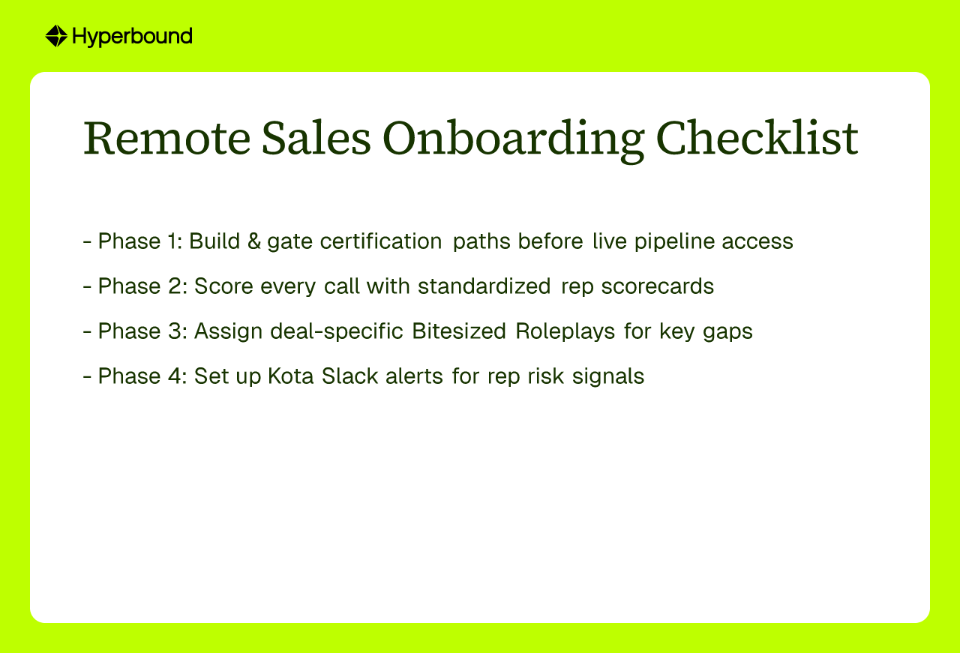
You can significantly reduce ramp time by replacing traditional information-dump onboarding with a structured coaching model. This model should focus on skill verification before reps touch live pipeline, objective feedback using scorecards, and just-in-time practice on specific deal-related challenges. As Vanta's case study shows, this approach can cut ramp time by over 60%.
Pre-call certification is a process where new sales reps must prove they can effectively handle realistic sales scenarios in a simulated environment before they are allowed to contact prospects. It’s important because it shifts the focus from simple knowledge transfer to demonstrated skill, ensuring that reps are truly prepared and preventing them from practicing—and potentially losing—valuable, live deals.
This model engages senior reps by focusing on "Bitesized Roleplays" that are directly tied to their live deals. Instead of generic training modules, a manager can assign a 5-minute practice session on a specific objection or scenario the rep is about to face. This just-in-time, contextual coaching is seen as highly valuable and directly applicable to closing deals, increasing adoption among experienced reps.
Sales managers can provide effective coaching at scale by leveraging AI tools that act as a force multiplier. Systems like Kota Activate analyze call and performance data to automatically identify which reps need coaching and on what specific skills. It then sends proactive alerts and coaching recommendations directly to managers in tools like Slack, allowing them to make high-impact interventions in minutes, not hours.
Traditional sales enablement often focuses on creating and distributing content and playbooks (information delivery). Revenue Activation, by contrast, is about turning performance data into measurable changes in rep behavior to drive revenue. It's an active process of analyzing performance, identifying gaps, and triggering targeted coaching to close those gaps, thus "activating" the revenue potential in your team.
Scorecards make coaching more effective by replacing subjective, gut-feel feedback with objective, consistent criteria. By defining what "good" looks like and measuring every practice and live call against that standard, both reps and managers get a clear, data-driven view of performance. This ensures feedback is fair, targeted, and focused on the specific behaviors that drive results.
Every sales team has call recordings piling up. Most have training content sitting in an enablement platform. The teams that ramp faster aren't the ones with the most data — they're the ones who turn that data into rep behavior change the fastest.
The four-phase model outlined here — certify before contact, score everything, deliver just-in-time practice, orchestrate coaching at scale — is what that looks like in practice. It's the difference between a 210-day ramp and a 72-day ramp. Between burning pipeline while your reps are still learning and generating 5x more of it.
This is Revenue Activation. And it starts with a single decision: to stop treating onboarding as information delivery and start treating it as performance coaching.
See how Hyperbound can help you activate your remote sales team →









Use Cases
Legal