
You're searching for Oliv.ai alternatives. But here's the real question you're asking: "Why is my win rate still flat even though I have call intelligence?"
You've invested in a tool that records calls, surfaces transcripts, and flags keywords. Your dashboard is full of data. And yet, your reps are making the same mistakes on call 47 that they made on call 1. New hires take forever to ramp. Deals stall at the same stage, quarter after quarter.
This is the call intelligence paradox — and it's more common than you think. As one sales leader on Reddit put it, "Most of the 'all-in-one' training platforms just became another tab my reps ignored." The data exists. The behavior doesn't change.
The reason is simple: there are two fundamentally different types of tools in this space, and most teams don't realize they're using the wrong category.
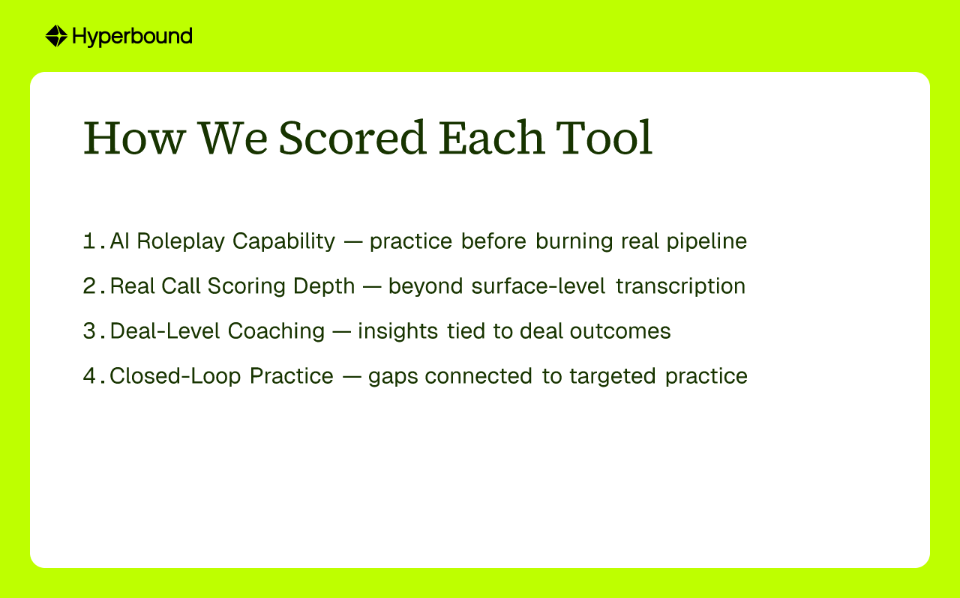
This article ranks five Oliv.ai alternatives — not just by features, but by their ability to drive rep behavior change. We scored each tool across four criteria:
Here's how they stack up.
Best for: Teams that want a robust system of record for customer conversations.
Gong is arguably the most well-known name in conversation intelligence — and for good reason. It captures and analyzes real customer interactions at scale, tracks talk-to-listen ratios, and gives leaders an unbiased view of rep behavior across the entire team. Chorus (now part of ZoomInfo) operates in a similar space.
These tools are genuinely excellent at what they do. If you want to build a library of "best moments from call recordings," identify winning talk tracks, or give managers visibility into rep conversations, Gong delivers.
The limitation is in what comes after the analysis. Tools in this category are frequently described as "suited for reviewing calls but not for interactive learning." Gong tells you a rep missed the discovery question or talked over a key objection — but there's no built-in environment for that rep to practice fixing it before the next call. The coaching still falls to the manager, in a meeting that may or may not happen.
Coaching score: High on insight. Low on behavior change.
Best for: Large enablement teams managing structured training programs at scale.
Mindtickle takes a broader approach, positioning itself as a full sales readiness platform. It centralizes learning content, onboarding programs, and training certifications — directly solving the pain that reps describe as "hunting through different logins" for training resources. For enablement leaders managing dozens of programs across large teams, the consolidation is real value.
It also includes roleplay features. But here's where it falls short for teams serious about coaching: the AI simulations aren't purpose-built for dynamic practice. As reps note in community discussions, "AI lacks the ability to counter objections realistically," making practice feel more like a checkbox than an actual skill-builder. Mindtickle's strengths are in content delivery and certification — not in the kind of live-fire, high-fidelity practice that actually rewires rep behavior.
Coaching score: Strong on structure. Moderate on practice fidelity. Weak on closed-loop skill development.
Best for: Teams that want to give reps more practice at-bats, especially for early-stage conversations.
This category represents a meaningful step toward active coaching. Unlike call recorders, Second Nature and PitchMonster put practice front and center — offering AI-driven roleplay scenarios for cold calls, discovery, and objection handling. PitchMonster claims reps see a 28% average win rate increase, and both tools create a safe environment for reps to fail fast without torching real pipeline.
The gap, however, is in realism and integration with actual performance data. Second Nature is frequently critiqued for lacking scenario depth — its AI personas aren't trained on what real buyers in your specific market actually say. The result is practice that feels generic, not like the nuanced, skeptical buyer your rep will face on Thursday. And critically, neither platform closes the loop: they don't analyze real call performance to tell a rep which skill they should practice next. The practice is disconnected from the actual gaps.
Coaching score: Strong on practice volume. Weak on scenario realism and closed-loop feedback.
Best for: High-velocity sales or contact center teams where in-call script adherence matters.
Balto and Cresta take a different approach — they coach reps during the live call, not before or after. Balto provides dynamic real-time coaching prompts that surface suggested responses as the conversation unfolds. Cresta uses AI-driven prompts to guide agents through complex interactions in the moment.
For teams where reps are handling hundreds of transactional calls per day and need compliance guardrails or script consistency, this is genuinely powerful. If your reps are frequently thrown off by unexpected technical questions mid-call, real-time assist tools can fill that gap.
Where they fall short for complex B2B sales: the coaching is tactical, not developmental. They teach reps what to say right now — they don't build the underlying skill of knowing what to say. There's no pre-call practice layer and no deal-level strategic coaching. They optimize the moment; they don't build the rep.
Coaching score: High on real-time guidance. Low on skill development and deal strategy coaching.
Best for: Sales teams serious about closing the gap between call data and actual win rate improvement.
Hyperbound doesn't just analyze what happened — it changes what happens next. Founded in 2024 and backed by Y Combinator, Hyperbound coined the "Revenue Activation" category to describe exactly the problem we opened with: teams have more data than they know what to do with, but data alone doesn't move deals.
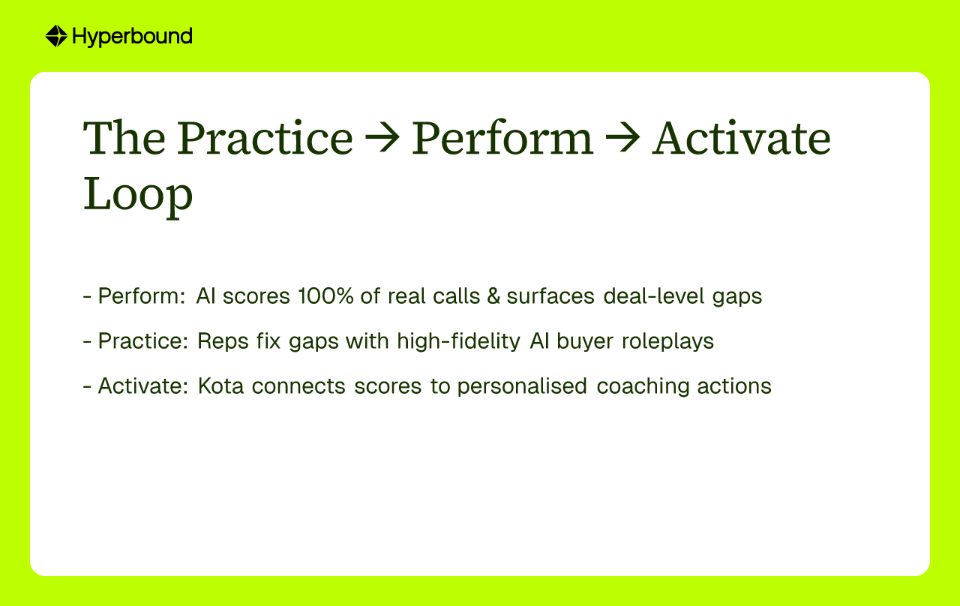
The platform runs on what Hyperbound calls the Practice → Perform → Activate model, and it's the most coherent closed-loop coaching system available today.
Hyperbound Perform deploys AI scorecards on 100% of real calls — not a sample, all of them. But unlike tools that look at individual calls in isolation, Perform rolls up insights across every touchpoint in a deal — from first cold call to closing conversation. It surfaces deal health signals grounded in actual buyer behavior, not CRM fields or gut feel. It tells you not just that a deal is at risk, but why — and which rep behaviors are responsible.
Based on those real-world gaps, reps are directed to Hyperbound Practice. This is where Hyperbound separates from every other tool on this list. The AI buyer personas are trained on 2M+ hours of real B2B sales conversations — not scripted roleplay templates. Your reps aren't sparring with a chatbot that folds at the first pushback. They're practicing against dynamically responsive personas that sound like the actual CFO or skeptical champion they'll face.
For tenured reps who tune out traditional roleplay, Bitesized Roleplays target specific skills in focused sessions — no one's sitting through a 45-minute generic module. And when reps need to practice walkthroughs, Demo Call Screen Sharing makes the simulation match the actual scenario.
Kota Activate is the intelligence layer that sits above Practice and Perform. Think of Kota as an AI Revenue Analyst — it connects roleplay performance scores with real call analysis to surface personalized coaching recommendations at exactly the right time. It tells managers where to focus their limited coaching hours instead of leaving them to guess.
This is the closed loop that every other tool on this list is missing: Score Real Calls → Identify Skill Gaps → Targeted Practice → Score Real Calls Again.
This isn't theoretical. Teams using Hyperbound report 50% faster ramp times and a 150% increase in DM → demo conversion rates. Vanta reduced ramp time by 60% — from 210 days to 72 days — while growing their BDR team 4x and influencing $125M+ in pipeline, according to CRO Stevie Case. Nivoda hit a 2x revenue increase YoY alongside that 150% demo rate jump, per Director of Sales Performance Rob Rangel.
Hyperbound integrates directly with Gong, Salesforce, HubSpot, Zoom, Google Meet, and major LMS platforms including Seismic and Highspot — so it slots into existing workflows rather than replacing them. It's also SOC 2 Type II, GDPR, ISO 27001, and HIPAA compliant, with support for 25+ languages.
Coaching score: Highest across all four criteria — AI roleplay fidelity, real call scoring depth, deal-level coaching, and closed-loop practice.
The right answer depends on where your team's real bottleneck is. Use this decision tree to find out:
Q1: Is your primary goal to record and analyze past calls for manager review?
Q2: Do you need a centralized platform to manage training content, certifications, and onboarding programs at scale?
Q3: Do your reps need more at-bats and basic practice before going live — without worrying about deep integration with real call data?
Q4: Are you running a high-volume, transactional operation where in-call script consistency is the priority?
Q5: Is your real problem that win rates are flat, ramp is too slow, and you can't connect what reps practice to how they actually perform on real deals?
If you're at Q5, the data-to-behavior gap is your problem — and more call recording won't fix it. Hyperbound closes that gap with a coaching loop that connects real call performance directly to targeted practice, and practice back to deal outcomes.
Passive insight tools record and analyze what happened on a call, serving as a system of record. Active coaching platforms are systems of action that provide reps with a structured environment to practice and improve their skills based on that performance data before their next live call.
Conversation intelligence is excellent at identifying performance issues but typically lacks a built-in mechanism for reps to practice and correct those issues. This creates a gap between data and behavior change. Simply knowing a rep struggles with objections isn't enough; they need a safe, effective way to practice handling them, which is where active coaching comes in.
AI roleplay offers a safe and scalable environment for reps to get more practice "at-bats" without risking live deals. It allows them to build muscle memory, master new talk tracks, and gain confidence in handling difficult objections. High-fidelity platforms simulate realistic buyer personas, preparing reps for the dynamics of real-world conversations.
Hyperbound is the only platform that creates a closed loop connecting real call performance, targeted AI practice, and measurable deal outcomes. While other tools focus on one piece of the puzzle (call recording, content management, or basic practice), Hyperbound's "Practice → Perform → Activate" model analyzes 100% of calls, identifies deal-level skill gaps, and guides reps to practice exactly what they need to improve.
Hyperbound's AI buyer personas are trained on a massive dataset of over 2 million hours of real B2B sales conversations, not on generic scripts. This allows the AI to replicate the specific nuances, skepticism, and objections that reps face from actual buyers, leading to practice that feels authentic and prepares them for real-world scenarios.
Yes, Hyperbound is designed to complement and enhance your existing tools. It integrates directly with leading platforms like Gong, Salesforce, HubSpot, Zoom, Google Meet, Seismic, and Highspot, fitting seamlessly into your current sales and enablement workflows.
Book a custom demo to see the Practice → Perform → Activate model in action, or try a free AI sales roleplay today and see what your reps are actually up against.










Use Cases
Legal