You've been there. The awkward silence. The forced smiles. The strange feeling of pretending to be someone else while your colleague fumbles through a scripted sales pitch. Traditional role-playing in sales training often feels more like bad community theater than professional development.
"It always feels like everyone is just trying to memorize their lines and not embarrass themselves," reports one sales professional. Another bluntly states, "I think it's childish. We are grown."
Yet the ability to handle objections effectively remains one of the most critical skills in your sales arsenal. When objections are handled satisfactorily, a sales rep's success rate can jump as high as 64%, according to industry research.
So how do you build this high-value skill without subjecting your team to the cringe-worthy mock call scenarios that make everyone uncomfortable? This guide will walk you through three powerful, practical alternatives that build real skill without the theatrical awkwardness.
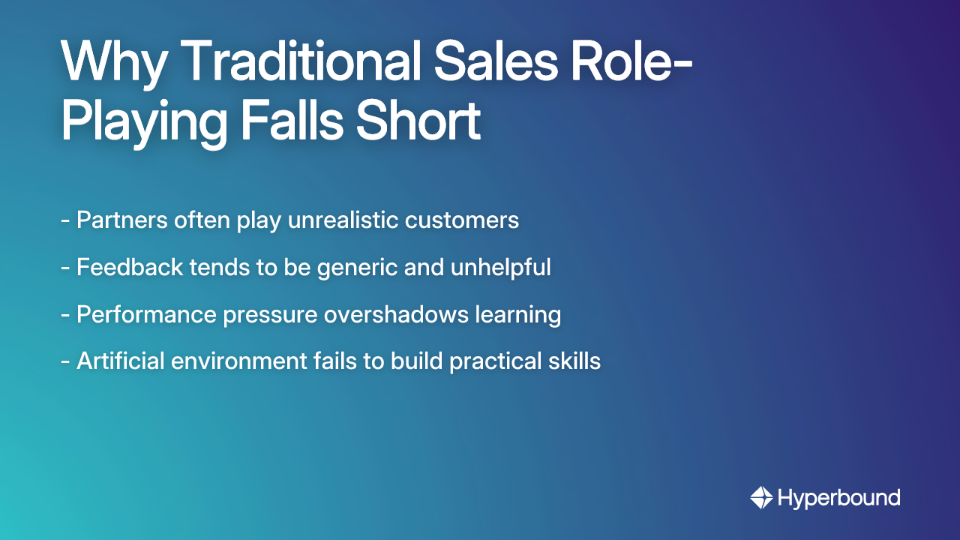
The fundamental issue with traditional sales training role-play is that it can't recreate the complexity of real customer interactions. As one sales professional put it, "You can't recreate a live customer meeting because there's so many factors that go into how a conversation goes."
In typical role-playing scenarios:
But the goal isn't just to avoid embarrassment—it's to develop the confidence and competence to transform objections from roadblocks into opportunities for deeper engagement.
The most recommended alternative to role-playing comes straight from top-performing sales teams: analyzing real call recordings. This approach replaces artificial scenarios with actual customer interactions, helping reps develop their own natural cadence.
"Listen to call recordings and give feedback," suggests one sales professional who finds traditional role-play "awkward and not productive."
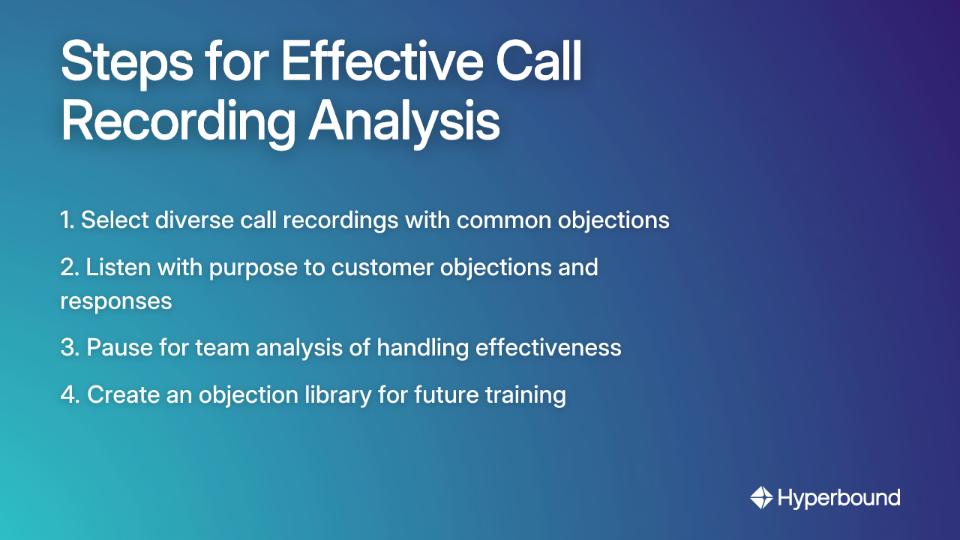
How to Run an Effective Film Review Session:
This method provides the authenticity missing from scripted scenarios while creating a safe environment for learning. Platforms like Hyperbound can automate this entire process, using AI to analyze thousands of calls, identify key moments, and score them against your playbook. Best of all, it leverages real customer language and situations that your team actually encounters.
Rather than putting individuals on the spot with mock call scenarios, collaborative brainstorming sessions harness diverse perspectives to solve common objections. This approach aligns with what sales professionals actually value: "Not roleplaying as in pretending to be a caller and a client, but throwing out ideas for campaigns, scripts, presentations I think is important for preparation."
Powerful Brainstorming Techniques for Objection Handling:
The collaborative approach offers several advantages over traditional role-play:
After the brainstorming session, document the best responses for each objection type and share them with the team for future reference. This becomes a living document that evolves as your team encounters new objections and develops better responses.

Sometimes, the challenge with objection handling isn't knowing what to say—it's being able to say it confidently and naturally in the moment. Targeted drills help build that muscle memory without the pressure of a full mock call.
"Role-playing should emphasize refining messaging and addressing common objections to enhance sales performance," notes one sales professional.
How to Run Effective Objection Response Drills:
This drill format builds confidence through repetition while keeping the environment supportive and focused on improvement rather than perfection.
Beyond practice methods, equip your team with a structured approach to handling any objection. Leading sales methodologies emphasize that having a consistent framework helps reps respond confidently even to unexpected objections.
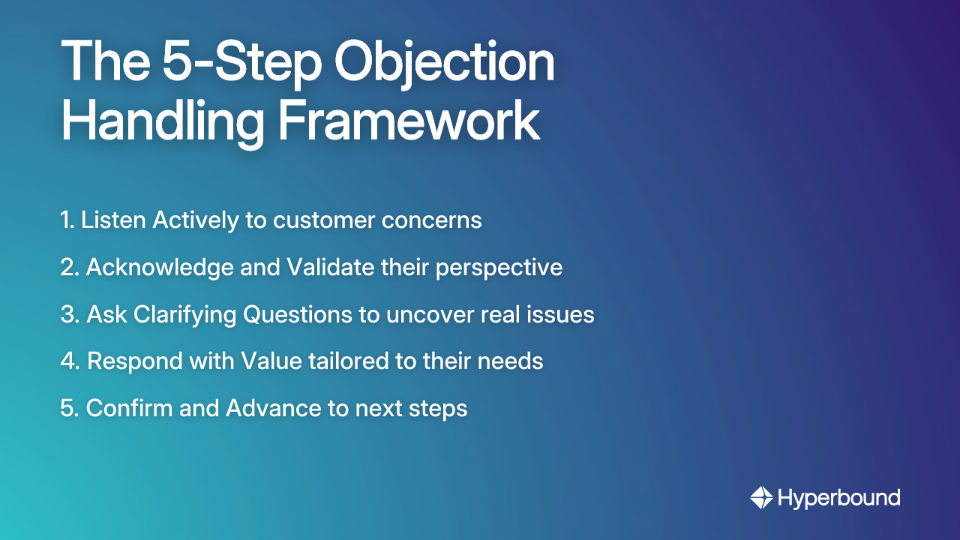
The 5-Step Objection Handling Framework:
Tactical Plays for Common Objections:
For Price Objections:
For "We're Happy with Our Current Solution" Objections:
For Timing Objections:
Mastering objection handling isn't about memorizing scripts or enduring awkward role-play sessions. It's about building a system for continuous, realistic, and collaborative practice.
Here's a weekly practice schedule that combines all three methods:
By following this schedule, your team will gradually build confidence in handling objections without ever having to sit through another uncomfortable scripted scenario.
Remember, the goal isn't to "win" against objections—it's to understand customer concerns and guide the conversation toward mutual value. As you refine your approach through these practice methods, you'll transform objections from anxiety-inducing roadblocks into valuable opportunities to demonstrate your understanding of customer needs.
The most successful sales professionals don't dread objections; they welcome them as a chance to deepen the conversation and build stronger relationships. With these alternative practice methods, your team can develop that same confidence and skill—no awkward role-playing required.
Start implementing these techniques today, and watch as your team's closing rate improves through more effective objection handling. After all, in sales, it's not about avoiding the difficult conversations—it's about mastering them.
Traditional sales role-play often fails because it's an artificial environment that doesn't replicate the complexity of real customer conversations. Participants tend to focus on memorizing lines rather than genuine interaction, partners may act as unrealistic customers, and the pressure to perform can overshadow actual learning, making the exercise awkward and unproductive.
Three powerful alternatives to traditional role-playing are: analyzing real call recordings (Film Reviews) to learn from actual customer interactions, collaborative brainstorming sessions to tap into the team's collective knowledge without individual pressure, and targeted rapid-response drills to build muscle memory for common objections in a low-stakes environment.
Analyzing real call recordings provides authentic learning material, replacing artificial scenarios with real customer language, tone, and objections. This method allows teams to dissect what works and what doesn't in a safe, analytical setting, identify the true concerns behind objections, and build a library of proven, effective responses based on actual successful outcomes.
A proven 5-step framework for handling sales objections is: 1) Listen actively to the customer's full concern. 2) Acknowledge and validate their point to build rapport. 3) Ask clarifying questions to uncover the real issue. 4) Respond by connecting your solution's value to their specific need. 5) Confirm you've addressed their concern and advance to the next step.
To handle price objections effectively, first seek to understand the context by asking questions like, "Compared to what?" or "What budget did you have in mind for a solution like this?" Then, reframe the conversation from cost to value using the Boomerang Technique, highlighting the return on investment (ROI) and how the solution pays for itself, positioning the price as a strategic investment.
Make practice less awkward by shifting the focus from individual performance to collaborative problem-solving. Use methods like team-based call reviews, group brainstorming, and rapid-response drills where the emphasis is on generating ideas and quick repetition, not on a flawless performance. This removes the "spotlight" and reduces the performance anxiety that makes traditional role-play uncomfortable.









Use Cases
Legal