The average sales rep ramp-up time is over 3-5 months, but structured training can cut this by up to 50%, highlighting the severe disadvantage of starting without a plan.
Take control of your career by creating a self-directed 90-day onboarding plan focused on product mastery, customer immersion, and practical skill application.
Proactively build a support network by shadowing top reps, finding a mentor, and consuming content from sales thought leaders and communities.
Use AI Sales Roleplays to safely practice conversations, master objection handling, and gain confidence without risking live deals.
You've landed your first sales job, and the excitement is palpable. But 90 days in, reality hits hard: "I haven't had any real or formal training. Day 1 consisted of a list of things to do with no instructions on where or how to get the info being requested." Sound familiar?
If you're nodding your head, you're not alone. Many new sales reps find themselves thrown into the deep end without a life jacket – expected to swim immediately while figuring out the strokes on their own. You might even feel like the Reddit user who wrote, "I almost want to cry finding all this out. I can't believe I have been put through such hell when there's other companies out there that actually train their sales team."
The harsh truth? While some fortunate reps enjoy "7 weeks of onboarding and training" at companies that "take a ton of pride in training," many others receive nothing more than "half-hearted product training with basic 'overcoming objections' training" – if anything at all.
This guide isn't about commiserating, though. It's about empowering you to take control of your sales career from day one, even when your company has failed to provide the training you deserve. Whether you ultimately decide to stay and prove them wrong or build your skills to find a better opportunity, this survival guide will help you not just endure, but thrive.
The Harsh Reality: Why Waiting for Training Isn't an Option
Before diving into your action plan, let's understand why proactive self-training isn't just helpful – it's essential for your survival and success.
The stakes are incredibly high for new sales reps:
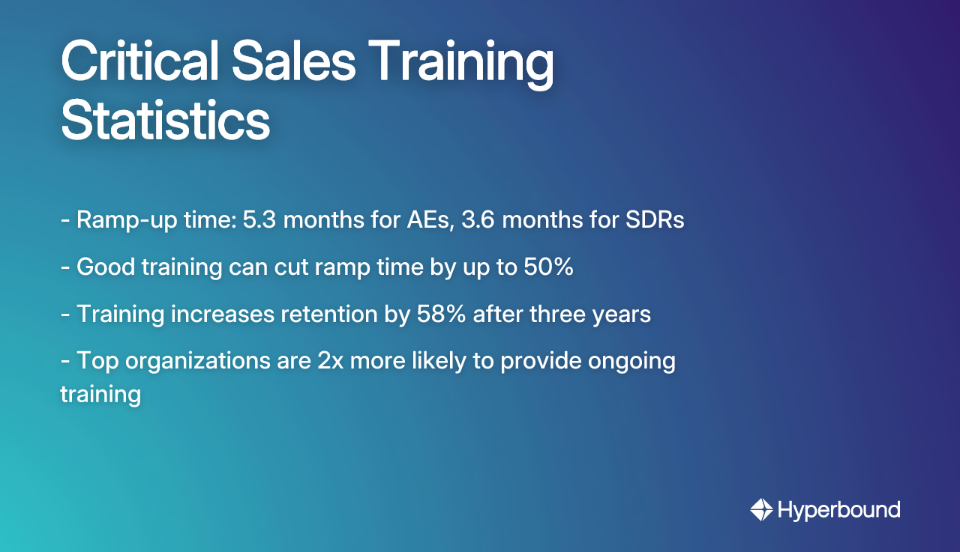
The average ramp-up time for an Account Executive (AE) is 5.3 months, and for a Sales Development Representative (SDR), it's 3.6 months. With structured training, these times can be cut by up to 50%. Without it, you're starting with a severe disadvantage.
The sales industry has a turnover rate of approximately 30%. Good onboarding and training can increase retention by 58% after three years. Your company's lack of training isn't just frustrating – it's a red flag about how they value (or don't value) their employees.
Top-performing sales organizations are twice as likely to provide ongoing training compared to low-performing ones.
Many experienced sales professionals will give you blunt advice: "If any young people are reading this, bail ASAP if you don't receive sales training, don't even stay for a single month." That might be the right move eventually, but before making that decision, let's equip you with a plan to build your skills and resume – regardless of what path you ultimately choose.
Your DIY Onboarding: A 90-Day Plan for Success
Since your company didn't provide a structured onboarding plan, you'll need to create one for yourself. Here's a 30-60-90 day framework to guide your self-directed learning journey:
Phase 1: The First 30 Days – Foundation & Immersion
Goal: Absorb everything you can about the product, customer, and internal processes.
Action Steps:
Become a Product Master: Go beyond the basics. Schedule time with product specialists or technical team members to understand your offering inside and out.
What technology is needed to use your product?
Is it customizable? To what extent?
What does post-sale support look like?
What are the most common use cases?
Understand Your Customer & Market: As one Reddit user wisely noted, sales training should be about "the market gap. How you solve it. Why you do it better than others. Why now." Research your ideal customer profile (ICP) and buyer personas.
Who exactly benefits from your solution?
What pain points does it address?
Who are your competitors, and how do you differentiate?
Master Your Tools: Don't let "convoluted software" be your downfall. Block time in your calendar for self-directed training on your CRM and other sales tech.
Find tutorials on YouTube or the software's help center
Practice entering data and running reports
Learn keyboard shortcuts to increase efficiency
Shadow Top Performers: Proactively ask the best reps if you can listen in on their calls. Observe how they handle discovery, pitch, and manage objections.
Take detailed notes on their approaches
Ask thoughtful questions after calls
Request to review their email templates and sequences
Phase 2: Days 31-60 – Application & Practice
Goal: Move from learning to doing. Start building your pipeline and practicing your skills.
Action Steps:
Start Making Calls: Begin conducting discovery calls and building your pipeline.
Record your calls (with permission) for self-review
Start with "easier" prospects to build confidence
Focus on asking good questions rather than pitching
Execute Outbound Prospecting: Learn about account research, personalized outreach, and multi-channel engagement.
Create templates for different prospect types
Test different subject lines and messaging approaches
Track which methods yield the best response rates
Learn a Qualification Framework: Research and apply a methodology like MEDDICC (Metrics, Economic Buyer, Decision Criteria, Decision Process, Identify Pain, Champion, Competition) to qualify leads more effectively.
Apply the framework to your discovery calls
Create a cheat sheet to ensure you're covering all bases
Keep track of deals that fall through and identify which qualification elements you missed
Start Tracking Your Metrics: Use a "repeatable sales process you can measure." Track your activities (calls, emails) and outcomes (meetings booked, opportunities created).
Set personal daily and weekly goals
Compare your metrics to company averages
Identify areas for improvement
Phase 3: Days 61-90 – Refinement & Execution
Goal: Gain confidence, demonstrate advanced skills, and start closing deals.
Action Steps:
Focus on Closing: Aim to close your first deals and demonstrate your growing competence.
Practice handling final objections
Develop a smooth process for agreements and paperwork
Learn to recognize buying signals
Perfect Your Objection Handling: Anticipate common objections and prepare thoughtful responses in advance. Reframe them as opportunities to clarify value.
Create an objection handling document
Role-play responses with colleagues
Review lost deals to identify patterns in unresolved objections
Build Consistency: For SDRs, consistently meet prospecting targets. For AEs, manage your pipeline effectively and demonstrate a clear path to closing deals.
Create a daily routine that works for you
Build a healthy pipeline with deals at various stages
Develop a forecast you can defend to management
The Unofficial Curriculum: 10 Essential Skills to Teach Yourself
While your 90-day plan gives you structure, you also need to focus on developing specific skills that formal training would typically cover. Consider this your personal learning and development curriculum:
Active Listening: Don't just wait for your turn to talk. Truly hear the prospect's pain points and extract context to refine your pitch.
Practice summarizing what you've heard before responding
Ask clarifying questions to deepen understanding
Notice non-verbal cues in video calls
Consultative Questioning: Focus on solving the prospect's problems by asking questions like, "What are your goals?" and "What hurdles do you face?"
Develop a list of powerful open-ended questions
Learn to ask "why" without sounding interrogative
Practice the art of the follow-up question
Value-Based Storytelling: Learn to share relevant customer stories that highlight value and make your solution memorable, instead of just listing features.
Collect case studies and success stories
Structure stories with a clear problem, solution, and result
Customize stories to match each prospect's situation
Add value with each follow-up (share an article, new insight, etc.)
Know when to pivot or walk away
Objection Handling: Prepare for rejection and learn to see it as an opportunity to learn and improve your approach.
Anticipate common objections before they arise
Use the "feel, felt, found" technique for emotional objections
Practice turning objections into opportunities
Time Management: Prioritize high-value tasks. Use your calendar religiously to block time for prospecting, follow-ups, and learning.
Create time blocks for different activities
Eliminate distractions during focused work
Track how you spend your time for a week to identify inefficiencies
Market Expertise: Become a trusted partner by developing a deep understanding of your industry and market trends.
Subscribe to industry newsletters and publications
Set up Google alerts for your industry and competitors
Join relevant LinkedIn groups and participate in discussions
Building Trust Through Empathy: Connect with prospects on a human level. Understand their needs and build genuine rapport.
Research prospects before calls (LinkedIn, company news)
Find authentic common ground to build relationships
Focus on solving problems, not just selling products
AI Utilization: Leverage AI-powered platforms like Hyperbound to practice and refine your skills in a safe environment. Use AI to simulate realistic sales calls, get instant feedback on your performance, and analyze your conversations to pinpoint areas for improvement. This allows you to master your talk tracks and objection handling before you ever speak to a live prospect.
Self-Coaching & Growth Mindset: After calls, ask yourself what went well and what could be improved. Actively seek feedback and embrace a mindset of continuous learning.
Keep a "lessons learned" journal
Record and review your own calls, using a tool with AI Real Call Scoring to get objective, data-driven feedback on your performance against your company's sales methodology.
Set specific improvement goals each week
Building Your Support System: Finding Mentors and Resources
You're on your own, but you don't have to be alone. Proactively build the support network your company should have provided:
Look Internally:
Find a Mentor: Identify a top-performing rep and ask for 15 minutes of their time each week. Come prepared with specific questions.
Peer Learning: Connect with other new hires. Share what you're learning and work through challenges together.
Learn from Other Departments: Schedule short meetings with people in Marketing, Product, and Customer Success to understand the full customer lifecycle.
Look Externally:
Research Formal Methodologies: Teach yourself the frameworks top companies use. Look into Sandler Sales training, Dale Carnegie Sales Advantage, ASLAN Sales Training, and Winning by Design.
Consume Content: Dive into sales books, listen to podcasts, and follow thought leaders on LinkedIn.
Join a Community: Participate in online forums like Reddit's r/sales to ask questions and learn from a global community of sales professionals.
Conclusion: Turning Challenge into Opportunity
Being thrown into sales without proper training isn't fair, but it's a reality many face. By following this structured 90-day plan, mastering the 10 essential sales skills, and proactively building your support network, you can not only survive but potentially outperform peers who received formal training.
Remember that this path, while harder, builds incredible resilience, self-discipline, and resourcefulness—qualities of every top sales performer. You'll develop muscles that others won't, making you more adaptable and self-sufficient throughout your career.
As one Reddit user who faced a similar situation shared: "From what I have learned on my own, I currently have one of the biggest agencies in our industry about to go to the proposal stage." Your success is in your hands. Now you have a plan to achieve it.
Whether you decide to stay at your current company or leverage your self-taught skills to find a better opportunity, you're now equipped with a roadmap to sales success—one that you've created for yourself.
Frequently Asked Questions
What should I do if my new sales job provides no training?
If your new sales job provides no training, you should immediately create your own structured self-onboarding plan. Focus on mastering the product, understanding the customer, and learning your sales tools in the first 30 days. Proactively shadow top performers, build a support network of mentors and peers, and commit to developing core skills like active listening and objection handling on your own.
How can I effectively teach myself sales?
You can effectively teach yourself sales by following a structured plan, consuming external resources, and practicing consistently. A great approach is to use a 30-60-90 day plan that moves from learning (Days 1-30) to application (Days 31-60) and refinement (Days 61-90). Supplement this with sales books, podcasts, and online courses on methodologies like Sandler or MEDDICC, and use AI tools to practice your skills.
What are the most important skills for a new sales rep to learn first?
The most important skills for a new sales rep to learn first are product mastery, understanding the ideal customer profile (ICP), and active listening. Before you can sell effectively, you must know what you're selling (product), who you're selling to (ICP), and what problems they truly face (active listening). These three skills provide the foundation for every other sales activity.
How can I practice sales conversations without risking real deals?
You can practice sales conversations safely and effectively by using AI-powered role-playing platforms and by role-playing with supportive colleagues. AI simulators like Hyperbound allow you to run through realistic sales calls, practice handling objections, and receive instant, objective feedback on your performance. This lets you build confidence and master your pitch before engaging with live prospects.
How do I know when to quit a sales job that offers no training?
You should consider quitting a sales job with no training if the environment is unsupportive, you receive no mentorship, and you see no path for growth after proactively trying to succeed for at least 90 days. While a lack of formal training is a red flag, giving it your best effort first builds valuable skills. If top performers are unwilling to help, management is absent, and the culture doesn't value development, it's time to leverage your new skills to find a better opportunity.
What is a simple 90-day plan for a new sales rep without training?
A simple 90-day plan for a new sales rep without training focuses on three phases: Foundation, Application, and Refinement.
Days 1-30 (Foundation): Immerse yourself in the product, customer profiles, and internal tools. Shadow top performers and absorb everything.
Days 31-60 (Application): Start making calls, prospecting, and applying a qualification framework like MEDDICC to your conversations.
Days 61-90 (Refinement): Focus on closing your first deals, perfecting your objection handling, and building a consistent, repeatable sales process.


.png)