
Modern B2B deals are rarely won in a single conversation. They are decided by buying committees: a group of stakeholders with competing priorities, different evaluation criteria, and their own internal dynamics. Despite this, most AI sales roleplay tools only support 1-on-1 practice, which leaves reps unprepared for the meetings that actually determine deal outcomes: the 5-person Zoom call with an economic buyer, a technical evaluator, a champion, a procurement lead, and legal.
Standard 1-on-1 roleplay does not prepare reps for the interplay of competing agendas, cross-functional objections, and stakeholder politics that define enterprise deal cycles. When the number of decision-makers increases, the complexity multiplies exponentially.
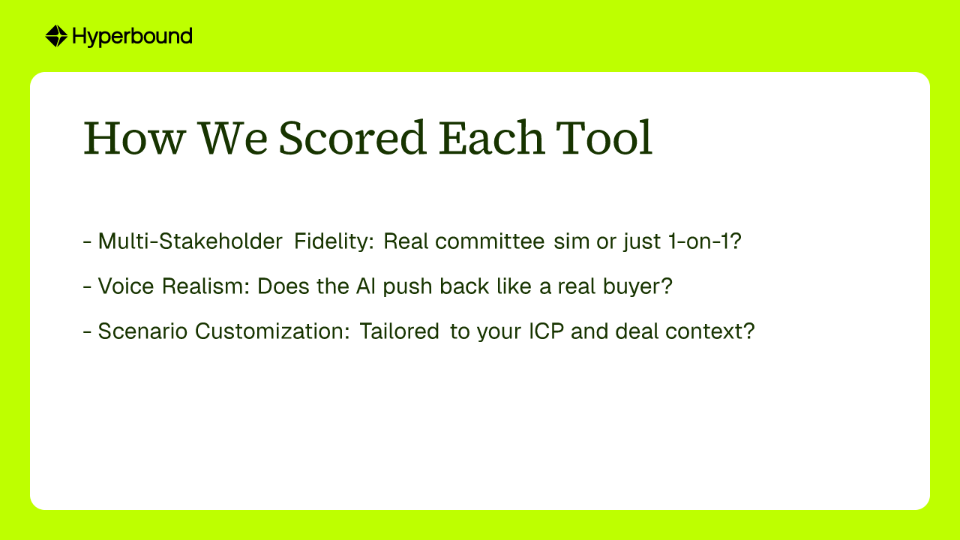
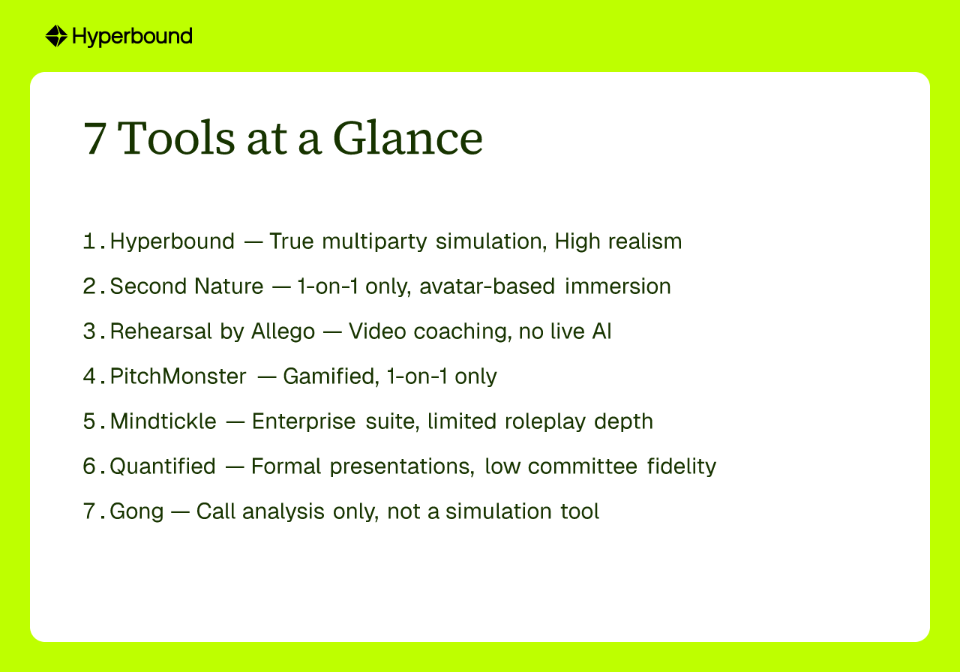
This guide breaks down the 7 best multiparty sales roleplay software tools built for complex multi-stakeholder deals. Each tool is scored on three dimensions that matter for buying committee prep:
Multi-Stakeholder Fidelity: High | Voice Realism: High | Scenario Customization: High
Hyperbound Practice is purpose-built for the kind of selling that actually happens in enterprise deals. While most platforms offer AI roleplay as a 1-on-1 feature, Hyperbound's Multiparty Roleplays let reps practice with multiple AI buyer personas simultaneously: a champion, an economic buyer, and a procurement lead all in the same simulated call.
The AI personas are built from 2M+ hours of simulated calls, informed by analysis of real B2B sales patterns. This means they do not just recite canned objections but behave the way real buyers behave. The economic buyer challenges ROI. The technical evaluator goes off-script. The champion tries to run interference. Reps have to navigate competing agendas in real time, just like they would on an actual deal.
The LinkedIn Chrome Extension further differentiates Hyperbound: reps can build digital buyer bots directly from a prospect's LinkedIn profile. Before a big meeting, a rep can practice against AI personas modeled on the actual stakeholders they are about to face: a simulation built around that person's role, seniority, and likely priorities, not a generic archetype.
Key Features:
Best For: B2B SaaS sales teams running complex, multi-stakeholder deal cycles who need reps ready for the buying committee, not just the initial discovery call.
Multi-Stakeholder Fidelity: None | Voice Realism: Medium | Scenario Customization: Medium
Second Nature is built around 3D AI avatars designed to create an immersive, visually engaging roleplay experience. Reps practice against a single animated persona, with the ability to upload documents and scripts to add context to scenarios.
The avatar-based approach is well-suited for presentation and demo practice, but it is firmly a 1-on-1 tool. There is no mechanism for simulating a buying committee, and the conversational AI follows structured scenarios rather than dynamically adapting when a buyer goes off-script.
Key Features:
Best For: Teams prioritizing visual immersion and presentation skills in a structured 1-on-1 setting. Not a fit for buying committee simulation.
Multi-Stakeholder Fidelity: None | Voice Realism: N/A | Scenario Customization: Low
Rehearsal is the practice module inside the Allego sales enablement platform. Reps record video responses to prompts and submit them for manager or peer review. It is a video coaching loop, but it does not involve conversational AI.
There is no conversational AI to respond to. Reps record against a static prompt, not a dynamic interlocutor. This makes it useful for pitch rehearsal and messaging certification, but it will not prepare anyone for the unpredictable nature of a 5-person buying committee call. Rehearsal does not simulate live group conversations at all.
Key Features:
Best For: Organizations with a strong peer coaching culture that need a structured video practice workflow. Not a replacement for interactive AI roleplay.
Multi-Stakeholder Fidelity: None | Voice Realism: Medium | Scenario Customization: Medium
PitchMonster takes a gamification-first approach to sales roleplay, using leaderboards, challenges, and competitive scoring to drive rep adoption. It allows users to create roleplays from existing call recordings and training materials, and its coaching mechanism uses leading questions to encourage self-reflection after sessions.
For teams with low engagement in training programs, the gamification model drives adoption. Reps are more likely to practice when there is a leaderboard involved. However, PitchMonster supports only 1-on-1 practice sessions. There is no multi-persona simulation, and the AI's responsiveness prioritizes engagement mechanics over conversational realism.
Key Features:
Best For: Sales teams looking to drive consistent roleplay adoption through competition. Primarily suited for repeatable 1-on-1 scenarios like cold calls and discovery.
Multi-Stakeholder Fidelity: Low | Voice Realism: Medium | Scenario Customization: High
Mindtickle is a comprehensive revenue enablement platform that rolls training, content management, conversation intelligence, and readiness programs into a single suite. Roleplay is one module within this larger ecosystem rather than a purpose-built simulation engine.
The platform's strength is breadth: if you need a single system to manage certifications, content, coaching, and analytics at enterprise scale, Mindtickle covers a lot of ground. That breadth comes at the cost of depth in the roleplay module. The AI practice capabilities are more akin to standard 1-on-1 exercises, and multi-stakeholder simulation is not a feature designed into the product. For teams running complex deal cycles who specifically need buying committee practice, Mindtickle's roleplay module is adjacent to the problem, not built for it.
Key Features:
Best For: Large enterprises that need a consolidated enablement platform and are willing to trade specialized roleplay fidelity for platform-wide consolidation.
Multi-Stakeholder Fidelity: Low | Voice Realism: High | Scenario Customization: Medium
Quantified focuses on communication skills development using photorealistic AI avatars and detailed analytics to help professionals improve presentations and formal sales conversations. The visual fidelity is impressive; the avatars are designed to simulate a human face-to-face interaction in a way that other tools do not.
Quantified can simulate an audience setting, which gives it an edge over purely 1-on-1 tools. However, audience simulation is different from buying committee simulation. When a procurement lead challenges pricing while the technical evaluator raises an integration concern in the same meeting, that requires a fundamentally different type of practice than presenting to a passive audience. Quantified is designed for formal, high-stakes presentations such as executive briefings or regulated-industry compliance pitches, rather than the fluid, unpredictable mechanics of a live multi-stakeholder discovery or demo call.
Key Features:
Best For: Enterprise teams in regulated industries that need reps certified on high-stakes, formal presentations. Not optimized for dynamic, unscripted multi-stakeholder sales conversations.
Multi-Stakeholder Fidelity: N/A (Analyzes stakeholder dynamics, but does not simulate them) | Voice Realism: N/A (Does not simulate calls) | Scenario Customization: N/A (Does not run roleplays)
Gong belongs on this list for a different reason than the others: it is the best source of raw material for building realistic multiparty roleplay scenarios, even though it does not run simulations itself.
Gong's conversation intelligence platform records and analyzes real sales calls, surfacing what top performers do differently when engaging economic buyers versus technical evaluators versus champions. That data is invaluable for understanding how multi-stakeholder dynamics actually play out in your deals. The gap is that Gong stops at insight. It tells you what happened on calls; it does not give reps a place to practice before the next one. That missing piece, turning call analysis into deliberate practice and deal-level coaching, is what Revenue Activation is built for.
For teams already using Gong, the logical pairing is a dedicated multiparty sales roleplay software that can actually use those insights. Notably, Hyperbound integrates natively with Gong, feeding real call analysis into targeted practice scenarios so reps close the loop from what's happening in their deals to what they're rehearsing before the next meeting.
Key Features:
Best For: Data-driven enablement teams using real customer conversations to build realistic training content. Best used in combination with a dedicated roleplay platform.
Most tools on this list use the term "sales roleplay" to describe 1-on-1 practice, which leaves reps no more prepared for a five-person buying committee than they were before. The gap between deal complexity and training capability is significant.
Modern B2B selling involves navigating buying committees where every major deal has stakeholders with competing priorities. The reps who consistently close at that level are the ones who have practiced managing these dynamics, not just rehearsed a pitch against a single objection.
Most multiparty sales roleplay software on the market today does not solve this. The tools offer individual-practice mechanics under the same label. For organizations serious about reducing ramp time, increasing win rates, and preparing reps for complex deals, the training tool needs to match the complexity of the problem.
Hyperbound is the only platform on this list that lets reps practice the full buying committee dynamic: with multiple AI personas, built from 2M+ hours of simulated calls modeled on real B2B sales patterns, scored against your actual methodology, and connected to real deal data through the broader Revenue Activation Platform so practice is always relevant to what is live in the pipeline.
Multiparty sales roleplay software is a training tool that uses AI to simulate sales conversations with multiple buyer personas at the same time. Unlike traditional 1-on-1 roleplay tools, it recreates the dynamic of a real buying committee, allowing sales reps to practice managing competing priorities, cross-functional objections, and group politics in a single, interactive session.
Multi-stakeholder roleplay is crucial because modern B2B deals are rarely made by a single person; they are decided by a buying committee. Reps must be able to navigate conversations with an economic buyer focused on ROI, a technical evaluator concerned with integration, and a procurement lead focused on terms, often all in the same meeting. Practicing these complex dynamics is the only way to prepare reps for the reality of enterprise sales cycles.
The best AI sales roleplay tools prepare reps by simulating the buying committee environment. For example, a platform like Hyperbound allows a rep to practice a call with AI personas representing a champion, an economic buyer, and a technical evaluator simultaneously. The AI is trained to push back with realistic, role-specific objections, forcing the rep to manage different agendas, build consensus, and guide the conversation, just as they would in a high-stakes deal.
Hyperbound is the best tool for simulating a full buying committee. It is the only platform on this list purpose-built for multiparty roleplays, allowing reps to interact with several distinct AI buyer personas in a single session, and it is part of the broader Revenue Activation Platform, which also delivers deal-level coaching and AI-driven insights tied to live pipeline outcomes. This high-fidelity simulation, combined with AI built from millions of hours of simulated calls modeled on real sales patterns, provides the most realistic practice for complex, multi-stakeholder deals.
Yes, leading platforms allow for deep customization to match a team's specific sales context. Tools like Hyperbound allow tailoring scenarios to a team's Ideal Customer Profile (ICP), sales methodology, and common objections. Hyperbound's LinkedIn Chrome Extension allows building "digital twin" buyer bots from a prospect's actual LinkedIn profile, enabling highly specific pre-meeting practice.
AI provides instant, objective feedback through detailed scorecards after each roleplay session. These analytics go beyond simple pass/fail assessments. They often measure adherence to a specific sales methodology (like MEDDPICC or BANT), track talk-to-listen ratios, identify missed opportunities to ask key questions, and flag moments where objections were handled effectively or ineffectively, providing a data-driven path for improvement.









Use Cases
Legal