
Your rep just came out of a "great" discovery call. The champion loved the pitch. The demo went flawlessly. Then nothing. Silence for three weeks.
Here's the uncomfortable truth: the buying committee is not just one person. It's 6–12 decision-makers and influencers — each with their own priorities, doubts, and resistance. And deals don't move forward just because one person is convinced. The entire group needs to be nudged toward a decision.
Yet most sales training still looks like this: one rep, one manager playing "the prospect," thirty minutes of mock cold call. That's practicing for a solo performance when you're about to conduct an orchestra.
One-on-one roleplay has a fatal flaw — it trains reps for a conversation that doesn't exist in enterprise deals. It builds confidence for a linear, two-person dialogue, but the moment a rep walks into a room with a CFO, a skeptical Director, and an enthusiastic champion all pulling in different directions, that confidence evaporates. They've never practiced reading the room when the room has competing agendas.
What enterprise reps actually need is multiparty sales roleplay — structured simulations that mirror the messiness of real buying committees. Below are seven high-stakes scenarios built for exactly that, complete with setup cards, coaching focuses, and debrief checklists your enablement team can use right now.
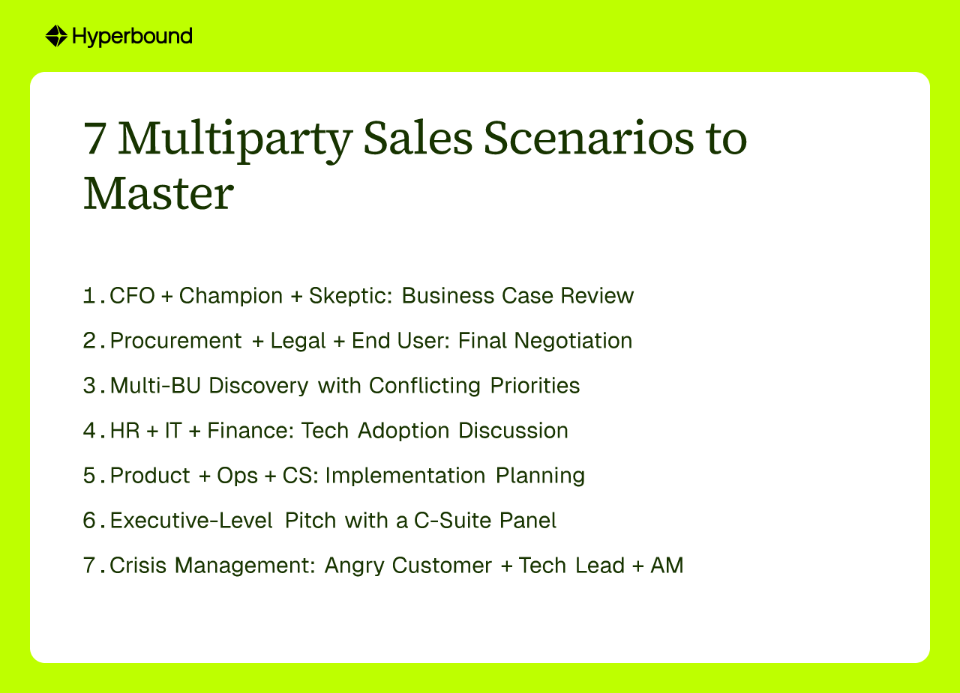
This is the make-or-break scenario. The CFO holds the budget. The Champion is your internal ally. The Skeptic is looking for any reason to kill the deal. Your rep has to defend ROI, empower the advocate, and neutralize the opposition — all at the same time.
How to practice this at scale: Running this manually requires pulling three senior employees into a training session. Hyperbound's Multiparty Roleplays let enablement teams deploy this scenario on-demand, any time, with AI personas trained on 2M+ hours of real B2B sales conversations. Every rep gets consistent, high-fidelity at-bats — no scheduling, no favors.
Setup Card:
Coaching Focus: Tailoring the value proposition to financial vs. operational priorities, leveraging a champion to co-sell, and controlling the room without alienating the skeptic.
Debrief Checklist:
The deal is 90% done. This is where it dies. Procurement wants price concessions, Legal is scrutinizing every data clause, and the End User is terrified the solution they fought for will get stripped down to save money.
Setup Card:
Coaching Focus: Multi-threaded negotiation, protecting deal value under commercial pressure, and finding shared ground between cost, risk, and utility.
Debrief Checklist:
In enterprise deals, the solution often spans multiple business units — each with their own KPIs, workflows, and pain points. This scenario tests whether a rep can unify a fragmented room or accidentally deepen the divide.
Setup Card:
Coaching Focus: Facilitated multi-stakeholder discovery, surfacing shared business outcomes, and building a unified value narrative across conflicting departmental priorities.
Debrief Checklist:
Before any SaaS tool gets a purchase order, it passes through an informal internal tribunal: HR asks if people will actually use it, IT asks if it's secure, and Finance asks if it fits the budget. This scenario trains reps to address all three gate-keepers at once.
Setup Card:
Coaching Focus: Cross-functional objection handling and translating the same solution into three different languages — organizational (HR), technical (IT), and financial (Finance).
Debrief Checklist:
Winning the deal is only half the battle. This late-stage scenario — equally useful for AEs and CSMs — trains reps to set realistic expectations and avoid the post-sale implosion that kills renewals and expansions before they start.
Setup Card:
Coaching Focus: Expectation management, aligning on a realistic implementation timeline, and establishing trust across internal and external stakeholders simultaneously.
Debrief Checklist:
The CRO got you a slot on the executive calendar. You have 20 minutes with the CEO, CMO, and Sales Director. They're impatient. They don't want features — they want business outcomes. This is where reps learn to earn the room.
Setup Card:
Coaching Focus: Executive presence, strategic narrative construction, and the ability to pivot the pitch in real time as executives redirect, interrupt, and interrogate.
Debrief Checklist:
This one's for post-sales and account management teams. A major issue has surfaced. The customer is furious. Your Technical Lead needs to diagnose without over-committing. Your Account Manager needs to save the relationship. The rep in the middle has to hold it all together.
Setup Card:
Coaching Focus: De-escalation, maintaining composure under fire, and coordinating an internal and external response that's transparent without creating new risk.
Debrief Checklist:
Reading through these seven scenarios, the value is obvious. The logistics, less so.
To run a single one of these manually, you need to recruit two or three senior employees, align their calendars, brief them on their personas, run the session, and then generate consistent coaching feedback. For one rep. Once. And given that 80% of training is forgotten within 30 days, a single repetition is rarely enough to change behavior.
This is the core operational problem with multiparty sales roleplay done the traditional way: it's expensive, unscalable, and inconsistent. The result is that most enablement teams skip it entirely — leaving reps to encounter their first real buying committee inside an actual deal.
Hyperbound Practice solves this. With Hyperbound's Multiparty Roleplays, enablement teams can deploy every one of these scenarios on-demand, at scale, with no internal volunteers required. AI personas take on each role in the room — CFO, Champion, Skeptic, Procurement — and react, push back, and redirect just like real stakeholders do. Each persona is built from analysis of 2M+ hours of real B2B sales conversations, not generic scripts, meaning the objections land the way they actually do in enterprise deals.
After every simulation, Hyperbound's AI Scorecards deliver instant, objective feedback on how the rep managed the multi-stakeholder room dynamics — talk ratios, methodology adherence, missed objection handling opportunities, and where they lost the room. No manager required, no subjectivity, no lag between practice and insight.
This feeds into a continuous improvement loop that extends well beyond practice. Reps simulate complex multi-stakeholder calls with Hyperbound Practice, those behaviors are measured on real deals with Hyperbound Perform (which analyzes all calls across an entire deal lifecycle — not just individual conversations), and Kota, Hyperbound's AI assistant, surfaces the right coaching intervention at the right time through Kota Activate. The result is a system where practice directly translates into deal execution.
The proof is in the numbers: companies using Hyperbound see 50% faster ramp time and a 2x faster time to first won deal. Vanta cut ramp time from 210 to 72 days — a 60% reduction — while growing their BDR team 4x and generating 5x pipeline.
The buying committee isn't going to get smaller. Enterprise sales cycles aren't going to get simpler. But your reps don't have to walk into those rooms unprepared.
Multiparty sales roleplay is a training simulation where a sales representative practices engaging with a group of stakeholders, each with different roles and priorities, to mirror a real enterprise buying committee. Unlike traditional one-on-one roleplay, this method prepares reps for the complex group dynamics of B2B deals. It trains them to manage competing agendas, build consensus, and navigate conversations with decision-makers like CFOs, legal teams, and skeptics all in the same room.
Traditional one-on-one roleplay is not enough because it trains reps for a simple, two-person conversation that rarely exists in complex enterprise deals. Enterprise sales involve convincing a buying committee of 6-12 people. One-on-one practice fails to prepare reps for navigating the conflicting priorities, group politics, and diverse objections that arise when multiple stakeholders like finance, IT, and end-users are involved in a decision.
A buying committee is the group of individuals within a company who are all involved in the decision to purchase a product or service. This group typically includes 6 to 12 people, from the economic buyer (like a CFO) and the champion who advocates for the solution, to end-users, technical evaluators, and potential skeptics. Successfully closing an enterprise deal requires gaining consensus from this entire committee, not just convincing one person.
Common high-stakes scenarios include business case reviews with a CFO, champion, and skeptic; final negotiations with procurement, legal, and end-users; and executive-level pitches to a C-suite panel. These simulations are designed to mimic the most critical moments in a deal cycle. Other valuable scenarios involve multi-department discovery calls with conflicting priorities and crisis management situations where reps must de-escalate an angry customer alongside technical and account management teams.
The most effective way to practice multiparty scenarios at scale is by using AI-powered roleplay platforms. Manually organizing these sessions is a logistical challenge, requiring multiple senior employees to act as stakeholders. AI tools like Hyperbound solve this by providing on-demand access to AI personas (e.g., a skeptical CFO, a compliant Legal Counsel) that are trained on real sales conversations. This allows every rep to get consistent, high-fidelity practice without scheduling conflicts or burning out internal volunteers.
Multiparty roleplay develops critical skills such as building consensus, managing group dynamics, handling cross-functional objections, and tailoring a value proposition to different stakeholders simultaneously. Reps learn how to read a room with competing agendas, leverage a champion to co-sell, neutralize skeptics with data and empathy, and maintain executive presence under pressure. These are the skills that separate average reps from elite enterprise sellers.
Stop training for conversations that don't exist. See how Hyperbound's Multiparty Roleplays can prepare your team for the ones that do.









Use Cases
Legal