
Most global sales organizations train their reps in English. The enablement materials, the onboarding programs, the roleplay simulations — all built in English. Yet the prospects those reps call every day speak German, Japanese, French, Portuguese, Korean, and dozens of other languages. Reps are trained in one world and deployed into another.
This is not a minor communication gap. It is a revenue problem. Non-native speakers frequently encounter comprehension issues with customers that directly erode sales performance. One sales professional put it bluntly: “Her conversion rate suffered a lot because of that.” When a rep preps in English, practices objections in English, and gets coached in English — then steps onto a live call in German or Japanese — something gets lost. Not just the words, but the confidence, the cadence, the nuance that closes deals.
The fix is not more English training. It is training that happens in the language the rep actually sells in. With multilingual sales roleplay, reps practice discovery calls, objection handling, and demos in the exact language they will use on a live call — and receive coaching feedback in their native language.
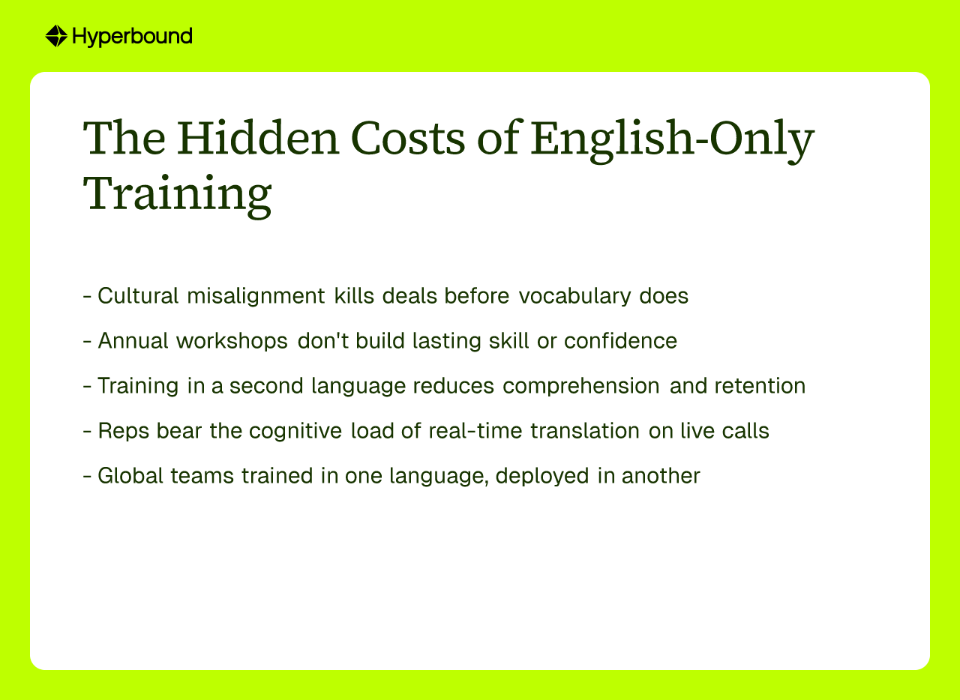
The problem runs deeper than just translation. Effective global sales training requires what Training Industry calls "Effective Localization": the ability to cater to both language differences and cultural differences simultaneously. A discovery framework that lands well with a prospect in Chicago can fall completely flat in Tokyo, not because of words, but because of different expectations around formality, relationship-building, and how business decisions get made.
Sales leaders building global teams know this firsthand. In discussions about expanding into APAC, one recurring observation stands out: "The biggest issue in having an effective B2B team focusing on APAC will likely be cultural more than language." Cultural differences at times in the sales process are not a minor footnote; they are often the deciding factor.
Beyond the cultural dimension, there is a logistical one. Traditionally, fixing the language training gap meant choosing between expensive regional workshops or flying everyone to a central location for a single annual kickoff. Neither approach delivers the continuous, repetitive practice that actually builds skill and confidence. These efforts also struggle to provide the ongoing reinforcement needed after the initial training event.
And when training does happen in a language that is not the rep's native tongue, comprehension takes a hit. It's well-established that training in a native language enhances comprehension, allowing employees to grasp and apply complex concepts more effectively. Without that, organizations see lower engagement, reduced retention, and a team that enters customer conversations underprepared.
The result is a global sales team that is technically hired to sell in multiple languages but trained to succeed only in one.
This is exactly the problem that Hyperbound's multilingual sales roleplay is built to solve. Instead of forcing reps into an English-only practice environment, Hyperbound lets them simulate real sales conversations in over 30 languages - in the rep's native language, the prospect's language, or both.
Supported languages include English, Spanish (Spain + LATAM), French (France + Canada), German, Portuguese, Italian, Japanese, Korean, Mandarin Chinese, Cantonese, Dutch, Polish, Swedish, Norwegian, Danish, Czech, Romanian, Hebrew, Hindi, Gujarati, Marathi, Tamil, Thai, Vietnamese, and Indonesian, with additional languages available on request.
The practical impact of this is significant across several dimensions:
Confidence and engagement: When language barriers are removed from the practice environment, reps can focus entirely on mastering their sales framework: the questions they ask, the objections they handle, the way they position value. That focus builds genuine confidence rather than surface-level familiarity, boosting rep engagement and leading to more productive learning experiences.

Better retention: A rep practicing complex objection handling in Portuguese is going to internalize that skill far more deeply than one who practices in English and then mentally translates on a live call. The cognitive load of real-time translation in high-stakes conversations is enormous. Multilingual roleplay eliminates it.
Inclusivity at scale: Every rep on your global team gets access to the same quality of training, regardless of where they are based or what language they sell in. This scalability removes the cost burden of running separate localized workshops for each region.
Most sales practice tools were not designed with global teams in mind. The few that mention multilingual support typically cover two or three languages and rely on surface-level translation that strips out the nuance, rhythm, and cultural texture of a real conversation. Practicing against a robotic translation of an English script does not prepare anyone for a real sales call in Japanese or German.
Genuine multilingual sales roleplay is a harder technical problem to solve. It requires low-latency voice processing. Research suggests real-time translation needs to stay below 1.5 seconds of latency to feel natural, with accuracy rates as high as 94% for language pairs like English-Spanish. Anything clunkier than that breaks the flow of a simulation and defeats the purpose.
It also demands dialect and regional awareness. Spanish in Spain is not the same as Spanish in Mexico or Colombia. The AI buyer persona in a roleplay simulation needs to reflect not just the language but the regional speech patterns, and in some cases, the natural code-switching that happens in multilingual business environments. These are the technical requirements that separate meaningful multilingual simulation from a basic translation overlay.
Most importantly, the AI prospect within the simulation needs to carry the cultural weight of the region it represents. A Japanese prospect should reflect Japanese business customs around formality and consensus. A German prospect should embody the direct, precision-focused communication style common in the DACH market. A roleplay tool that speaks the language but ignores the culture is only solving half the problem.
Here is what this looks like in practice for teams operating across different regions:
EMEA: A rep in Germany can practice handling pricing objections from a German-speaking AI prospect that mirrors the negotiation dynamics typical of the DACH region. A rep in Paris can work through their full discovery call sequence in French before getting on a call with a major Parisian account, building fluency in both the language and the sales motion.
LATAM: A team selling into Brazil can run complete roleplays in Portuguese, mastering the specific vocabulary and phrasing their industry uses. Reps targeting Mexico or Argentina can practice in Spanish, gaining the confidence to lead complex technical demos without the cognitive tax of working in a second language.
APAC: This is perhaps the most critical region for multilingual sales roleplay, precisely because the challenges here are as much cultural as linguistic. A rep preparing for a call with a Japanese enterprise prospect can practice formal introductions and patient, relationship-first conversations in Japanese. A rep targeting a Korean account can rehearse how to navigate questions around implementation timelines and post-sale support in Korean, with an AI persona that reflects how those conversations typically unfold in that market.
In each of these cases, the rep is not just learning words. They are building muscle memory for how to sell in a specific cultural and linguistic context.
Practice is only as valuable as the feedback that follows it. After every multilingual sales roleplay session in Hyperbound, reps receive instant, detailed coaching on what they did well and where they need to improve.
Critically, this feedback is delivered in the rep's preferred language. A Spanish-speaking rep who practices a simulation in English can receive their full performance breakdown and coaching notes in Spanish. A French-speaking rep running German-language roleplays can process their feedback in French.
This matters because receiving feedback in a language the rep is fully comfortable with ensures clarity and ease of understanding, making the coaching immediately actionable. When a rep has to mentally translate their own performance feedback, critical nuances get lost and the speed of improvement slows down. Native-language coaching closes that loop entirely.
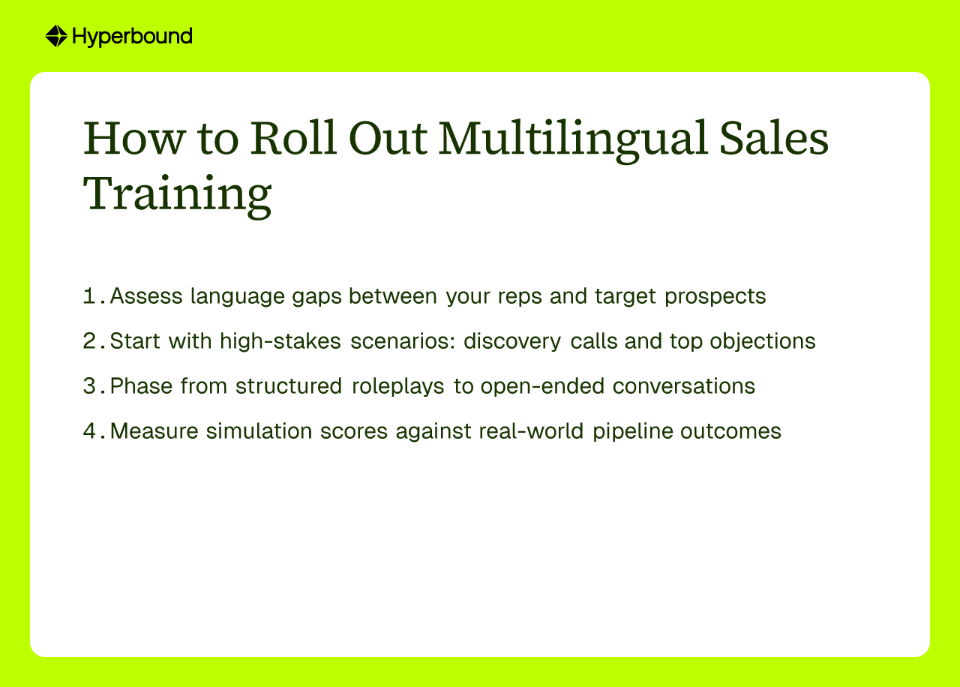
Rolling out a multilingual training program does not need to be a major undertaking. Here is a practical framework for getting started:
1. Assess language needs. Map the primary languages spoken by your target prospects against the language proficiency of your sales team. Identify where the largest gaps exist. These are your highest-priority markets to cover in training.
2. Start with your highest-stakes scenarios. Before building out a full library of roleplays, focus on the moments that matter most: the initial discovery call and the top three objections your reps face in each target market. Get those right first.
3. Phase your rollout. Begin with more structured roleplay scenarios to help reps build foundational vocabulary and confidence in the target language. Then progressively move toward open-ended, free-flowing conversations that better replicate the unpredictability of real customer conversations.
4. Measure what matters. Track rep completion rates and performance scores within the simulations, then connect those metrics to real-world outcomes: meeting conversion rates, deal progression, and sales cycle length. The correlation will tell you where practice is translating into results.
With Hyperbound, the setup process is fast. Building the first roleplay simulation takes less than 10 minutes. Custom personas can typically be configured within two weeks, and most teams begin seeing measurable value within the first 30 days.

Global sales is hard. Sales teams are competing against local representatives who grew up in the market, speak the language natively, and understand the cultural context instinctively. Training reps in English and hoping for the best on a German or Japanese call is not a strategy; it is a disadvantage accepted by default.
Multilingual sales roleplay changes that. By letting reps practice discovery, objection handling, and demos in the language they will actually sell in, it gives them the confidence and preparation to show up as genuine peers to their prospects, not outsiders translating on the fly.
This is what Revenue Activation looks like in practice. Hyperbound is not just a roleplay tool; it is the Revenue Activation Platform, built to close the gap between insight and execution across the entire deal lifecycle. Practice is where it starts: reps build real skill in 30+ languages, with culturally-aware AI buyers trained on real B2B sales patterns and coaching feedback delivered in their native language. From there, Hyperbound Perform scores real calls and surfaces deal-level coaching actions, and Kota Activate orchestrates it all, recommending the right coaching intervention at the right moment.
Hyperbound's support for 30+ languages means your entire global team across EMEA, LATAM, APAC, and beyond trains on the same platform, in the language that makes them most effective. And when the coaching feedback lands in the rep's native language too, the entire learning loop is optimized for comprehension, retention, and speed of improvement.
The deals are global. The training should be too. Book a demo with Hyperbound to see multilingual sales roleplay in action for your team.
Multilingual sales roleplay is a training method that allows sales representatives to practice real-world sales scenarios, such as discovery calls and objection handling, in the specific language and cultural context of their prospects. Instead of training in a single language like English and then translating on live calls, reps can simulate conversations in languages like German, Japanese, or Spanish. This builds confidence, improves fluency, and eliminates the cognitive load of real-time translation, leading to better sales performance.
English-only training is ineffective because it fails to prepare sales reps for the linguistic and cultural realities of their target markets, leading to miscommunication, lower confidence, and lost deals. When reps are trained in English but sell in another language, they often struggle with comprehension, nuance, and cultural alignment. This creates a disconnect where training doesn't match the real-world environment and forces reps to mentally translate during high-stakes conversations, which hurts their performance.
Effective multilingual training platforms go beyond simple translation by incorporating cultural nuances into their AI roleplay scenarios. This means an AI prospect from Japan will reflect Japanese business customs (e.g., formality, consensus-building), while a prospect from Germany will exhibit a more direct communication style. By simulating these cultural contexts, reps learn not just what to say, but how to say it in a way that resonates with local expectations.
Modern sales roleplay platforms like Hyperbound support a wide range of languages to cover major global markets across EMEA, LATAM, and APAC. Hyperbound supports over 30 languages, including Spanish, French, German, Portuguese, Mandarin Chinese, Japanese, Korean, Hindi, and many others. This extensive coverage ensures that global teams can practice in the exact language they use to sell, regardless of the region they operate in.
A key feature of advanced multilingual training tools is providing coaching and performance feedback in the sales representative's preferred native language. For example, a Spanish-speaking rep who completes a roleplay in English can receive their entire performance analysis in Spanish. This ensures they fully understand the feedback without anything getting lost in translation, which accelerates skill development and makes the coaching more actionable.
You can start implementing multilingual training by first assessing your team's language gaps, then focusing on high-stakes scenarios like discovery calls and common objections in your key markets. Start with structured roleplays to build foundational confidence before moving to more open-ended conversations. Platforms like Hyperbound make this easy, allowing you to build the first simulation in under 10 minutes and start seeing measurable improvements in team performance within the first 30 days.










Use Cases
Legal