
You've shortlisted your sales training software. You've sat through the demos, compared the pricing pages, and now you're stuck choosing between three platforms — Hyperbound, Mindtickle, and Second Nature. All three are legitimate, well-regarded tools used by real sales teams at real companies. This isn't a comparison designed to tear any of them down.
But here's the truth sales reps already know: most AI roleplay still feels robotic. It doesn't push back the way a real buyer does. It can't handle the awkward silences, the weird tangents, or the emotional weight of a prospect who's been burned by your competitor. Sales practitioners on Reddit have noted this directly — "The limitations are real. AI still can't fully replicate the awkward silences, weird tangents, and emotional dynamics of real conversations."
That gap is exactly what this comparison is designed to close. If roleplay fidelity and coaching depth are your decision criteria — and they should be, for any team trying to ramp faster and win more deals — then the five dimensions below will give you a clear answer.
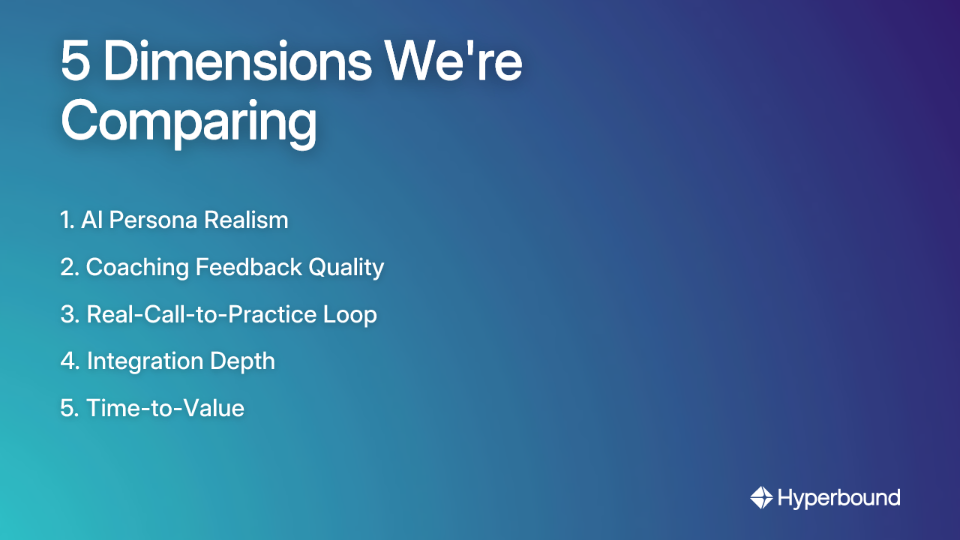
We'll compare all three tools across:
The whole premise of AI roleplay falls apart if the "buyer" doesn't feel real. Sales reps know immediately when they're talking to a scripted chatbot — and when the AI just agrees with everything or fails to counter objections, it stops being practice and becomes theater.
Users evaluating AI sales tools have flagged this repeatedly: "AI just agrees and tells me why I'm right. It doesn't challenge me." Generic, script-driven AI personas don't prepare reps for the "Price Haggler," the "Loyalist" who's already locked in with a competitor, or the "Later Gator" who keeps kicking the can down the road.
Hyperbound's approach starts at the data layer. Its AI personas are built from analysis of over 2 million hours of real B2B sales conversations — not constructed from hypothetical scripts. That means when a rep practices a cold call or objection-handling scenario, the AI buyer pushes back the way actual buyers do. It handles the dynamic pivots, the unexpected skepticism, and the pressure moments that generic training tools simply can't replicate.
Mindtickle and Second Nature both offer structured roleplay scenarios and have strong foundations in sales readiness. Mindtickle's roleplay capabilities are embedded within a broader sales enablement suite, while Second Nature leverages established NLP for conversational simulation. Both are solid options for foundational training. The gap shows up in the source of their AI's knowledge — which, for most platforms, remains closer to curated scripts than real buyer behavior.
.png)
Practice without feedback is just repetition. And as sales teams have learned the hard way, the quality of AI feedback varies wildly — "The quality of the feedback really varies" is a complaint that surfaces constantly in communities evaluating these tools.
What reps actually need is feedback that tells them exactly what they missed, in the context of their specific sales methodology. Did they nail the discovery questions? Did they drop the ball on the budget conversation? Did their closing language align with MEDDIC or BANT?
Hyperbound's AI Scorecards provide instant, objective scoring after every roleplay — tracking talk ratios, methodology adherence, key selling moments, and specific areas for improvement. The accompanying AI Coaching layer gives methodology-aligned feedback, surfacing missed opportunities and recommending better language for the next rep. It's not just a score; it's a coaching session in written form.
Second Nature offers solid analytics and customizable scoring systems — a genuine strength. It's a mature platform with good feedback infrastructure. Mindtickle provides structured feedback as part of its broader readiness platform, though the feedback loop can feel less connected to a team's specific nuances and live call behaviors.
.png)
This is the dimension that separates a practice tool from a performance engine — and it's the area where the gap between these three platforms is most significant.
The fundamental problem is this: reps who ace simulations can still struggle on live calls because the pressure is different. More importantly, most platforms ask managers to guess what a rep needs to work on, rather than pulling that answer directly from the rep's actual call data. The result is practice that's disconnected from real-world performance gaps.
Hyperbound is the only platform in this comparison that closes that loop. Here's how the cycle works:
This turns call data from a rear-view mirror into a GPS for skill development. Instead of knowing what went wrong after the deal is lost, reps get targeted reps on the specific skill before the next call.
Mindtickle and Second Nature both excel at the practice side of this equation. What they lack is the native, automated bridge between live call outcomes and practice assignment. That bridge typically requires manual intervention from a manager — which means it happens inconsistently, or not at all.
.png)
Sales reps don't live in training portals. They live in Salesforce, Slack, and their calendar. Any sales training software that requires a separate destination to launch creates friction — and friction kills adoption.
Hyperbound is designed to be workflow-native. It integrates directly with Salesforce, Google Meet, Zoom, Slack, and major LMS/CMS platforms. A manager can receive a Slack alert from Kota flagging a deal risk surfaced in Perform, then assign a targeted roleplay that the rep launches directly from their calendar before their next prospect call. Check out the full list at hyperbound.ai/integrations.
Mindtickle benefits from being part of a comprehensive sales readiness platform — its integrations with Salesforce and other enterprise tools are solid. Second Nature offers good LMS integrations but can feel more isolated from the daily tools reps use for active deals.
The key distinction isn't just which tools each platform connects to — it's why the integrations exist. Hyperbound's integrations are purpose-built to fuel the real-call-to-practice coaching loop, making every touchpoint an opportunity to reinforce behavior change.
.png)
Onboarding a new sales rep costs time and money. Every week a rep isn't ramped is a week of pipeline they're not building. Sales leaders need training tools that accelerate performance — not add another complex software layer to navigate.
Hyperbound delivers measurable, fast results. The proof points are validated and specific:
The platform is designed for fast implementation — reps are practicing on relevant, realistic scenarios within days, not weeks. The entry product, Hyperbound Practice, is the starting point for every deployment and is built to deliver immediate value without heavy configuration.
Mindtickle, as a broader sales readiness platform, comes with more configuration overhead. It's powerful — but that power requires more time to unlock. Second Nature can also experience longer implementation timelines depending on the complexity of customization and integration work.
.png)
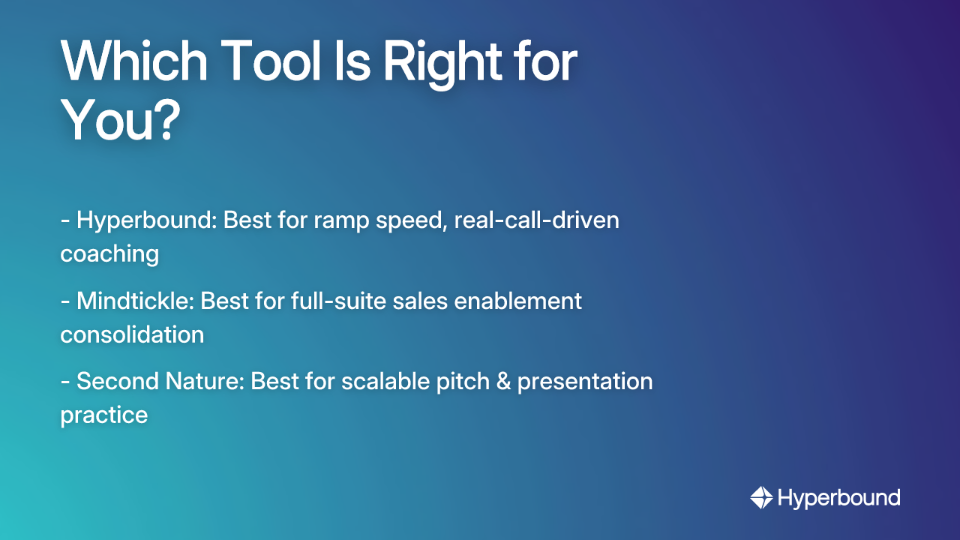
Mindtickle and Second Nature are legitimate sales training software platforms — teams have built real skills using both. But when the decision criteria is roleplay fidelity and coaching depth, the comparison tells a clear story.
Hyperbound is the only platform in this group that:
That's not just practice. That's what Hyperbound calls Revenue Activation — the shift from passively reviewing call data to actively using it to change rep behavior and win more deals.
With 250,000+ AI simulations delivered across more than 7,000 companies and a 4.9/5 rating on G2, the results speak for themselves.
If you're ready to see what that loop looks like for your team, book a demo with Hyperbound and find out why teams like Vanta, LinkedIn, and Nivoda chose it to power their sales coaching.
AI sales roleplay software is a training tool that uses artificial intelligence to simulate realistic sales conversations, allowing reps to practice scenarios like cold calls, objection handling, and discovery without needing a live person. Unlike static scripts, advanced platforms like Hyperbound create dynamic AI buyer personas that can push back, ask unexpected questions, and mimic the unpredictability of real-world sales calls. This provides a safe, scalable environment for reps to build skills and confidence before engaging with actual prospects.
Hyperbound's AI personas are more realistic because they are trained on a massive dataset of over 2 million hours of real B2B sales conversations, not on pre-written, hypothetical scripts. This data-driven approach allows the AI to replicate the subtle nuances, specific objections, and dynamic behavior of actual buyers. While tools like Mindtickle and Second Nature offer structured scenarios, Hyperbound's foundation in real-world data provides a higher level of conversational fidelity, better preparing reps for live calls.
The "real-call-to-practice loop" is Hyperbound's unique system that automatically analyzes a sales rep's actual customer calls, identifies specific skill gaps, and then assigns targeted AI roleplay exercises to address those weaknesses. This is crucial because it connects training directly to on-the-job performance. Instead of managers guessing what reps need to practice, the system uses data to create a continuous improvement cycle and turn training from a periodic event into a real-time performance engine.
While conversation intelligence tools like Gong and Chorus are used to record and analyze past calls, Hyperbound actively uses those insights to improve future calls through targeted AI practice. Think of it as the difference between a game film (Gong/Chorus) and a drill session (Hyperbound). Gong shows you what went wrong; Hyperbound gives you the reps to fix it before the next game. In fact, Hyperbound integrates with these tools, pulling data from them to power its real-call-to-practice loop and turn insights into action.
Hyperbound is best for enterprise sales teams and high-growth SaaS companies that need to ramp new hires faster, improve the performance of their entire team, and connect coaching directly to revenue outcomes. If your primary goals are reducing ramp time, increasing win rates, and ensuring your team consistently executes your sales methodology on live calls, Hyperbound is the ideal choice. Companies like Autodesk, Vanta, and LinkedIn use it to drive measurable results through data-driven coaching.
Teams can get started with Hyperbound and have their reps practicing in realistic AI simulations within days, not weeks or months. The platform is designed for rapid implementation and immediate value. This focus on fast time-to-value is a key advantage, enabling companies to see improvements in ramp time and performance much faster than with more complex, all-in-one enablement platforms.
Yes, Hyperbound is fully customizable to your company's specific sales methodology (like MEDDIC, BANT, or Sandler), product offerings, and common buyer objections. The AI Scorecards and Coaching feedback are aligned with your unique sales motion. This ensures that the practice and feedback reps receive are directly relevant to the conversations they are having every day, reinforcing the right behaviors and helping them master your go-to-market strategy.










Use Cases
Legal