
You signed the contract for Mindtickle because it checked every box in the RFP. Robust content management. Coaching workflows. Sales readiness dashboards. The demo looked impressive.
Then the bill came due — and so did the reality. Your 80-rep team is using about 20% of the platform. Your managers are still coaching by gut feel. And your new hires are taking just as long to ramp as before, only now you're paying enterprise-tier pricing for the privilege.
Sound familiar? You're not alone. On forums like this Reddit thread from sales enablement practitioners, the frustration is palpable: "Reps hated it, managers hated it, and nobody could find what they needed without 10 clicks and a bunch of swearing."
Here's the thing: Mindtickle is a powerful platform — for enterprise teams with dedicated enablement ops, six-figure implementation budgets, and months to configure it. For mid-market teams with 50–500 reps, it's often the wrong tool. You don't have a tool problem. You have a fit problem.
This guide is built for sales leaders, VP-level buyers, and enablement managers who need a platform that moves fast, scales coaching without adding headcount, and delivers results you can take to your CRO. Every alternative on this list was evaluated through three lenses that matter specifically to mid-market:
We've also included two data points you won't find on most Mindtickle alternatives lists: team size fit and implementation timeline — because both matter enormously when you're a lean team that can't afford a 12-week rollout.
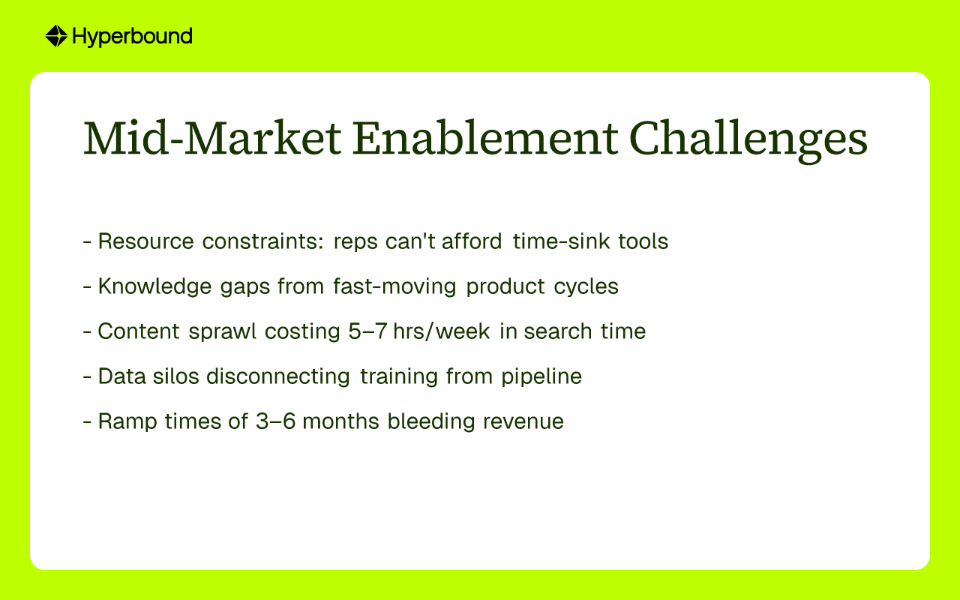
Mid-market isn't just a smaller version of enterprise. It's a fundamentally different operating environment. Research on sales rep ramp metrics shows that average ramp time for B2B sales reps sits between three and six months — and every week of delay is direct revenue left on the table.
According to analysis of mid-market enablement challenges, teams in this segment face a specific combination of pressures:
The issue with Mindtickle in this context isn't that it's a bad product — it consistently earns strong reviews — but its complexity becomes a liability at mid-market scale. A steep learning curve, limited assessment customization, and feature sprawl designed for large enablement ops teams often mean mid-market buyers pay for enterprise infrastructure they'll never fully use.
Before diving in, here's a snapshot of how the top alternatives compare on the two criteria most lists skip entirely — team size fit and implementation timeline.
.png)
Note: Seismic and Highspot announced a merger in February 2026. They are listed as a combined entry.
If Mindtickle's problem is doing too much, Hyperbound solves a more specific and arguably more important problem: turning your existing sales knowledge into a continuous practice engine that gets reps ready fast and keeps them sharp.
Hyperbound coined the Revenue Activation category — the idea that data alone doesn't change outcomes. What changes outcomes is when you take insights from your best conversations and use them to practice, refine, and replicate winning behaviors across your entire team.
Hyperbound Practice is the core product for mid-market teams. Instead of generic training modules, reps practice against AI buyer personas built from analysis of 2M+ hours of real B2B sales conversations. Every cold call, discovery session, objection, and multi-stakeholder demo can be rehearsed before it goes live.
What sets it apart for mid-market:
The proof is in the results. Nivoda, a mid-market B2B company, deployed Hyperbound and achieved a 50% reduction in ramp time, a 150% increase in demo conversion rates, and doubled revenue year-over-year — directly attributed to the consistent practice culture Hyperbound enabled. Rob Rangel, Director of Sales Performance at Nivoda, credits the platform with transforming how quickly reps get from hired to fully productive.
Similarly, Vanta used Hyperbound to cut ramp time from 210 days to 72 days — a 60% reduction — while growing their BDR team 4x and scaling pipeline 5x.
On average, teams using Hyperbound save 3.5 workweeks of coaching time per manager, per quarter. That's the scalable coaching equation mid-market teams need.
Pricing & Fit: Purpose-built for teams of 50–500 reps. Integrates natively with Gong, Salesforce, HubSpot, Seismic, Highspot, and Slack. SOC 2 Type II, GDPR, and HIPAA compliant.
Gong is the gold standard for call intelligence. It records, transcribes, and analyzes sales conversations to surface coaching moments, deal risks, and patterns from your top performers. With the launch of AI Trainer, Gong has also added AI roleplay capabilities — reps can now practice against AI scenarios built from real customer interactions and receive scored feedback.
For mid-market teams, Gong's biggest value prop is helping managers coach more efficiently — they can review AI-flagged moments from five calls in the time it used to take to review one, and now direct reps to practice specific skills through AI Trainer.
Where it differs from Hyperbound: Gong's primary strength remains conversation intelligence and deal visibility — AI roleplay is a newer addition to a platform built around call analysis. Hyperbound's Practice → Perform → Activate loop is purpose-built around the practice-to-deal-outcome cycle, with deeper roleplay fidelity (multiparty roleplays, demo call screen sharing, 25+ languages) and an orchestration layer (Kota) that connects practice directly to deal coaching. For teams that want both, Hyperbound integrates directly with Gong: analyze real calls in Gong → identify skill gaps → assign targeted practice in Hyperbound.
Best for: Teams with an existing coaching culture that want data-driven accountability, deal inspection, and are looking for a single platform that combines call intelligence with emerging AI roleplay capabilities. Implementation typically takes 2–4 weeks.
Note: Seismic and Highspot announced a definitive merger agreement in February 2026, combining the two largest enablement platforms into a single entity. If you're evaluating either tool today, you're effectively evaluating the merged platform's future roadmap.
If your reps are wasting hours hunting through Dropbox folders, outdated Google Drives, and email threads for the right deck, the Seismic/Highspot combination is built to solve that. Seismic centralizes content, tracks how assets perform in deals, and ensures reps are always using the most current messaging. Highspot adds stronger guided selling — surfacing the right content to reps at the right stage of a deal, directly inside their CRM — and analytics that show how content influences deal outcomes.
Both platforms have added training and coaching functionality in recent years, but content management remains their core competency. The implementation timeline (6–12 weeks depending on scope) and learning curve are real — especially for lean enablement teams. With the merger still in progress, mid-market buyers should ask about combined product roadmaps and whether pricing or packaging will change.
Best for: Mid-market teams where content chaos is the primary bottleneck and sales-marketing alignment is a priority. Less ideal as a standalone coaching solution.
Lessonly earned its reputation by making it genuinely easy for enablement teams to build and deliver training content — no instructional design degree required. Its lesson builder is intuitive, completion tracking is clear, and reps can access it without the friction that kills engagement in more complex LMSs.
It's been absorbed into the Seismic ecosystem (now branded Seismic Learning), which adds depth but also some of that enterprise complexity. With the Seismic-Highspot merger underway, Lessonly's future positioning within the combined platform is worth asking about during evaluation.
Best for: Teams that need a clean, focused onboarding and continuous learning solution and don't yet need deep coaching analytics. Implementation typically runs 6–10 weeks.
Showpad earned a 4.6/5 on G2 by delivering a solid combination of content management, guided selling, and video coaching in one platform. It's a legitimate all-in-one contender for teams that want to consolidate tools without going full enterprise.
Its coaching tools are more structured than Seismic's, and its CRM integrations are solid. The implementation timeline (6–12 weeks) is the main drawback for teams that need to move fast.
Best for: Mid-market teams consolidating content, training, and basic coaching into a single vendor relationship.
If your team already runs their prospecting and sequencing through Outreach, their built-in AI feature Kaia provides real-time guidance during live calls — surfacing battlecards, objection responses, and relevant content as conversations unfold.
It's not a standalone enablement platform, and it won't replace structured onboarding or practice. But for teams deeply embedded in the Outreach ecosystem, it reduces the tool-switching tax and delivers in-the-moment support.
Best for: Teams already using Outreach as their primary sales engagement platform who want coaching embedded in their existing workflow.
Here's a frustration that comes up repeatedly among enablement leaders evaluating tools: "We trialed a few of the usual suspects and honestly they all kinda looked the same in a demo."
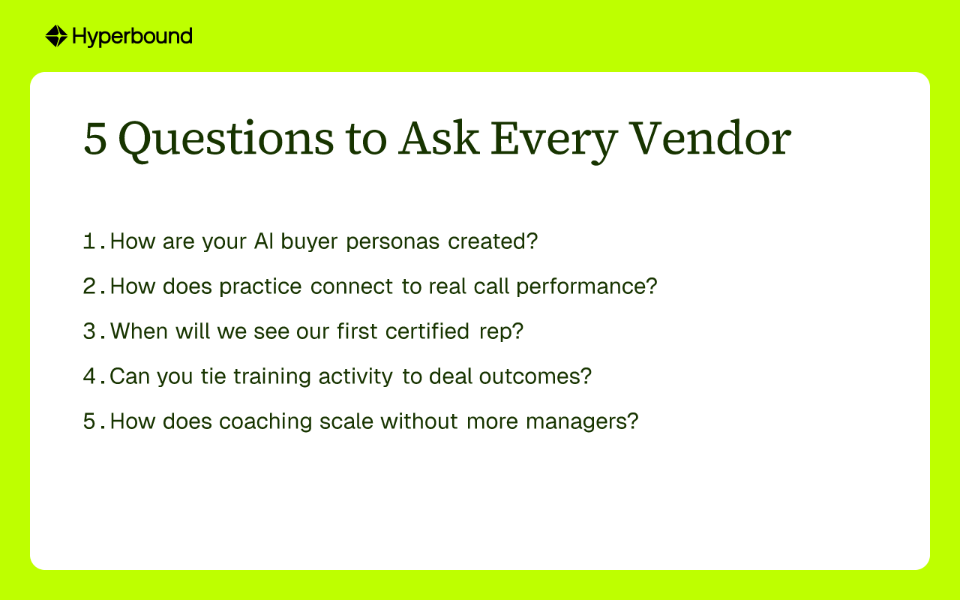
They're not the same. But vendors are good at demoing to their strengths and glossing over their gaps. These questions will cut through the noise — and reveal which platforms are actually built for mid-market outcomes versus which ones are just an enterprise product on a smaller invoice.
1. "How are your AI buyer personas created — from generic scripts, or from our own top-rep data?"
Generic practice is better than no practice. But practicing against an AI that mirrors your actual buyers, knows your real objections, and reflects your top performers' best habits is what drives real ramp acceleration. Ask vendors to show you exactly what data trains their AI. If the answer is vague, that's your answer.
2. "How does practice connect to real-world call performance? Can your platform score live calls and feed those gaps back into targeted practice?"
Practice in a vacuum produces confident-sounding reps who still struggle on live calls. The platforms that deliver measurable ramp impact are the ones that create a continuous loop: score real calls → identify specific skill gaps → assign targeted practice → rescore. Ask vendors to walk you through this loop end-to-end with a real customer example.
3. "What does your implementation look like, and when will we see our first certified rep?"
This question separates vendors built for enterprise rollouts from those built for mid-market speed. A 12-week implementation timeline isn't just slow — it's a compounding cost. Every week without a functioning enablement system is another new hire ramping without structured support. Push for specifics: what happens in week one, and what does "live" look like?
4. "Can you show us how your platform ties training activity to deal outcomes?"
Engagement metrics alone won't get your CFO to renew the contract. The platforms worth paying for can demonstrate a measurable connection between what reps practiced and how their live deals performed. Ask for customer examples with specific numbers — ramp time reduction, conversion rate improvement, revenue impact.
5. "How does your platform scale coaching without requiring additional manager headcount?"
For most mid-market teams, the bottleneck isn't content — it's coaching capacity. Managers are already stretched. The right enablement tool should provide every rep with personalized, objective feedback on-demand, not just give managers another dashboard to review. Ask vendors how many hours of manager time their platform saves per quarter, and whether they have customer data to back it up.
The best Mindtickle alternative for your mid-market team isn't a cheaper version of an enterprise tool — it's a platform purpose-built for speed, scalable coaching, and measurable impact.
If you're evaluating options, anchor your decision on three things: how fast can you get your first rep certified, whether the platform can scale coaching without adding headcount, and whether you can tie training activity directly to ramp time and revenue outcomes.
For teams of 50–500 reps that need to move fast and prove ROI, Hyperbound Practice is purpose-built for exactly this challenge. The Nivoda results — 50% ramp reduction, 150% demo conversion increase, 2x revenue year-over-year — happened on a mid-market team with a lean enablement function and a two-week implementation.
If you're ready to see what that looks like for your team, explore Hyperbound Practice and request a personalized demo built around your actual buyer personas and sales scenarios.
Mindtickle is often a poor fit for mid-market companies because it is designed for large enterprises, leading to excessive complexity, long implementation times, and a high cost for features that smaller teams don't use. Mid-market teams (typically 50-500 reps) operate with fewer resources and need to move faster. They require tools that offer a quick "speed to value," scalable coaching without adding managers, and a clear impact on ramp time. Enterprise platforms like Mindtickle often come with a 3-6 month configuration period and features designed for dedicated enablement ops teams, which can overwhelm a lean mid-market organization and delay ROI.
The most important factors are speed to value, coaching scalability, and measurable impact on ramp time. Unlike enterprise tools that focus on comprehensive feature sets, mid-market solutions must deliver results quickly with limited resources. This means asking critical questions during your evaluation: How quickly can our first rep be fully certified and productive? Can the platform provide consistent coaching to every rep without burning out our managers? And can it directly tie training activities to revenue outcomes like shorter ramp times and higher conversion rates?
AI sales coaching scales enablement by providing every sales rep with instant, objective, and personalized feedback on their practice sessions without requiring a manager's direct involvement. Platforms like Hyperbound use AI to create realistic buyer personas for reps to practice with. After each roleplay, an AI Scorecard analyzes performance against key metrics like methodology adherence and objection handling. This automates the repetitive parts of coaching, freeing up managers to focus on high-level strategy and deal-specific guidance, effectively allowing you to scale coaching capacity without increasing headcount.
A conversation intelligence tool like Gong analyzes past calls to tell you what happened, while a sales practice platform like Hyperbound allows reps to proactively practice and improve before the next live call. Conversation intelligence is retrospective; it's excellent for identifying winning patterns and coaching opportunities from real-world conversations. A practice platform is proactive; it closes the learning loop by giving reps a safe space to apply that feedback, rehearse new messaging, and build muscle memory. The two are complementary: you can use insights from Gong to create targeted practice scenarios in Hyperbound.
You can measure the ROI of a sales enablement platform by tracking key metrics like reduction in new hire ramp time, increase in demo-to-close conversion rates, and improvements in quota attainment. The most effective platforms connect training activity directly to business outcomes. For example, you should be able to see that reps who completed a specific objection-handling module have higher win rates on deals where that objection arises. Look for vendors who can provide case studies with quantifiable results, such as a 50% reduction in ramp time or a 150% increase in conversion rates, as seen with companies using Hyperbound.
A realistic implementation timeline for a mid-market focused enablement tool should be between one to four weeks. This ensures a rapid speed to value and prevents the project from becoming a resource drain. Platforms built for mid-market speed, like Hyperbound (1-2 weeks) or Gong (2-4 weeks), prioritize a structured onboarding process to get teams live quickly. In contrast, more complex, enterprise-focused platforms like Seismic or Highspot can take 6-12 weeks, which represents a significant delay in achieving productivity gains for a fast-moving team.








Use Cases
Legal