
Browse any medical sales forum and you'll find the same recurring debate: "Is hiring a coach actually worth it, or is it just another overpriced program that promises the world?" The skepticism is real — and honestly, earned. Reddit threads are littered with warnings like "Don't go to medical sales college" and the blunt reminder that "if it sounds too good to be true, it's too good to be true."
But here's the problem: the loudest voices online are reacting to bad coaching programs — not the concept of medical sales coaching itself. And the legitimate programs aren't doing a great job explaining what their coaches actually do day-to-day versus what the landing page promises.
So let's fix that. This is a no-nonsense breakdown of what a medical sales coach actually does on a Tuesday afternoon, what they can't do regardless of how much you pay, and when coaching ROI is genuinely worth it — for individual reps and sales teams alike.
A good medical sales coach is part strategist, part practice partner. Their work isn't magic — it's a structured, repeatable process designed to sharpen the specific behaviors that win deals in a highly technical, relationship-driven sales environment.
Here's what that looks like in practice:
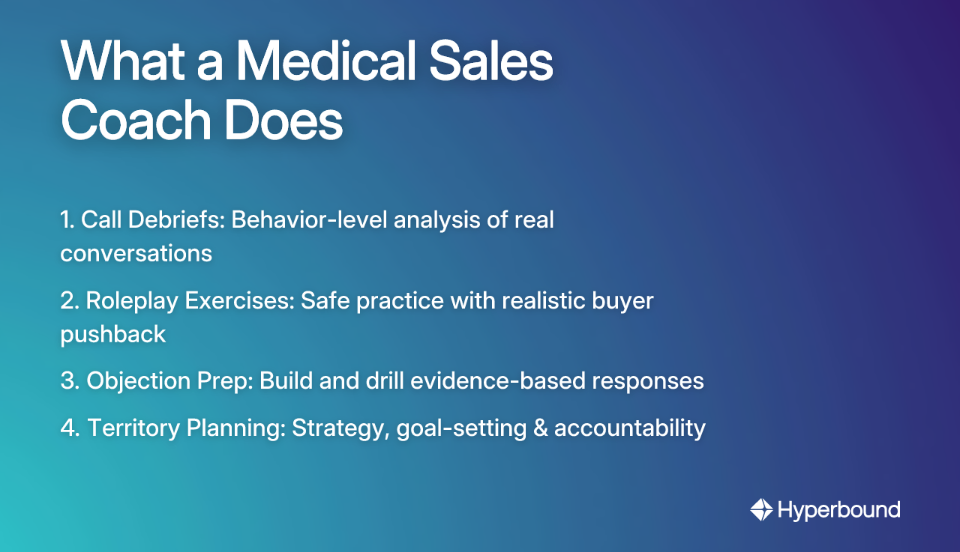
After a real sales conversation, a coach will sit down with a rep and break down exactly what happened. Not just "that went well" or "you lost them at the pricing conversation" — but a detailed, behavior-level analysis. Where did the rep build rapport? At what point did the physician or hospital administrator disengage? Was the clinical value proposition communicated clearly?
The goal is to help the rep self-discover blind spots, not just be told what to fix. A coach asks probing questions: "What do you think the buyer was really concerned about there? How did your response address that?" This builds self-awareness that transfers to the next call.
This is arguably the most valuable — and most time-intensive — part of medical sales coaching. A coach plays the role of the buyer: a skeptical surgeon, a cost-conscious OR director, or a hospital administrator evaluating three competing vendors. They introduce unexpected objections, ask hard clinical questions, and don't make it easy.
The rep gets to fail safely. They practice handling curveballs before a real deal is on the line. And they get immediate, specific feedback afterward — on messaging, confidence, pacing, and objection responses.
Medical device and pharma sales involve objections that are uniquely complex: questions about clinical efficacy data, reimbursement hurdles, hospital formulary processes, and competitive product comparisons. A coach helps reps anticipate these objections, build evidence-based responses, and then drill those responses through repetition until they become second nature.
The goal isn't to script reps — it's to make them so fluent with their responses that they can adapt in real time without losing composure.
Beyond the individual call, a coach helps reps think strategically about their geography. This includes assessing the rep's current skills and approach, setting specific sales and personal goals, building a concrete action plan for the territory, and establishing accountability checkpoints to track progress.
For early-career reps — Associate Sales Reps (ASRs) and Clinical Specialists transitioning into quota-carrying roles — this kind of structured territory strategy can be the difference between a rep who flounders and one who hits quota in their first full year.
Understanding the limits of medical sales coaching is just as important as understanding its value. Here's where programs sometimes oversell and reps wind up disappointed.
They don't replace your manager. A coach provides supplementary, skill-focused guidance. They aren't accountable for your quota, they don't set your comp plan, and they don't have visibility into company priorities or product strategy. Your direct manager owns your overall performance development — a coach sharpens the edges.
They can't guarantee a hire or a deal. A coach can dramatically improve your cold calling confidence, your objection handling fluency, and your ability to navigate a complex healthcare account. But whether a company has an open territory, whether a hospital system is in a buying cycle, or whether a surgeon is willing to change vendors — none of that is in a coach's control.
If a program is promising guaranteed placement or guaranteed income, that's the red flag the Reddit community has been warning you about. The entry level world is tough — coaching makes it more navigable, but it doesn't eliminate the uphill battle.
Coaching isn't equally valuable in all situations. For sales leaders deciding where to invest, these are the three moments where the return is most measurable:
The ramp period is brutal. A new medical device rep has to simultaneously learn the product, the clinical terminology, the competitive landscape, the account dynamics, and how to navigate hospital procurement — all while carrying a quota. Without structured coaching, most of that learning happens through trial and error in front of real buyers.
Targeted coaching during onboarding compresses that learning curve. When coaching is embedded early, some programs report 10X ROI in the first year — because a rep who reaches competence six months faster is generating revenue, not consuming it.
When a new device or product line hits the market, the entire sales team needs to get fluent — fast. New clinical data, unfamiliar objections, fresh competitive positioning. Coaching at this stage ensures every rep can confidently walk through the value proposition with a skeptical physician, not just recite the features on the spec sheet.
The reps who can't handle the hard questions in the first 60 days of a launch lose deals they should have won. Coaching closes that gap.

Winning business from an entrenched competitor is one of the most skill-intensive scenarios in medical sales. The incumbent has relationships, inertia, and a known track record. To unseat them, a rep needs a razor-sharp value proposition, a clear counter to the competitor's strengths, and the ability to handle the inevitable pushback without flinching.
Coaching in this scenario specifically prepares reps for the nuanced, high-stakes conversations that competitive displacement requires — and roleplay is the only way to rehearse them before they count.
Here's the tension that every sales director eventually runs into: the value of great medical sales coaching is clear, but one-on-one coaching is expensive, time-limited, and inconsistent.
A single coach — internal or external — can realistically work with a handful of reps. If your medical device team has 20, 50, or 100 reps across multiple territories, that coverage model breaks down fast. Scheduled coaching sessions happen weekly or biweekly at best, which means reps are going into high-stakes calls without having practiced since their last session. Feedback quality varies by coach. And the cost of scaling human coaching to match team growth is essentially a headcount conversation every time.
The question isn't whether coaching works. It's how do you deliver it consistently to every rep on the team, without adding a coach for every ten reps?
.png)
This is where the conversation is moving fast. AI-powered platforms are now capable of delivering the two most valuable parts of human coaching — realistic roleplay and immediate, specific feedback — at scale, on demand, for every rep on your team.
Hyperbound Practice is the tool built specifically for this. Instead of waiting for a scheduled coaching session, reps can practice a cold call to a skeptical OR director, run through a discovery conversation with a hospital administrator, or drill objection handling before a competitive displacement meeting — any time, on demand.
Here's how it maps directly to what a human medical sales coach does:
The operational loop looks like this: reps practice before calls → get immediate feedback → identify skill gaps → practice those specific gaps → and then score their real calls through Hyperbound's AI Real Call Scoring to see whether the practice is translating into better live conversations. It's the continuous improvement cycle that most coaching programs aspire to but rarely deliver consistently.
A great medical sales coach focuses on the fundamentals: call debriefs, roleplay, objection preparation, and territory strategy. When used at the right moment — new rep onboarding, product launches, competitive displacements — the ROI is real and measurable. But the model has a ceiling. One-on-one coaching doesn't scale, and the gap between your top performers and the rest of the team widens every month that mid-tier reps aren't getting consistent, quality practice.
AI-powered coaching tools like Hyperbound deliver the most valuable parts of that human coaching equation — realistic practice and immediate feedback — to your entire medical device sales team, on demand, without adding headcount. Results like a 60% reduction in ramp time (from 210 to 72 days) aren't outliers anymore. They're what happens when every rep practices at scale.
A medical sales coach helps reps improve their performance through personalized training, focusing on practical skills like call debriefs, role-playing difficult conversations, preparing for objections, and strategic territory planning. Unlike a manager, a coach's primary role is to provide a safe space for practice and offer behavior-level feedback to sharpen the specific skills needed to win deals in the complex healthcare environment.
Yes, medical sales coaching is worth the investment, especially during critical career stages. The ROI is highest for new reps during onboarding, for entire teams during a product launch, and when trying to displace an entrenched competitor. Coaching can dramatically shorten a new rep's ramp-up time and, for experienced teams, it ensures consistent messaging and prepares them for high-stakes scenarios, directly impacting win rates.
No, a legitimate medical sales coach cannot and should not guarantee you a job. Their role is to improve your skills and confidence, which makes you a much stronger candidate, but they do not control hiring decisions or market availability. Be wary of any program that promises guaranteed placement, as a coach's influence is on your performance, not on external hiring factors.
A sales manager is responsible for your overall performance, quota attainment, and alignment with company goals, while a sales coach focuses specifically on developing your individual selling skills through practice and feedback. Your manager owns your results (the "what"), while a coach hones your process and behaviors (the "how").
AI sales coaching platforms like Hyperbound use artificial intelligence to simulate realistic sales scenarios, allowing reps to practice conversations with AI-powered buyer personas. After each session, the AI provides instant, detailed feedback on performance. This technology automates the most valuable parts of human coaching—realistic role-play and immediate debriefs—and delivers them on-demand to an entire team.
Role-playing is crucial in medical sales because it allows reps to practice navigating complex, high-stakes conversations in a safe environment before a real deal is on the line. It builds the muscle memory and confidence needed to handle tough objections about clinical data, negotiate with skeptical surgeons, and maintain composure under pressure with hospital administrators.
.png)









Use Cases
Legal