
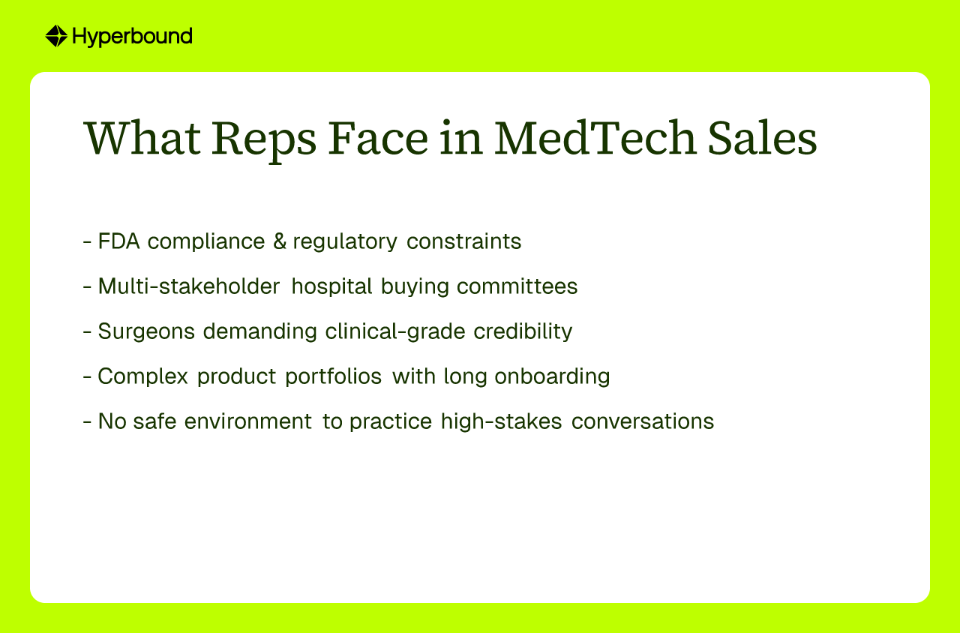
Medical device field reps operate in one of the most demanding sales environments on the planet. They're not just selling — they're navigating FDA compliance, multi-stakeholder buying committees, surgeons who expect clinical-grade credibility, and product portfolios so complex that onboarding alone can take months.
The daily reality? Content is scattered across shared drives, email threads, and outdated portals. Compliance constraints mean one wrong document shared with a prospect can trigger a serious regulatory issue. And when it comes to preparing for a high-stakes conversation with a hospital administrator or a skeptical clinician, there's often no safe place to practice — so reps end up learning on real prospects, burning pipeline while they build skill.
As one sales ops leader put it on Reddit: "Not just reading it — ensuring my team actually knows the complicated regulatory stuff." That's the bar. And traditional training methods aren't clearing it.
A modern medical device sales enablement stack isn't a luxury anymore — it's the infrastructure that separates a high-performing field team from one that's constantly playing catch-up. Below, we've broken down 8 tools for 2026, organized by functional category, with a decision framework at the end to help you build the right stack for your situation.
Best for: Letting reps master complex, compliant conversations with clinical buyers before they ever talk to a real prospect.
The biggest gap in medical device sales enablement isn't content — it's practice. Reps can read every clinical study and memorize every objection handler, but none of that prepares them for the moment a skeptical surgeon pushes back mid-pitch, or when a hospital procurement team asks a question that wasn't in the training deck.
Hyperbound Practice closes that gap with AI-powered roleplays built from 2M+ hours of real B2B sales conversations — not generic scripts. The AI buyer personas are dynamically responsive, meaning reps can't just memorize a path through the simulation. They have to think on their feet, just like on a real call.
Key features for medical device field reps:
Organizations using Hyperbound have seen 50% faster ramp times and 2x faster time to first won deal — metrics that matter directly to VPs and CROs trying to shorten the lag between hiring and revenue contribution.
Best for: Creating a single source of truth for all sales and clinical content in the field.
Highspot is one of the most widely adopted content management platforms in MedTech, and for good reason. It solves the scattered content problem that plagues field reps who spend valuable pre-call time hunting through email threads for the latest spec sheet or clinical study.
Key features:
Best for: Delivering personalized content experiences at scale across diverse clinical stakeholders.
Where Highspot excels at organization and compliance, Seismic pushes further into personalization. For medical device reps calling on different buyer personas — a department head vs. a clinical reviewer vs. a CFO — Seismic's AI-driven content recommendations surface the right asset for each specific context.
Key features:
Best for: Organizations that want content management and coaching in one consolidated platform.
Showpad is built to handle complex product portfolios — which makes it a natural fit in medical device environments where a single rep might carry dozens of SKUs across multiple therapeutic categories. Its unified approach reduces tool sprawl, a pain point that comes up consistently when enablement leaders evaluate their stacks.
Key features:
Best for: Automatically scoring 100% of rep conversations to surface deal-level risks and coach reps to win.
Where traditional conversation intelligence tools show you what happened on a call, Hyperbound Perform shows you what to do next. It connects call analysis directly to coaching and deal execution. For medical device teams, this means moving beyond passive call recording to active, AI-driven deal coaching that flags compliance risks and identifies the behaviors that win complex clinical and commercial deals.
Key features:
The Hyperbound advantage: Perform and Practice work together seamlessly. Insights from real calls in Perform are used to generate personalized AI roleplay scenarios in Practice, creating a closed-loop system where reps continuously drill the skills they need to improve deal outcomes.
Best for: Building structured onboarding, certification, and compliance training programs at scale.
For medical device companies with long onboarding cycles and formal certification requirements, Docebo provides the LMS infrastructure to manage it all. New reps need to learn not just the product, but the regulatory environment — and that knowledge needs to be documented and tracked.
Key features:
Best for: Creating a fast, searchable, always-current playbook for field reps who need answers in the moment.
Not every organization needs a full-scale LMS. For smaller MedTech teams or those who need to push critical regulatory and tariff updates quickly without rebuilding entire training modules, Trainual offers a more agile alternative.
Key features:
Best for: Managing the entire customer relationship lifecycle and serving as the integration backbone of your enablement stack.
Every tool on this list is more powerful when it talks to your CRM. Salesforce remains the industry standard for medical device organizations managing complex account hierarchies — hospital systems, GPOs, IDNs — and long, multi-touch sales cycles.
Key features:
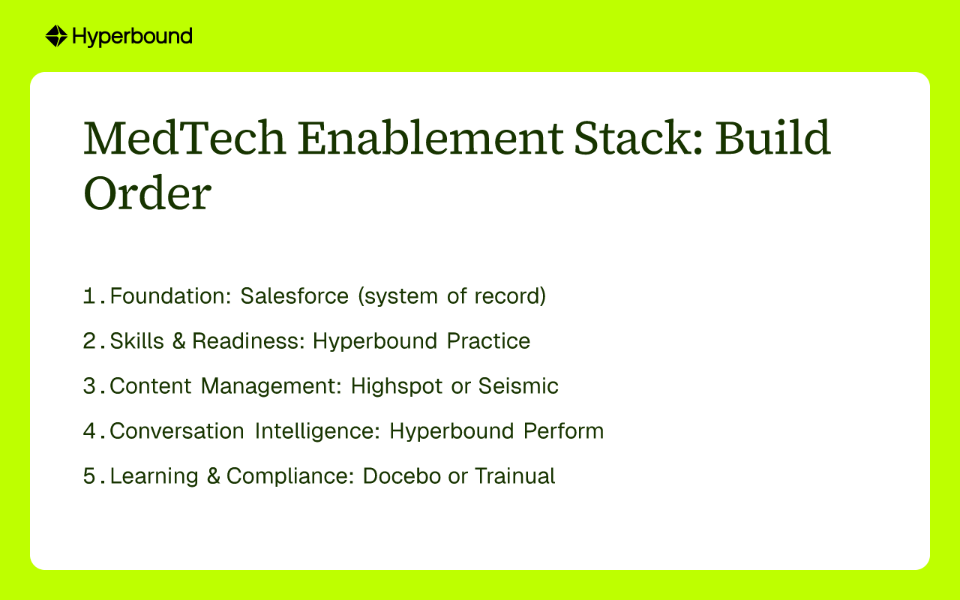
Picking between these tools is genuinely hard — and sales ops leaders agree. The goal isn't to buy all eight at once. It's to layer them in strategically based on where your biggest performance gaps actually are.
Step 1 — Foundation (CRM): Start with Salesforce. Before anything else, you need a system of record. Every other tool you add will integrate into it.
Step 2 — Skills & Readiness: Add Hyperbound Practice early. The fastest lever on revenue isn't content or analytics — it's rep effectiveness in live conversations. Getting reps practicing with realistic AI buyer personas from day one shortens ramp dramatically and protects pipeline during new product launches.
Step 3 — Content: Implement Highspot or Seismic to eliminate content chaos and compliance risk. Your skilled reps now need instant access to the right materials, in the field, at the right moment.
Step 4 — Intelligence: Layer in Hyperbound Perform to analyze real-world conversations and create a continuous feedback loop. Insights from Perform automatically generate personalized practice scenarios in Hyperbound Practice, turning raw call data into targeted skill development.
If you already have Salesforce and an LMS like Docebo, ask one question: "Where is the biggest gap between what reps know and what they can actually execute under pressure?"
If the gap is conversation skills: Reps have done the training and know the material — but freeze when a surgeon pushes back, or can't confidently handle a procurement team's pricing objection. They know the playbook; they just can't run it live. Add Hyperbound Practice. It activates the static knowledge sitting in your LMS and turns it into dynamic, repeatable skill. The AI roleplays meet reps where they are — Bitesized sessions for tenured reps, full discovery or objection-handling simulations for newer hires.
If the gap is content access: Reps are skilled but waste time before every call hunting for the right case study, the latest clinical data, or a compliant leave-behind. They're showing up to hospital meetings unsure if the materials they have are current. Add Highspot or Seismic. Organized, compliant content at their fingertips changes the dynamic of every field interaction.
The universal rule: Prioritize tools that integrate with what you already have. The last thing medical device enablement leaders need is another data silo. Look for platforms with native CRM, LMS, and call intelligence integrations — and confirm those integrations actually work at depth, not just on paper.
Medical device sales enablement is the strategic process of equipping field sales representatives with the specific tools, content, skills, and data-driven insights they need to effectively engage complex clinical and economic buyers. The primary goal is to improve sales productivity and ensure all conversations and materials are fully compliant with strict industry regulations.
Sales enablement is especially critical in the medical device industry due to a unique combination of challenges that reps face daily. These include navigating strict FDA regulations, selling to multi-stakeholder hospital buying committees, establishing clinical-grade credibility with surgeons, and mastering complex product portfolios. A strong enablement strategy directly addresses these hurdles, reducing compliance risks and improving sales effectiveness.
The foundational layer of any stack should be a robust CRM like Salesforce to serve as your system of record. After that, the most impactful first investment is typically in a skills and readiness platform like Hyperbound Practice. This is because improving a rep's ability to handle high-stakes conversations with clinical buyers provides the most direct and immediate lift to revenue and pipeline conversion.
AI-powered roleplay provides a safe and scalable environment for medical device reps to practice and master complex, compliant conversations before engaging real prospects. Platforms like Hyperbound allow reps to simulate discussions with realistic AI buyer personas (e.g., skeptical surgeons, budget-focused administrators), practice handling specific objections related to clinical efficacy or cost, and receive instant, objective feedback—all without risking live deals.
Sales enablement tools help maintain compliance primarily by controlling content and standardizing messaging. Content management systems (like Highspot or Seismic) use version control to ensure reps only access and share approved, up-to-date materials. Skills and readiness platforms (like Hyperbound) allow teams to train and certify reps on the correct, compliant way to discuss products, clinical data, and off-label use cases, creating a consistent and defensible standard.
Conversation intelligence (CI) tools, like Hyperbound Perform, analyze past conversations to show you what happened on a call and provide insights on performance. Conversation practice tools, like Hyperbound Practice, are used to prepare for future conversations by allowing reps to actively drill their skills in a simulated environment. The best-in-class approach integrates both, using insights from real calls (intelligence) to create targeted training scenarios (practice).
The return on investment (ROI) from a medical device sales enablement platform is measured through direct improvements in core sales metrics. Key performance indicators to track include faster new hire ramp time (e.g., 50% faster), reduced time-to-first-deal, increased win rates, higher quota attainment, and improved message consistency and compliance across the entire field team.
Medical device sales isn't getting simpler. Regulatory environments are tightening, clinical buyers are more sophisticated, and the stakes on every field conversation are higher than ever. The right enablement stack doesn't just organize your content or log your calls — it builds the capability of your team to handle those moments with credibility and confidence.
The best-performing MedTech field teams in 2026 will be the ones that combine organized content, real-call intelligence, structured learning, and — critically — a realistic, scalable way for reps to practice the conversations that matter most before they happen live (Hyperbound).
Ready to see how AI roleplays built specifically for clinical buyer personas can prepare your team for their most demanding conversations? Request a demo of Hyperbound Practice and see how we build scenarios tailored to your specific devices, your clinical buyers, and the objections your reps face in the field every day.









Use Cases
Legal