
Published by Hyperbound | The Revenue Activation Platform
Medical device sales readiness is no longer a content problem. It is a closed-loop systems problem.
Revenue leaders in medtech are operating under unprecedented pressure: shrinking budgets, expanding territories, longer deal cycles, and a compliance environment that punishes mistakes. Meanwhile, the tools most teams rely on — content libraries, call recording platforms, and one-off coaching sessions — were built for a simpler era of selling.
This report synthesizes the most critical data across AI adoption, sales enablement, training economics, and regulated-industry selling complexity to give CROs, VPs of Sales, Sales Enablement Leaders, and Revenue Operations executives a clear-eyed view of where the market stands heading into 2026 — and what the highest-performing organizations are doing differently.
Key findings at a glance:
The organizations that win in 2026 will be the ones that stop treating sales readiness as a one-time event and start building it as a continuous, closed-loop system.
There has never been more pressure on revenue leaders to do more with less.
Sales headcount is flat or shrinking. Quotas are rising. And buyers — especially in healthcare — are more sophisticated, more committee-driven, and more skeptical than ever. Against this backdrop, the question for every CRO and VP of Sales in the medical device space is no longer whether to invest in AI-powered sales readiness. It's how.
The era of experimentation is over. According to Highspot's State of Sales Enablement, 90% of companies have either already implemented AI or plan to this year. Salesforce's research reinforces this, finding that 9 in 10 sales teams use AI agents or expect to within two years. AI is no longer a pilot program — it's infrastructure.
But for medical device companies, the stakes are higher. A rep that stumbles in an enterprise SaaS discovery call loses a deal. A rep that stumbles in a surgical suite or in front of a Value Analysis Committee loses a deal, damages a relationship built over months, and potentially creates a compliance risk. The margin for error is thin, and the cost of an underprepared rep is enormous.
This report examines the forces reshaping medical device sales readiness in 2026: the macro AI mandate, the hidden cost of slow ramp, the unique complexity of regulated-industry selling, the technology landscape, and the economic case for closing the loop between insight and practice.
Revenue leaders are pouring capital into sales enablement technology. The data is unambiguous:
A note on these figures: analyst definitions across "sales coaching," "enablement," "conversation intelligence," and "simulation" vary widely. These numbers should be read as directional evidence of the scale of investment — not apples-to-apples comparisons.
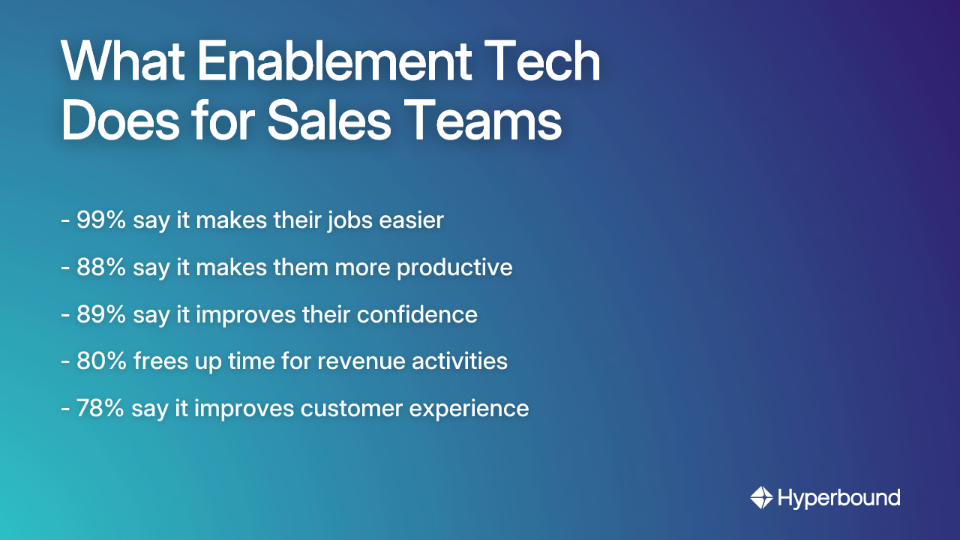
Adoption is high — and it's working, at least on the satisfaction front. Seismic's 2023 Value of Enablement Report found that among the 82% of respondents currently using enablement technology:
These are remarkable satisfaction scores. And yet, there's a paradox at the heart of the enablement market: despite near-universal adoption and positive feedback, execution effectiveness remains critically low.
Highspot's research reveals that only 10% of organizations consider themselves "very effective" at driving GTM initiatives that deliver business results. 55% struggle with either sales training or coaching. And sales coaching as an organizational priority rose 3x year-over-year — a sign that leaders know the gap exists, even if they haven't yet closed it.
The implication is clear: having tools is not the same as having outcomes. The market has more enablement technology than ever and fewer organizations achieving the readiness they need. Something structural is broken.
Ramp time is the period between when a rep is hired and when they reach full productivity. Every week in that window is a week of compensation expense with diminished revenue return. For most organizations, this lag is accepted as a cost of doing business. It shouldn't be.
Widely cited public benchmarks put average full-productivity ramp times at:
.png)
These should be treated as directional ranges drawn from practitioner benchmarking, not peer-reviewed primary research. Medical device ramp times, as we'll explore shortly, are typically understated when benchmarked against generic manufacturing.
To understand the true financial exposure of slow ramp, you need to start with rep economics. RepVue's salary data puts the median medical device sales rep at a $70,000 base and $160,000 OTE — with a current quota attainment rate of only 53.8%.
Using OTE as a conservative direct compensation basis:
And that's just the floor. These figures exclude:
For a hiring-cost baseline: secondary reporting citing SHRM data places the average cost-per-hire at approximately $5,475 for non-executive roles. For a revenue-carrying sales role, this is the starting point — not the total cost. The bigger financial hit is the lost pipeline and compressed time-to-productivity that never gets properly accounted for.
Here's what makes this especially urgent for medical device companies: ramp inefficiency compounds. An underprepared rep doesn't just miss their own quota. They burn relationships with key surgeons and procurement contacts. They mis-position products in high-stakes conversations. They erode trust with hospital systems that took years to develop.
In a 12–24 month sales cycle, you may only get one shot per account per buying cycle. A rep who isn't ready doesn't just delay a deal. They can cost you the deal entirely — and potentially the account relationship for years.
In most industries, sales training is a productivity investment. In medical devices, it is also a regulatory obligation.
The FDA's Quality Management System Regulation requires manufacturers to establish and maintain a documented quality system. The personnel provision at 21 CFR 820.25 explicitly requires manufacturers to establish procedures for identifying training needs and ensuring all personnel are adequately trained for their responsibilities.
The commercial side of the field is equally scrutinized. The CMS Open Payments program requires applicable manufacturers to report transfers of value — including meals, consulting fees, and other interactions — made to covered recipients like physicians and teaching hospitals. This regulatory visibility means every rep interaction is, in some sense, a matter of record. Inconsistent, off-script, or non-compliant messaging in the field isn't just a coaching problem. It's a compliance risk.
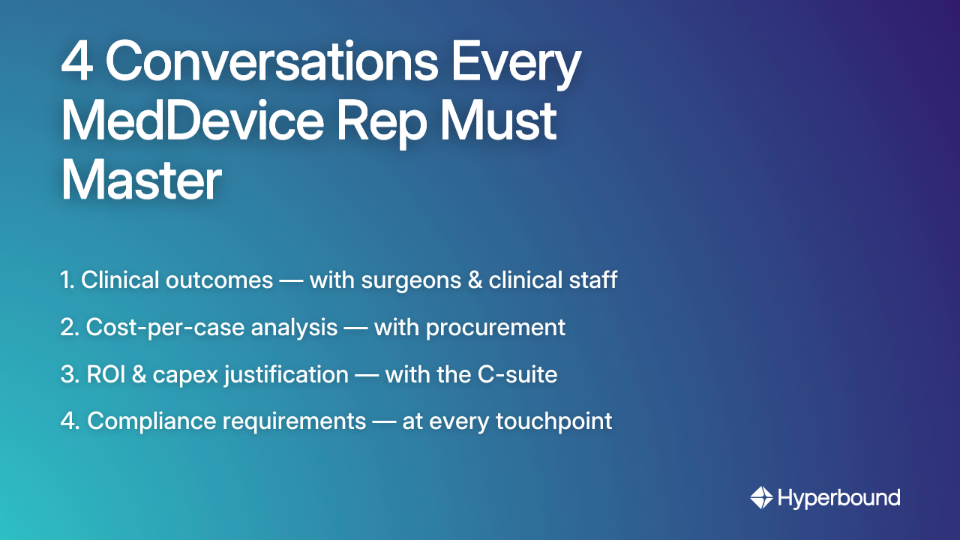
Medical device reps don't sell to a single buyer. They navigate a cross-functional buying committee — and every member of that committee uses a different decision frame.
At the center of most hospital purchasing decisions sits the Value Analysis Committee (VAC) — a cross-functional governance body that evaluates products on clinical efficacy, safety, utilization, and financial value. IQVIA's research on VAC influence — drawn from a survey of 42 committee members — shows just how comprehensive and multi-layered this evaluation process is.
A fully prepared medical device rep must be ready to:
These are four fundamentally different conversations — and a rep who excels at one but flounders in another will stall at the VAC stage, no matter how good their product is.
Huthwaite International's analysis of medical device sales cycles describes a process that can stretch 12 to 24 months as products move through clinical evaluation, economic justification, and multi-level committee approvals.
This changes everything about how you think about rep readiness. In a short-cycle transactional environment, a rep can learn from a lost deal and recover in weeks. In a 12–24 month medical device environment, a single stumbled conversation — a missed objection, an off-message clinical claim, a flubbed C-suite ROI discussion — can derail an entire deal cycle and set the territory back by a year.
This is the critical insight that most medtech revenue leaders miss: medical device selling is not manufacturing selling.
It requires the precision and process discipline of manufacturing, the multi-stakeholder navigation skills of enterprise software, and the compliance fluency of a regulated healthcare profession — simultaneously. When leaders benchmark rep ramp time against generic manufacturing norms (4–6 months), they're setting expectations that the reality of the job simply cannot support.
ATD's research shows that goods-producing industries average only 12 training hours per employee per year, compared to 26 hours in finance, insurance, and real estate. Given the complexity of medtech selling, the data strongly suggests that the medical device industry is chronically underinvesting in rep development relative to the demands of the role.
Here is the central contradiction facing sales leaders in 2026: organizations have more data on rep behavior than ever before, and conversion rates haven't meaningfully improved.
Highspot's research captures the paradox clearly. Despite near-universal adoption of enablement tools, only 10% of organizations are "very effective" at driving GTM initiatives that produce business results. 55% still struggle with sales training or coaching. And while sales coaching priorities tripled year-over-year, the tools most teams use to deliver that coaching were not built for it.
The first wave of conversational intelligence platforms represented a genuine leap forward for revenue organizations. The ability to record, transcribe, search, and analyze thousands of sales calls gave leaders unprecedented visibility, surfacing talk ratios, deal risks, competitive mentions, and objection patterns.
But there's a structural limitation: these platforms are built for diagnosing what happened, not for ensuring what happens next is different.
When a manager sees a rep struggling with clinical objections or failing to navigate procurement pushback on a call recording, the platform has done its job. The insight is surfaced. But now what?
In most organizations, the answer is: a coaching note in Salesforce, a Slack message, maybe a 1:1 conversation. The rep nods, takes the feedback, and walks into the next high-stakes conversation having never actually practiced the correction under pressure.
This is the insight-to-practice gap. And it's costing organizations in missed quota, stalled deals, and extended ramp time — every quarter.
Forward-thinking organizations have started measuring something different. According to ATD's 2024 State of the Industry report, 60% of organizations now use "time to employee readiness or competence" as a primary success metric — a significant shift away from passive measures like course completion rates or training hours logged.
This matters because it reflects a fundamental reorientation of what success looks like in sales enablement: not "did the rep watch the video?" but "can the rep handle the conversation?"
That's exactly the question a closed-loop practice system is built to answer — and that traditional diagnostic-only tools cannot.
The downstream effects of the insight-to-practice gap are predictable:
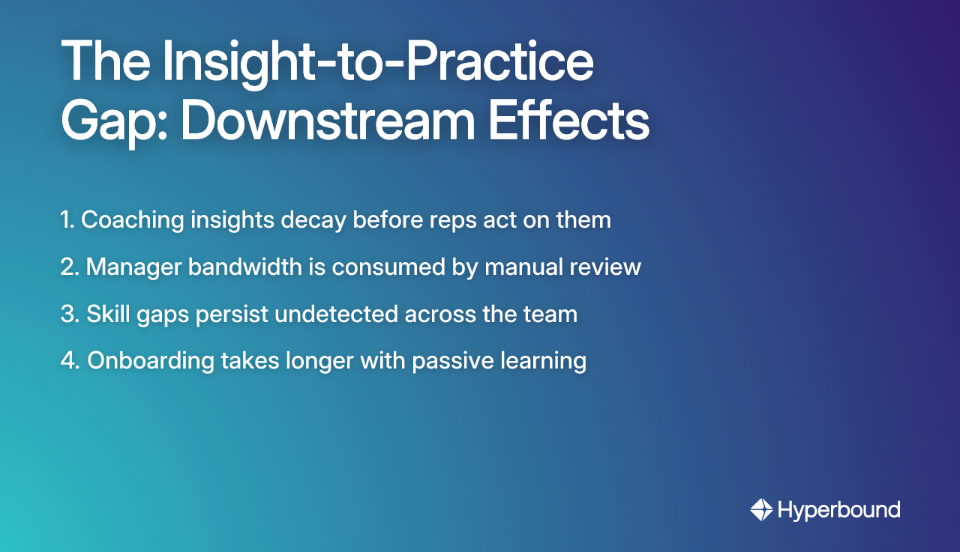
The organizations closing this gap are doing something structurally different: they're connecting the diagnostic data from real calls to a scalable engine for practice, then scoring again to confirm the improvement is real.
Not all sales technology is built for readiness. Understanding where your current tools fall on the maturity curve is the first step to identifying what your organization actually needs.
Here is a Gartner-style framework for assessing the landscape:
Representative platforms: Highspot, Seismic
What it does: Stores, organizes, and distributes training content, playbooks, product decks, and sales guides. Provides a system of record for what reps are supposed to know.
Where it excels: Ensuring reps have access to the right content at the right time. Formalizing onboarding curricula. Maintaining version-controlled sales collateral across large teams.
Where it falls short: Content delivery is about knowing, not performing. A rep can complete every course in the LMS and still fail in front of a VAC if they've never practiced the actual conversation. These platforms are a necessary foundation — but they are not a readiness system.
Representative platforms: Gong, Chorus (Zoom)
What it does: Records, transcribes, and analyzes real customer conversations. Surfaces deal risks, coaching moments, competitive signals, and conversation patterns. Provides managers with visibility into what's happening in the field.
Where it excels: Diagnosing performance patterns across the team. Identifying which objections are killing deals. Giving managers the data to have more targeted coaching conversations.
Where it falls short: Diagnosis is not prescription. These platforms identify what went wrong — but they don't provide a scalable, repeatable mechanism for reps to practice doing it right before the next high-stakes call. They are powerful rear-view mirrors. Revenue Activation requires a windshield.
Representative platforms: Second Nature, PitchMonster
What it does: Provides AI-powered practice simulations where reps can rehearse pitches, handle objections, and receive automated feedback. Often described as a "virtual pitch partner."
Where it excels: Giving reps repetitions in a safe environment. Scaling practice beyond what managers can personally deliver. Building confidence before important calls.
Where it falls short: Point-solution limitation. These tools are typically purchased separately from the call intelligence stack — which means the AI personas are generic, not trained on the company's actual buyer conversations. There's no connection between what a rep just failed at on a real call and the specific scenario they should practice next.
Representative platform: Hyperbound
What it does: A fully closed-loop system built around three integrated products:
Where it excels: This is behavior change infrastructure, not a content library or a diagnostic platform. The closed loop — score real calls → identify skill gaps → practice targeted roleplays → score again — means coaching is continuous, scalable, and measurable. Enterprise clients report 50% faster ramp, 150% higher DM-to-demo conversion rates, and 2x faster time to first won deal.
Why it's different: The AI personas aren't generic. They're trained on your actual call data. When Perform identifies a skill gap in a real conversation, Kota Activate doesn't just flag it — it routes the rep to the exact practice scenario that addresses it. The loop closes automatically.
The question for every revenue leader: At which level are you operating today — and what is the cost of staying there?
Traditional sales training models — classroom sessions, field ride-alongs, shadowing, manager-delivered coaching — have one thing in common: they are expensive, people-heavy, and capacity-constrained.
ATD's 2024 State of the Industry report puts the average direct learning spend at $1,283 per employee per year, with an average cost of $123 per learning hour. And this figure doesn't fully capture the hidden cost of the formats organizations are increasingly turning to:
Every hour a manager spends riding along with a rep, listening to a call recording, or running a mock pitch session is an hour not spent on strategy, forecasting, or their own quota-carrying activities. When you multiply that by a team of 10–20 reps in onboarding or skill development at any given time, the manager bandwidth cost alone is staggering — and it's virtually never captured in a training budget line.
Here's the structural limitation of the traditional model: there are only so many managers, and only so many hours in a day.
In medical device sales, where field ride-alongs are genuinely valuable — because there's no substitute for watching a great rep navigate a surgical suite or a VAC presentation — the right question isn't "should we eliminate ride-alongs?" It's "what can we scale so that the ride-alongs we do invest in are higher-leverage?"
AI roleplay doesn't replace the field. It replaces the low-leverage repetition that should never have required a manager's time in the first place. Before a new rep ever sits in front of a surgeon, they should have handled that objection 50 times in an AI simulation. Before a rep walks into a CFO conversation, they should have already failed at it — and recovered from it — in a safe practice environment.
That's the economic value of AI simulation that most organizations haven't yet fully modeled: frontloading failure in a zero-cost environment so that real conversations have better outcomes.
The business case for AI roleplay has gotten dramatically stronger in the past two years — not just because the technology has improved, but because it has gotten radically cheaper to deploy.
Epoch AI's research on LLM inference cost trends found that inference-related costs for a given capability level have been dropping at extraordinary rates — in some cases trending toward hundreds-fold reductions per year in their analysis. The exact pace varies by model and task, but the direction is unambiguous: the cost of generating high-quality, realistic AI buyer simulations at scale has collapsed.
This changes the ROI calculation for sales training fundamentally. Two years ago, deploying realistic AI simulations across an entire sales team of 200 reps was cost-prohibitive for many organizations. Today, it's one of the most economically efficient training investments available.
.png)
The financial case is not just about cost per learning hour. It's about speed to competency — and what each additional week of ramp time costs in delayed quota attainment.
With Hyperbound clients reporting 50% faster ramp and 2x faster time to first won deal, even a conservative application of that improvement to the medical device ramp cost model tells a compelling story: if a $13,300/month rep reaches full productivity even 6 weeks earlier, that's over $20,000 in recovered direct compensation value — per rep, per hire.
The evidence across every dimension of this report points to the same conclusion: medical device sales readiness in 2026 is a systems problem, not a content problem.
Let's trace the logic from beginning to end:
AI adoption is now a baseline expectation in every revenue organization. The sales enablement market is growing at 16%+ annually. Reps have access to more content, more tools, and more data about their performance than at any point in the history of the profession. And yet, only 1 in 10 organizations considers itself truly effective at driving GTM outcomes. 55% still struggle with basic sales training and coaching.
The tools most teams rely on — content libraries and call recording platforms — were built to solve a knowledge access problem. That problem is largely solved. The problem in front of us now is a behavior change problem.
Knowing what great looks like on a call is not the same as being able to execute it under pressure — in front of a skeptical surgeon, a cost-cutting CFO, or a 12-person VAC that has just asked a compliance question you didn't prepare for.
The medical device industry makes this challenge uniquely acute. With deal cycles stretching 12–24 months, regulatory exposure at every touchpoint, multi-stakeholder buying committees that require different conversations simultaneously, and median rep OTEs of $160,000, the cost of a poorly prepared rep — or a slow ramp — is not an abstraction. It's a six-figure revenue drag per hire.
At the same time, the forces enabling a new approach have never been stronger: AI adoption is mainstream, LLM costs are in freefall, regulated-industry compliance standards are being met by enterprise-grade platforms, and organizations are ready to move from enablement experiments to enablement infrastructure.
The organizations that will win in 2026 are building a closed loop. They score real calls to identify where reps are struggling. They route those reps to targeted AI roleplay practice built on their actual buyer conversations. They score again — both the practice and the next real call — to confirm the improvement is real. And they orchestrate coaching interventions at the deal level, so readiness is continuous, not episodic.
This is the definition of Revenue Activation. And it represents the most significant shift in how high-performing sales organizations will be built in the years ahead.
A Revenue Activation Platform is a closed-loop system that connects insights from real sales calls with targeted practice opportunities to actively improve rep performance. Unlike traditional tools that only diagnose problems (like call recording platforms) or provide content (like an LMS), a Revenue Activation Platform creates a continuous cycle: it analyzes live calls to identify skill gaps, automatically assigns reps to practice those specific skills in AI-powered simulations, and then measures their improvement on subsequent calls.
Conversational intelligence tools are primarily diagnostic, while Revenue Activation Platforms are built for behavior change. Tools like Gong are excellent for analyzing past conversations to tell you what happened. A Revenue Activation Platform takes the next step: it uses those insights to create a system for reps to practice and improve before their next high-stakes conversation. It closes the "insight-to-practice gap" by connecting analysis with a scalable training mechanism.
Medical device sales readiness is exceptionally challenging due to its unique combination of long sales cycles (12-24 months), complex multi-stakeholder approvals (surgeons, procurement, C-suite), and strict regulatory compliance requirements. Reps must master multiple, distinct conversations, and a single misstep can derail an entire year's worth of work, making upfront readiness critical.
AI can significantly shorten ramp time by providing new reps with unlimited, on-demand practice in a safe, simulated environment. Instead of waiting for manager-led roleplays, new hires can use AI simulations to practice handling objections from surgeons, navigating Value Analysis Committee questions, and discussing ROI with hospital administrators. This front-loads experience, builds confidence, and reduces the ~$80,000+ in direct compensation exposure that a typical 6-month ramp represents.
The "insight-to-practice gap" is the disconnect between identifying a rep's performance issue on a call and the rep actually practicing and mastering the correct behavior. A manager might tell a rep they need to handle an objection better, but without a structured way to practice, that feedback often decays. The rep hears the advice but never builds the muscle memory to apply it under pressure, which is why coaching efforts often fail to produce lasting results.
The most effective AI roleplay platforms use AI buyer personas trained on real conversation data to accurately simulate the specific objections, questions, and priorities of roles like surgeons, CFOs, or procurement managers. Instead of generic practice, reps can engage with an AI that mirrors the language and decision framework of a clinical expert or a financial stakeholder, ensuring they are prepared for the nuances of each critical conversation.
Yes, enterprise-grade AI training platforms designed for regulated industries are built to be compliant with standards like HIPAA, SOC 2, and GDPR. It is critical to choose a vendor that has invested in robust data security and privacy controls. Platforms like Hyperbound are SOC 2 Type II certified and HIPAA compliant, ensuring that any conversation data used for training is handled securely and in accordance with strict industry regulations.
The ROI for a Revenue Activation Platform is typically measured in faster ramp time, increased conversion rates, and a shorter time to a rep's first won deal. For example, Hyperbound clients report a 50% faster ramp time. For a medical device rep with a $160,000 OTE, shortening a 6-month ramp by just six weeks can recover over $20,000 in direct compensation value per hire, delivering a clear and rapid financial impact.
Hyperbound is the Revenue Activation Platform — the company that coined the "Revenue Activation" category to describe what happens when teams stop just analyzing call data and start using it to change outcomes.
Hyperbound's AI buyer personas are trained on 2M+ hours of real B2B sales conversations. The platform has delivered 250,000+ AI simulations across 7,000+ companies and 25,000+ reps, including Autodesk, Monday.com, Bloomberg, LinkedIn, Vanta, and IBM.
Hyperbound's three core products form a closed loop:
Enterprise results: 50% faster ramp | 150% increase in DM→demo conversion | 2x faster time to first won deal
Compliance: SOC 2 Type II | ISO 27001 | GDPR | HIPAA | 25+ languages supported
G2 Rating: 4.9/5
© 2026 Hyperbound, Inc. All rights reserved. This report is intended for informational purposes. Market size estimates reflect third-party analyst projections and are provided as directional evidence of category investment. Rep compensation and ramp time figures are modeled ranges based on publicly available data and should be validated against your organization's specific circumstances.










Use Cases
Legal