You hired a strong candidate. They came in with energy, passed every interview, and checked every box on paper. But three months into their ramp, they're still stumbling through clinical conversations, getting stonewalled by procurement, and losing credibility in the OR before the device even leaves the bag.
Sound familiar?
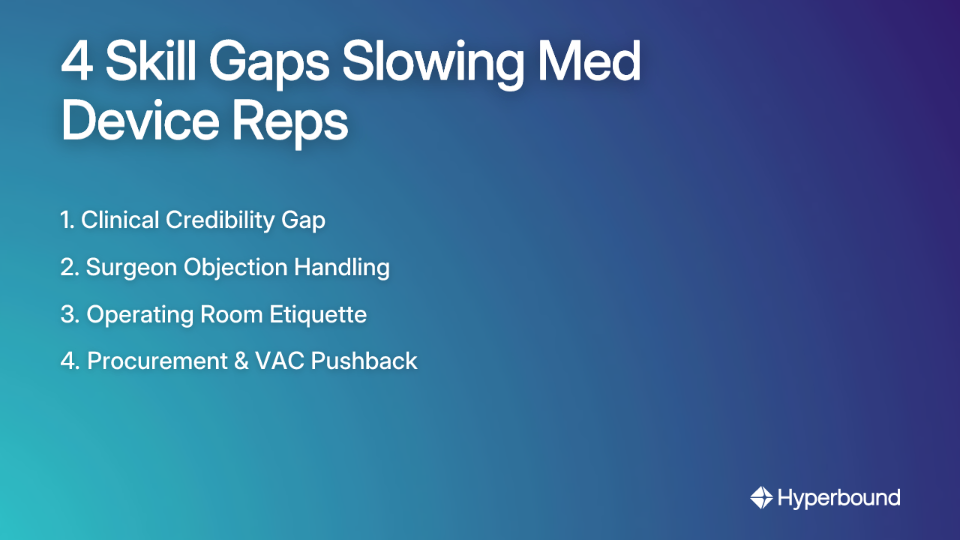
Medical device sales reps take an industry-average of 9 to 12 months to become fully productive — and that's not because they're not working hard enough. It's because the role demands something virtually no other sales job does: mastering four distinct, high-stakes skill layers simultaneously.
A rep entering the field must internalize deep clinical knowledge, absorb complex surgical protocols, develop confident objection-handling for both surgeons and procurement committees, and navigate sales cycles that can stretch six months or longer. Meanwhile, as one sales leader put it plainly on Reddit: "If onboarding takes 4 weeks and the company's usual sales cycle is 4-6 months and ramp-up is just 90 days, the new hire is disadvantaged from the start."
And yet, most medical device sales training programs are still product-focused. The ICP, the real buyer objections, and the situational fluency needed in the OR? Those are "left to in the field." That gap — between what onboarding teaches and what the job actually demands — is where ramp time bleeds out.
The companies winning right now have found a way to close that gap before reps ever enter a hospital. They're using AI-powered roleplay to let reps rehearse the highest-stakes conversations in their role repeatedly, without the risk of destroying a real relationship in the process. The results speak for themselves: top organizations are cutting rep ramp time by 50%.
Here's how.
Traditional role-playing has always been the theoretical answer to these challenges. Practice the surgeon conversation with your manager. Run through procurement objections with your enablement team. Shadow an experienced rep in the field.
The problem is that traditional role-plays come with a catch: 95% of medical representatives find them stressful, precisely because they happen in front of peers and managers. The performance anxiety that makes live sales conversations hard doesn't disappear in a traditional role-play — it follows reps into the practice room too. The result is that reps don't actually rehearse freely; they perform cautiously, which means they're not developing the genuine fluency the role demands.
AI roleplay removes that barrier entirely.
In an AI-powered practice environment, there's no judgment, no embarrassment, and no consequence for getting it wrong. A rep can attempt the same objection handling scenario twelve times until the response feels automatic. They can practice an OR consult conversation at 10pm before a big call the next morning. They can fail forward in a way that traditional methods never allowed.
Here's how AI roleplay directly closes each of the four gaps:
This isn't just a training upgrade — it's a fundamental shift in how quickly reps can acquire high-stakes conversational fluency.

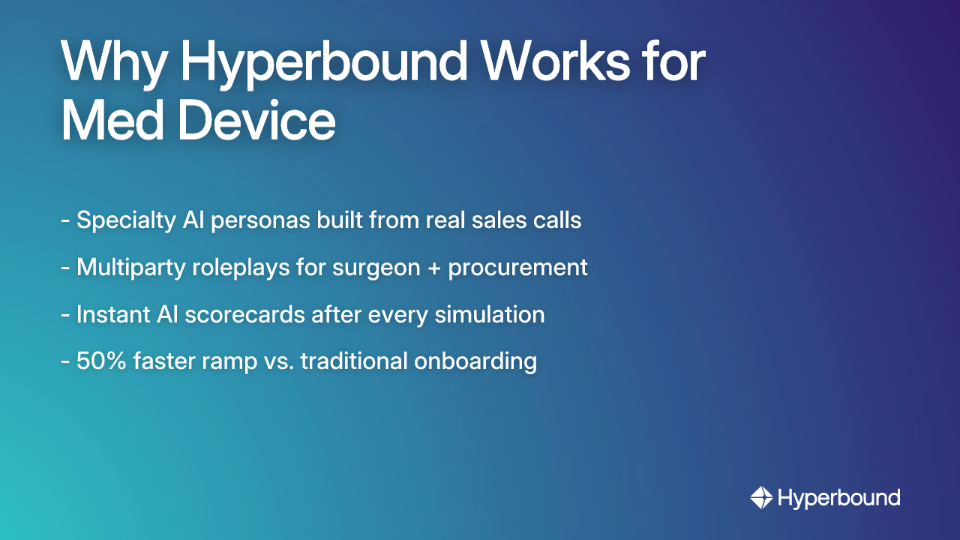
The data makes the case clearly. Companies using Hyperbound Practice — the AI roleplay platform built specifically to accelerate rep readiness — are achieving 50% faster ramp times compared to traditional onboarding approaches.
The most compelling analogue is Vanta, whose CRO Stevie Case oversaw the use of Hyperbound to grow their BDR team 4x while simultaneously cutting ramp time from 210 days to 72 days — a 66% reduction. That's not a marginal improvement. That's a structural transformation in how quickly reps start contributing to pipeline.
What makes Hyperbound Practice purpose-built for the complexity of medical device sales specifically?
Hyperbound's AI buyer personas aren't generic scripts. They're built from analysis of over 2 million hours of real B2B sales conversations, which means they respond dynamically — the way real buyers do. For medical device sales teams, this means building an AI "Orthopedic Surgeon" persona who pushes back on technique disruption, or an AI "Cardiologist" who asks pointed questions about procedural integration times. The practice mirrors reality closely enough that reps walk into live conversations with genuine confidence, not rehearsed talking points.
One of Hyperbound's standout features for medical device applications is Multiparty Roleplays. A rep can enter a single simulation with both an AI "Lead Surgeon" and an AI "Procurement Director" in the room simultaneously — each with their own priorities, objections, and communication style.
This is the only way to safely rehearse the exact dynamic that defines medical device deals: balancing a clinical champion's procedural concerns with an economic buyer's budget constraints, in real time, without derailing an actual relationship. No traditional medical device sales training program can replicate this scenario at scale.
After every simulation, reps receive instant, objective feedback through Hyperbound's AI Scorecards. These track talk-to-listen ratios, messaging adherence, how objections were handled, and where the conversation went off-track. Every rep is evaluated against the same criteria, giving sales enablement leaders consistent, actionable data on skill progression across the entire team.
This is particularly valuable for medical device sales leaders managing distributed teams across regions. Rather than relying on manager intuition or field ride-alongs to assess readiness, you get a standardized view of where every rep stands — and exactly what they need to practice next.
The medical device sales role is genuinely hard. The clinical complexity is real, the OR dynamics are unforgiving, and the procurement gauntlet is a legitimate obstacle. None of that changes.
But the idea that it must take 9 to 12 months to produce a fully productive rep — that part is outdated. It's a symptom of training programs that were never designed to address the actual skill gaps the role demands. When reps are only taught what's easy to teach in a classroom, the rest gets offloaded to the field, to shadowing, to trial and error. That's where the months go.
AI roleplay compresses that cycle by letting reps build conversational fluency before their first live interaction. It lets them fail safely, iterate quickly, and arrive at the hospital already calibrated for the specific objections, protocols, and stakeholder dynamics they'll face.
That's the shift. And the numbers confirm it: 50% faster ramp. 210 days down to 72. These aren't edge cases — they're what becomes possible when you replace information-delivery with deliberate, repeatable practice.

The ramp-up time for medical device sales reps is long—typically 9 to 12 months—because the role requires them to simultaneously master four distinct, high-stakes skills. These include establishing clinical credibility with surgeons, handling complex objections, mastering operating room etiquette, and navigating pushback from procurement and Value Analysis Committees (VAC). Traditional training often focuses on product knowledge, failing to adequately prepare reps for these real-world conversational challenges.
AI-powered sales roleplay is an advanced training tool where sales representatives practice conversations with an AI-driven persona that simulates a real buyer. It provides a safe, repeatable, and judgment-free environment for reps to hone their skills, handle objections, and build conversational fluency on their own time, without the pressure of performing in front of managers or peers.
AI roleplay prepares medical device reps by immersing them in realistic, industry-specific scenarios. Reps can practice explaining clinical data to an AI "cardiologist," navigate technique-related objections from an AI "surgeon," or defend a proposal to an AI "procurement director." This repeated, risk-free practice builds the reflexive confidence and situational fluency needed to succeed in high-stakes environments like the OR or a VAC meeting.
The primary advantage is that AI roleplay eliminates the performance anxiety and stress that 95% of reps feel during traditional role-plays with managers or peers. This allows for more authentic practice and faster skill development. Additionally, AI roleplay is scalable, consistent, and provides instant, data-driven feedback, enabling leaders to track progress objectively across the entire team.
Yes, advanced platforms like Hyperbound offer Multiparty Roleplays specifically for this purpose. A rep can enter a single simulation with both an AI "Lead Surgeon" and an AI "Procurement Director," each with different priorities and objections. This is the only way to safely rehearse the critical skill of balancing clinical and economic value propositions in real time.
Companies that implement AI roleplay training can expect a dramatic reduction in representative ramp time. The data shows that top organizations are cutting ramp time by 50% or more. For example, one company reduced its sales development ramp time from 210 days to 72 days, demonstrating a structural transformation in how quickly new hires become fully productive.
Ready to see what this looks like for your medical device sales team?
Stop letting long ramp times put your revenue goals at risk. Book a personalized demo with Hyperbound and see how AI roleplay can prepare your reps for any clinical conversation, procurement pushback, or OR interaction before they ever step into the field.
Or explore Hyperbound's medical device-specific roleplay scenarios to see the practice in action.










Use Cases
Legal