
You've decided on MEDDPICC. You've read the books, sat through the kickoff presentation, and maybe even watched a few David Weiss podcast episodes. Now comes the hard part: actually rolling it out without it turning into a soul-crushing CRM exercise that your reps resent and your managers quietly stop enforcing.
The frustration is real. As one sales rep put it on Reddit: "Our company rolled out MEDDPICC. They sent us an excel file with like 30 questions on it. Then had a 'sales champion' who used it in the past explain it. How about that for a training?" That's the failure mode — theory without execution, methodology without muscle memory.
The result? Reps who check boxes without qualifying. Managers who inspect CRM fields instead of coaching strategy. And a sales team that sounds robotic on calls because they're too focused on hitting every letter in sequence rather than actually listening to the buyer.
This guide is not another definition of MEDDPICC. It's a four-step execution roadmap designed for sales managers and enablement leaders who already know the framework and need to know how to make it stick — across reps at every tenure level, in every territory, at scale.
Before you design a single training module, you need to know where your team is actually breaking down — not where you think they are.
Self-reported CRM data is a poor diagnostic tool. Reps fill in fields to satisfy managers, not to reflect the actual state of the deal. The truth is in the conversations. Your call recordings are a far more reliable signal.
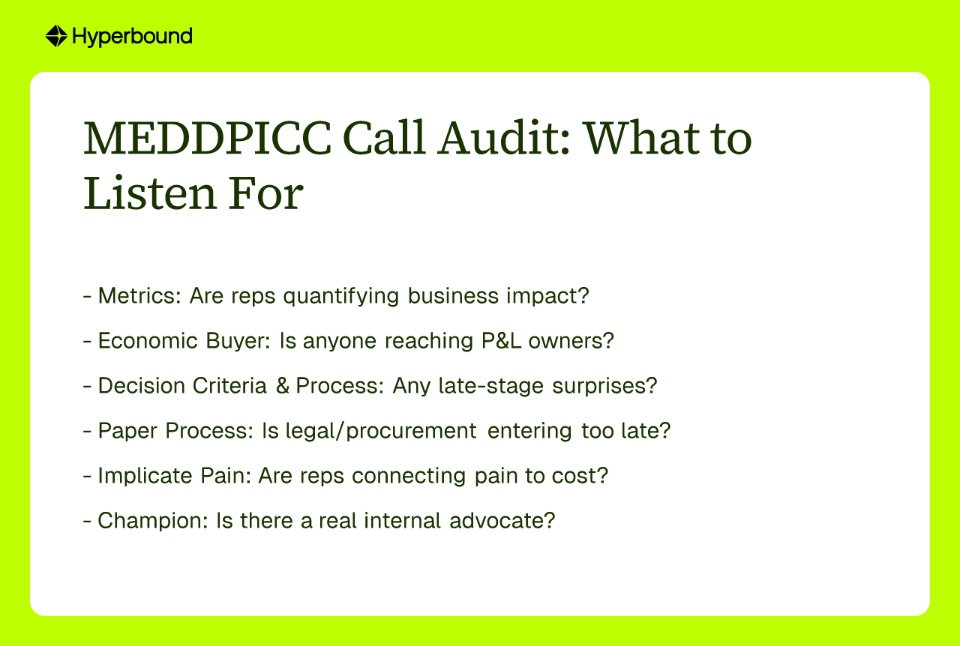
What you're listening for:
Pull a sample of 20–30 recent calls — a mix of won, lost, and late-stage stalls — and evaluate them against each letter of the framework. Specifically, look for:
Turn the diagnostic into data:
Manually reviewing calls doesn't scale past a small team. Hyperbound Perform lets you deploy custom AI scorecards against 100% of your recorded calls — automatically. Run it against a baseline sample of recent deals before your training launches, and you'll get a data-driven breakdown of exactly which MEDDPICC components your team is skipping, skimming, or executing poorly.
This baseline is critical. It gives you something concrete to train toward, and it sets the benchmark you'll measure against in Step 4.
Pattern-match to pipeline outcomes:
Once you have the call-level data, cross-reference it with deal outcomes:
Don't skip this step. A one-size-fits-all MEDDPICC training will underdeliver. Your gap analysis is what turns a generic rollout into a targeted one.

The fastest way to kill MEDDPICC adoption is to treat it as a separate activity that lives outside normal workflow. If reps have to go somewhere special to "do MEDDPICC," they won't do it.
Instead, embed it directly into your existing deal review structure. Here's how.
Build a MEDDPICC scorecard your team will actually use:
The scorecard should live in your CRM as required fields, and it should double as the agenda for your weekly deal reviews. Based on the MEDDPICC framework, here's a working template:
.png)
.png)
Use it as a coaching tool, not an interrogation:
The scorecard's job isn't to expose what reps don't know — it's to facilitate a strategy conversation. Research and practitioners alike consistently flag the failure mode where MEDDPICC becomes a managerial compliance exercise rather than a deal strategy tool.
Shift the framing in your deal reviews:
That distinction matters. The first is a checkbox. The second is a coaching conversation.
Knowledge of MEDDPICC is not the same as skill in applying it. Reps who can explain the framework in a training session will still stumble when a CFO asks why they should care, or when a "champion" who can't actually move the deal forward keeps scheduling meetings.
The fix isn't more theory. It's repetitions — deliberate, scenario-specific practice that builds real conversational muscle memory.
The problem is that most sales managers are outnumbered. A single enablement leader is typically supporting anywhere from 5 to 10 managers and 50 to 100 reps. Manual roleplays simply don't scale.
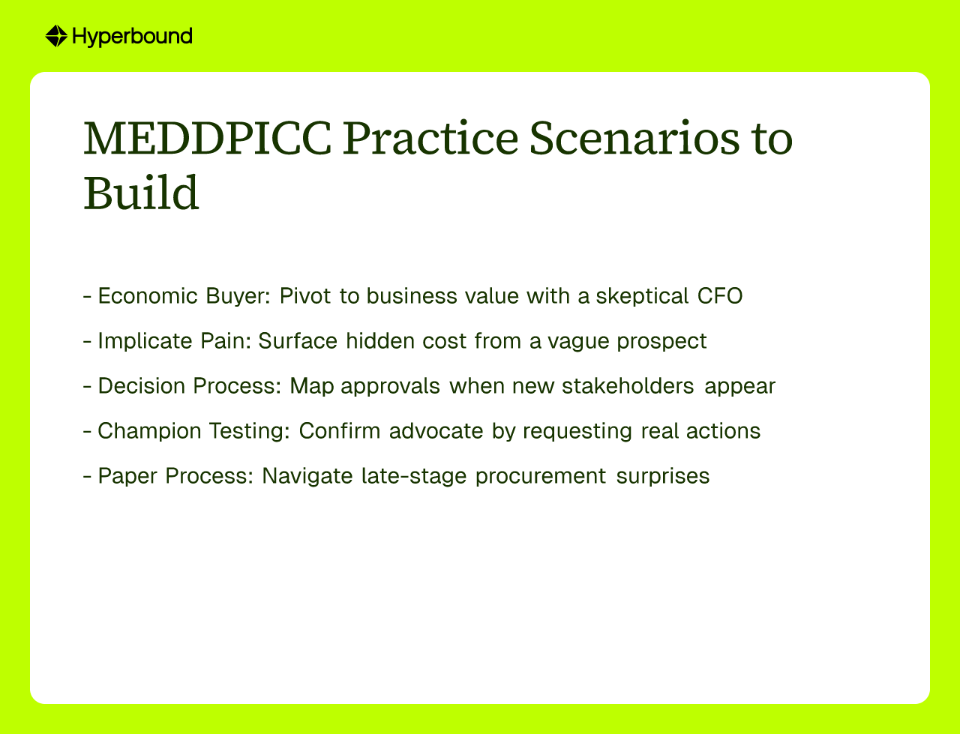
Build a MEDDPICC practice library using AI roleplay:
This is where Hyperbound Practice fits naturally into the rollout. Instead of one-off manager-led roleplays, you can build a full library of MEDDPICC-specific scenarios that every rep can access on demand — embedded directly in your CRM, sales enablement platform, or Slack.
The AI buyer personas in Hyperbound Practice are built from analysis of 2M+ hours of real B2B sales conversations, so reps aren't practicing against a generic bot — they're practicing against realistic buyer behaviors.
Example scenarios to build for each component:
Why this approach avoids the "robotic" problem:
One of the most consistent complaints about MEDDPICC training — as surfaced in community discussions — is that reps start sounding like they're reading off a checklist. "Nothing worse than a stilted sales call where the rep is clearly just checking boxes."
AI roleplay practice builds fluency, not rigidity. The more reps practice these conversations in a low-stakes environment, the more naturally the MEDDPICC thinking shows up in real calls — woven into the conversation, not bolted on top of it.
For tenured reps who don't need full-length simulations, Bitesized Roleplays within Hyperbound Practice let them sharpen a single skill — say, handling a competitive objection or recovering a stalled champion conversation — in just a few minutes between calls.
After every simulation, reps receive instant AI scoring and methodology-aligned coaching feedback: where they missed an opportunity to implicate pain, when they moved off discovery too quickly, or how they could have tested the champion more effectively. That immediate feedback loop is what makes the practice sticky.
A MEDDPICC rollout without measurement is just a suggestion. You need to track both behavioral adoption (are reps doing it?) and business impact (is it working?).
Leading indicators — what to track first:
CRM hygiene is your most accessible early signal. Are reps consistently completing the MEDDPICC fields you built in Step 2? Incomplete or blank fields across a rep's pipeline is an early warning that adoption is slipping.
But CRM hygiene alone tells you that something is missing — not why. For that, you need to go back to the calls.
Use Hyperbound Perform to score real calls against your MEDDPICC scorecard:
Once your framework is live, Hyperbound Perform automatically scores 100% of your team's real customer conversations against the custom MEDDPICC scorecards you built in Step 2. It integrates with popular conversation intelligence and sales engagement platforms — no additional workflow required.
The result is a dashboard that shows you:
This is the layer that distinguishes a real MEDDPICC rollout from a compliance exercise. Instead of asking, "Did you fill out the fields?", you can now ask, "Here's where your last five deals missed the mark — let's work on that."
Lagging indicators — measuring business impact:
Track the following at the 60- and 90-day marks post-rollout:
Create the continuous improvement loop:
The goal isn't a one-time training event. It's a flywheel:
This is what separates teams that "did MEDDPICC training" from teams that actually sell differently because of it.
Most MEDDPICC implementations fail not because the framework is wrong, but because the implementation is shallow. An Excel file with 30 questions is not a training program. A deal review where managers interrogate reps on CRM fields is not a coaching culture.
A real rollout looks like this: You assess your team's actual gaps using call data. You embed the framework into the workflows your team already lives in. You give every rep unlimited, realistic practice reps against AI buyer personas that behave like the economic buyers and skeptical champions they face every day. And you close the loop by measuring — at the call level, not just the pipeline level — whether the behaviors are actually changing.
The tools exist to do this at scale. Hyperbound Perform brings the scoring and deal-level intelligence. Hyperbound Practice brings the repeatable, scenario-specific skill development. Together, they turn MEDDPICC from a methodology your team knows about into one they actually execute — consistently, across every deal, for every rep.
Stop talking about MEDDPICC and start activating it. The result isn't just cleaner CRM data — it's higher win rates, shorter ramp times, and a sales team that qualifies with confidence instead of guessing.
MEDDPICC is a B2B sales qualification framework designed to help sales teams accurately assess and qualify complex deals. The acronym stands for Metrics, Economic Buyer, Decision Criteria, Decision Process, Paper Process, Implicate Pain, Champion, and Competition, with each letter representing a critical deal element that must be understood to improve forecasting and win rates.
Most MEDDPICC rollouts fail because they are treated as a theoretical, one-time training event rather than an integrated coaching system. Common pitfalls include focusing on CRM field compliance instead of skill development, providing checklists without context, and failing to offer reps a way to practice the methodology in realistic scenarios, which leads to poor adoption and resentment.
To make MEDDPICC stick and sound natural, reps need consistent practice in low-stakes, realistic scenarios. Instead of memorizing a script, tools like AI roleplay allow reps to build conversational muscle memory. This fluency enables them to weave MEDDPICC principles into their discussions organically, turning the framework into an instinct rather than a checklist they have to follow on a call.
The best way to measure MEDDPICC's effectiveness is to track both leading and lagging indicators. Leading indicators, available almost immediately, include CRM hygiene and analysis of call recordings to see if reps are applying the framework. Lagging indicators, typically measured after 60-90 days, are the business outcomes, such as increased win rates, shorter sales cycles, and larger average deal sizes.
MEDDPICC is an evolution of the original MEDDIC framework. MEDDIC stands for Metrics, Economic Buyer, Decision Criteria, Decision Process, Implicate Pain, and Champion. MEDDPICC adds two additional letters: "P" for Paper Process (the legal and procurement steps) and a second "C" for Competition, providing a more comprehensive view of modern complex sales cycles.
AI can significantly improve a MEDDPICC rollout by solving the challenges of scale and measurement. AI-powered tools can automatically score 100% of sales calls against your MEDDPICC scorecard to identify specific skill gaps (assessment). It can also provide unlimited, on-demand roleplay scenarios for reps to practice those specific skills against realistic buyer personas (practice and reinforcement).









Use Cases
Legal