
You've rolled out MEDDPICC. You've trained your team. You've built the fields in your CRM. And yet, every pipeline review still feels like an exercise in story-time, with reps giving optimistic updates that evaporate the moment a deal hits late stage.
Sound familiar? You're not alone.
Over on Reddit's r/sales, the frustration is palpable: "Reps fill out fields to make managers happy. Managers check boxes to survive pipeline reviews. Nobody actually uses it to decide the state of a deal." Another commenter put it bluntly: "Most reps treat it like hard labor, not a tool." And the sharpest critique of all: "The real issue is most sales managers don't know how to coach the methodology part — they only know how to audit the CRM part."
Here's the uncomfortable truth: the problem isn't MEDDPICC. When implemented correctly, research shows organizations enforcing MEDDPICC with an evidence requirement see 31% fewer late-stage deal losses than those treating it as a checklist. The framework works. The delivery mechanism is what's broken.
When it comes to your MEDDPICC CRM enforcement tool strategy, there are two dominant philosophies battling for adoption in today's sales organizations: CRM-native enforcement (required fields, validation rules, and workflow alerts baked into Salesforce or HubSpot) and AI-layer enforcement (tools that extract MEDDPICC signals directly from your call recordings and populate the CRM automatically). Each has real merit. Each has real limitations. And together, they're still missing a critical third dimension.
Let's break down the showdown.
This is the OG approach. You use your CRM's built-in features to force reps to enter data before they can move a deal forward. No "Economic Buyer" entered? You can't advance to Stage 4. It's clean. It's simple. And it feels like control.
How it's built in Salesforce: According to SalesMethods, the standard DIY implementation involves four steps:
It's a reasonable starting point. But it comes with some significant caveats.
.png)
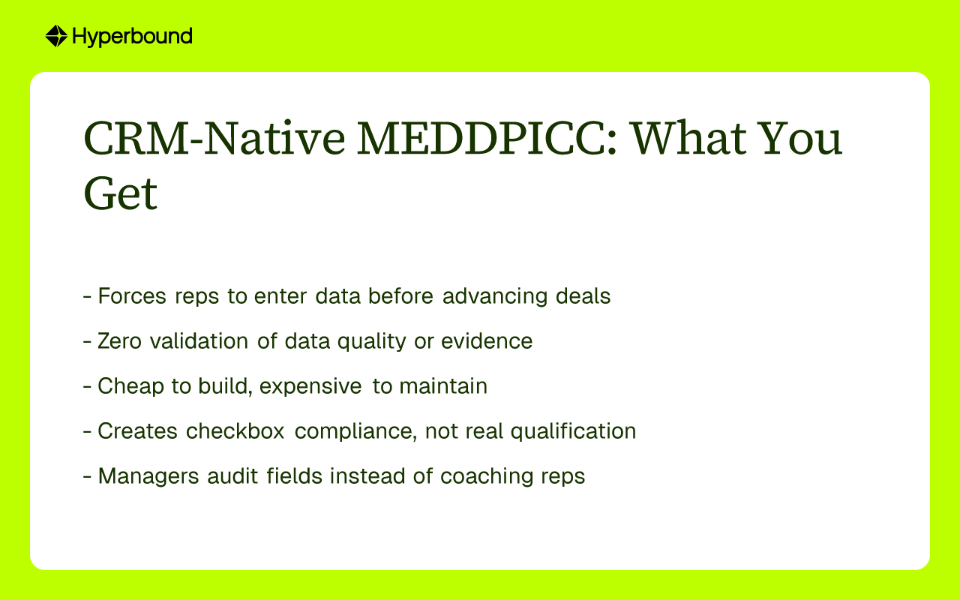
The core failure of native rules is that they measure input, not intelligence. A rep who types "CFO is the economic buyer" satisfies the field requirement — but has no idea if that CFO is actually bought in, has budget authority, or has ever heard a business case.
The second approach flips the model entirely. Instead of forcing reps to enter data, AI tools extract it — listening to your recorded calls, analyzing email threads, and automatically populating your MEDDPICC CRM fields with evidence pulled directly from buyer conversations.
This is "zero-touch automation" for deal qualification, and it's gaining serious traction. According to Gartner, 75% of B2B sales organizations were expected to adopt AI-guided selling solutions by 2025. The business case is straightforward: Bain & Company found that sellers spend only 25% of their time actively selling, with the rest eaten up by administrative tasks like CRM data entry. Automation doesn't just clean up your CRM — it buys back selling time.
Tools in this space connect to call recorders like Hyperbound, Gong, Chorus, or Salesloft, parse the conversation for qualification signals, and write them back to your CRM fields. When a rep asks "What would happen if you didn't solve this problem in the next quarter?" and the prospect lays out a $2M cost of inaction, that gets captured. When a champion says "I'm presenting this to the board on Thursday," that gets captured too. No manual entry. No interpretation lag. No happy ears.
.png)
The AI-layer approach is objectively better at capturing quality data. But it still doesn't solve the upstream problem: what if the rep never asked the right questions to surface the "Metrics," "Champion," or "Decision Process" in the first place? You can't extract what was never said.

Here's the fatal flaw that both enforcement philosophies share. You can force a field to be filled (native rules) or fill it for them (AI auto-fill), but if a rep never knew how to run a proper discovery call that uncovers an economic buyer's real priorities — enforcement doesn't fix that gap. It just hides it.
"Sales methodologies die when they become a performance for management rather than a navigation system for the rep." — Reddit r/sales
The missing layer isn't another enforcement mechanism. It's methodology coaching reinforcement — actually developing the rep's ability to execute MEDDPICC live, in front of a real buyer. And this is where Hyperbound's Revenue Activation Platform creates a solution that makes both enforcement approaches work better.
Hyperbound Practice ensures reps can execute MEDDPICC conversations before they're standing in front of a real prospect with budget on the line.
Reps practice discovery calls, champion-building conversations, and multi-stakeholder scenarios with AI buyer personas trained on 2M+ hours of real B2B sales conversations. After each session, AI Scorecards deliver instant, objective feedback on methodology adherence — flagging exactly where the rep failed to quantify Metrics, never confirmed the Decision Process, or missed a chance to build their champion.
This solves the coaching gap at scale. Instead of managers listening to less than 1% of recorded calls and hoping to catch a teachable moment, every rep gets structured, evidence-based coaching on their MEDDPICC execution after every practice session. Vanta used Hyperbound Practice to cut rep ramp time from 210 days to 72 days — a 60% reduction.
The outcome: reps enter live calls with the muscle memory to guide conversations that naturally surface all eight MEDDPICC elements — so there's actually something worth capturing.
Hyperbound Perform is the AI-layer enforcement piece, but built with a coaching flywheel underneath it.
Perform connects to your call recording infrastructure (Gong, Salesloft, Chorus, Aircall, and others), analyzes every call in a deal — not just individual conversations in isolation — and surfaces deal-level insights across the full lifecycle. Then it automatically writes the relevant MEDDPICC data back to your CRM. Currently live with HubSpot, with Salesforce support coming soon.
One critical differentiator: reps can manually review the extracted data before it's pushed to the CRM. This builds trust in the AI's output and keeps reps engaged with deal reality rather than bypassing the system entirely.
And when Perform detects a gap — say, a rep isn't quantifying Metrics effectively across multiple deals — it recommends a targeted, bite-sized roleplay in Practice to close that specific skill gap. The loop closes itself.
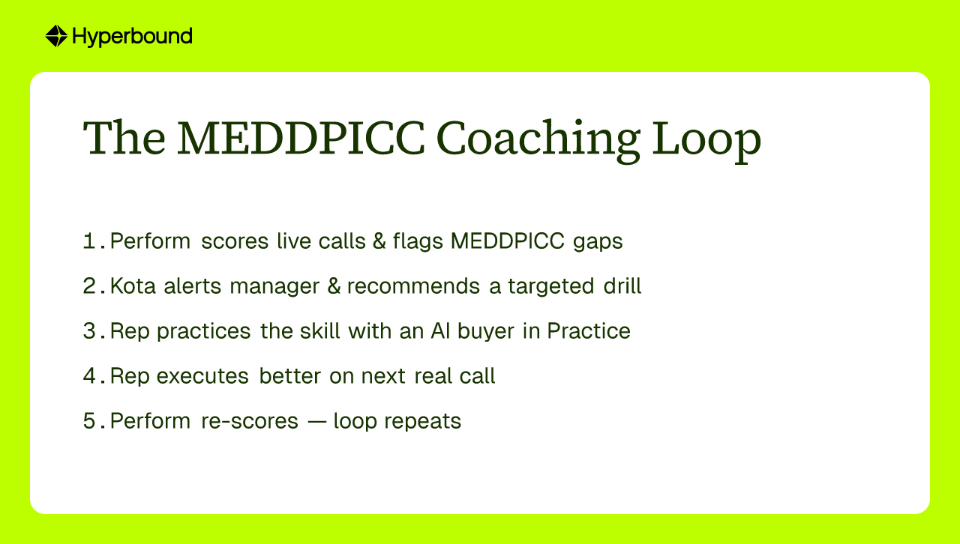
Here's how the full cycle works in practice:
Score real calls → identify skill gaps → practice roleplays → score real calls. It's the operational loop that transforms MEDDPICC from a checkbox exercise into a genuine competitive advantage.
Here's the honest summary:
CRM-native enforcement gives you structure and cost efficiency, but delivers checkbox compliance over actual intelligence. It's a floor, not a ceiling.
AI-layer enforcement gives you evidence-based, high-quality data without the manual entry burden — but it can only capture what actually happened on the call, and it can't fix rep skill gaps upstream.
The real answer isn't choosing one MEDDPICC CRM enforcement tool over the other. It's recognizing that enforcement without enablement is just a more sophisticated way of auditing incompetence. You need reps who can execute the methodology (Practice), a system that captures what they actually said (Perform), and an intelligent layer that connects those two things into a continuous coaching loop (Kota).
When those three pieces are in place, MEDDPICC stops being a CRM exercise and becomes what it was always meant to be: a navigation system for the rep that also happens to give leadership the pipeline visibility they've been chasing for years.

The main problem is that traditional enforcement focuses on data entry completion rather than the quality of the information. This leads to a "checkbox compliance" culture, where reps fill in fields to advance a deal in the CRM, but the data lacks real evidence from buyer conversations, giving a false sense of pipeline health.
An AI-layer tool for MEDDPICC works by integrating with your call recording platform (like Gong or Chorus) to automatically listen to and analyze sales conversations. It identifies and extracts key MEDDPICC elements discussed on the call—such as a champion's commitment or a quantifiable metric—and then populates the corresponding fields in your CRM, eliminating manual entry and grounding your data in real evidence.
Neither approach is a complete solution by itself. CRM-native enforcement provides structure but often leads to poor-quality data. An AI-layer provides high-quality, evidence-based data but can't fix underlying skill gaps. The best strategy combines AI data capture with a dedicated enablement program to ensure reps know how to uncover the MEDDPICC information on calls in the first place.
Reps often fail to adopt MEDDPICC because they view it as an administrative burden for management's benefit, not as a practical framework to help them win. This perception is usually the result of a rollout that focuses on CRM auditing instead of providing continuous, practical coaching on how to use the methodology to navigate complex deals.
The single most critical factor is to combine enforcement with enablement. A successful MEDDPICC implementation requires a system that not only tracks deal qualification criteria but also actively develops a rep's ability to execute the methodology. This creates a continuous improvement loop where skill gaps are identified from real calls and addressed with targeted coaching and practice.
The most effective way to ensure data accuracy is to base it on evidence from actual buyer conversations, not a rep's subjective opinion. AI tools that capture MEDDPICC signals directly from call recordings provide an objective source of truth. This removes "happy ears" and rep sentiment from the equation, giving leadership a far more reliable view of the pipeline.
Ready to stop chasing reps for CRM updates and start capturing real deal intelligence automatically?
👉 See how Hyperbound Perform auto-fills MEDDPICC fields from your calls.










Use Cases
Legal