
There's a thread on r/sales that every VP of Sales and RevOps leader should read. In it, a frustrated enterprise rep sums up exactly what's gone wrong with MEDDIC adoption at most companies:
"Reps fill out fields to make managers happy. Managers check boxes to survive pipeline reviews. Nobody actually uses it to decide the state of a deal."
That's not a MEDDIC problem. That's a delivery problem.
The MEDDIC framework — Metrics, Economic Buyer, Decision Criteria, Decision Process, Identify Pain, Champion — is one of the most proven qualification systems in enterprise sales. Its expanded variant, MEDDPICC, adds Paper Process and Competition for larger, multi-stakeholder deals. When applied correctly, it becomes a navigation system that helps reps understand where they actually stand in a deal.
But here's the enterprise-scale problem: one sales enablement professional serving 50–100 reps cannot manually enforce MEDDIC adherence at scale. Managers spend only 5–8% of their time coaching, and most of that coaching focuses on auditing CRM fields, not improving the actual conversations. As one sales leader put it in that same Reddit thread, "The real issue is most sales managers don't know how to coach the methodology part — they only know how to audit the CRM part."
The result? MEDDIC becomes theater. Reps treat it like hard labor — a checkbox enforced by leadership — rather than a tool that helps them win deals. For organizations managing 50 to 500+ reps, this inconsistency isn't just frustrating; it's a direct drag on win rates, ramp times, and revenue predictability.
The fix isn't more training decks or another certification program. It's an enterprise-grade technology system that enforces methodology in the flow of real deals, scales coaching beyond manager capacity, and closes the loop between practice and performance.
This article breaks down what that system looks like and the best MEDDIC training software options available today.
Before evaluating any platform, it's worth establishing what separates enterprise-grade MEDDIC training software from a generic LMS course with a quiz at the end. There are four non-negotiable pillars:
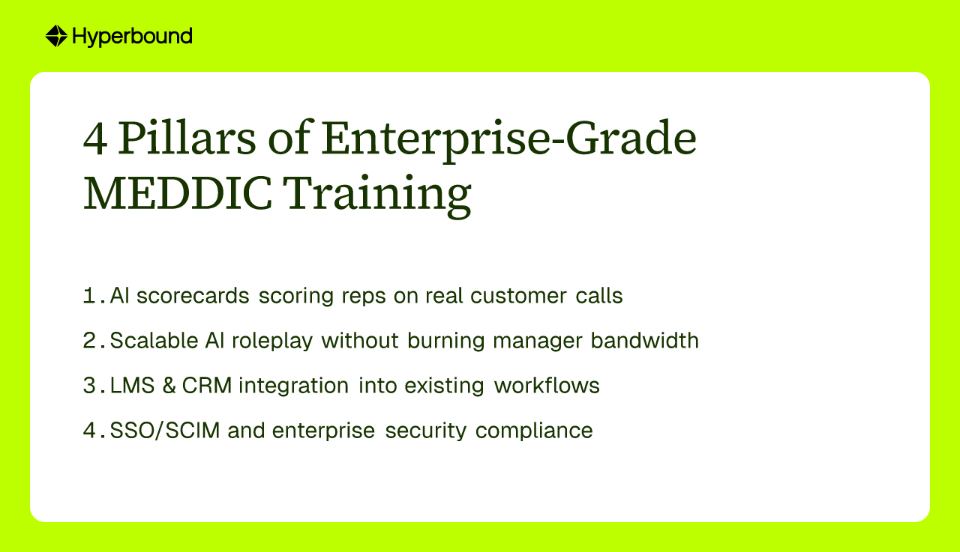
Theory without application is noise. Enterprise software must analyze actual customer conversations — integrating with popular call recording and dialer tools — and score reps against your custom MEDDIC criteria. This is the only way to know if the methodology is actually being used in the wild, not just in a training module.
Managers can't review every call. They can't ride along on every discovery. AI roleplay gives reps unlimited, safe "at-bats" to practice MEDDIC conversations — identifying the economic buyer, uncovering implicated pain, navigating a multi-stakeholder decision process — without burning live pipeline or pulling a manager into a Zoom room. Critically, the AI must be trained on real B2B sales data. Generic chatbot simulations don't prepare reps for the unpredictability of actual enterprise buyers.
Adoption dies when tools exist outside of daily workflows. Enterprise-grade MEDDIC training software needs deep CRM integration (Salesforce, HubSpot) and SCORM-compatible compatibility with leading LMS and sales enablement platforms so that practice is embedded where reps already work.
For any VP of Sales or RevOps leader bringing a new AI platform to their security team, compliance is a prerequisite. Look for SOC 2 Type II, GDPR, and ISO 27001 certifications at minimum, along with SSO and SCIM provisioning for seamless user management at scale.
Hyperbound is purpose-built for the enterprise adoption problem. It's not a content library, a call recorder, or an LMS. It's a closed-loop system that connects practice, real-world performance, and coaching activation — specifically designed so one enablement leader can drive consistent MEDDIC behavior across hundreds of reps.
The platform operates in three interconnected stages:
Practice: Master MEDDIC Conversations Before They're Live
Reps engage with AI buyer personas trained on 2M+ hours of real B2B sales conversations. These aren't generic voicebots reading from a script — they respond dynamically, push back on weak discovery, and simulate the kinds of complex multi-stakeholder scenarios that MEDDIC was designed for. A rep can practice navigating an economic buyer who's skeptical of ROI metrics, or run a multiparty call with both a champion and a technical decision-maker simultaneously.
AI Scorecards deliver instant, objective feedback after every simulation — tracking MEDDIC methodology adherence, talk ratios, key selling moments, and specific coaching areas. Bitesized Roleplays give tenured reps focused practice on a single skill without forcing them through a full-length generic certification they've already seen three times.
Perform: Score MEDDIC Adherence on 100% of Real Calls
Hyperbound Perform deploys AI scorecards on every actual customer conversation. It integrates directly with your existing call intelligence and engagement platforms and scores reps against your custom MEDDIC criteria — not just in simulations, but in live deals. This is where the "CRM theater" problem gets solved: you get objective data on whether your team is uncovering implicated pain, qualifying the economic buyer, and mapping the decision process — or just filling in fields after the fact.
The AI Deal Coaching layer goes one level deeper, looking across all calls in a single deal to surface what's helping or hurting the opportunity and recommending the next best action to keep the deal moving.
Kota Activate: Coaching at Scale Without Manager Dependency
Kota is Hyperbound's AI Revenue Analyst — the orchestration layer that sits above Practice and Perform. When Perform identifies a pattern of weak MEDDIC application on real calls (say, reps consistently failing to document Decision Criteria), Kota recommends targeted roleplay simulations to close that gap. It's a continuous improvement cycle: score real calls → identify skill gaps → assign personalized practice → score again.
This is what makes MEDDIC training software genuinely enterprise-grade: one enablement leader can surface methodology gaps across 300 reps, push personalized practice assignments, and measure whether behavior actually changed on the next real call — without requiring a manager to individually review each conversation.
Enterprise Validation:
The results speak for themselves. Vanta reduced sales ramp time by 60% — from 210 days down to 72 — while simultaneously growing the BDR team 4x and driving 5x pipeline growth. CRO Stevie Case credited Hyperbound's system for making that scale possible without a proportional increase in enablement headcount.
LinkedIn deployed Hyperbound across more than 3,000 sellers spanning three business units — LinkedIn Talent Solutions, LinkedIn Sales Solutions, and Sales Dev — across NAMER and EMEA, making it one of the largest enterprise rollouts of AI sales roleplay to date.
Enterprise Fit: SOC 2 Type II | GDPR | ISO 27001 | HIPAA compliant; SSO/SCIM; SCORM-compatible integrations with leading LMS and sales enablement platforms; CRM integrations with Salesforce and HubSpot; integrations with leading call intelligence and dialer platforms.
MEDDIC Academy, founded by methodology authority Darius Lahoutifard, is the official home of MEDDIC certification. It offers online courses, live workshops, and formal certifications at both individual and team levels. If your organization is starting from zero on MEDDIC knowledge and needs a credible, structured curriculum to establish shared language, MEDDIC Academy is the right starting point.
The limitation for enterprise teams is clear: it's an educational resource, not a technology platform. It provides the textbook. It doesn't provide the flight simulator, the ongoing enforcement mechanism, or the data layer to measure whether reps are applying the methodology in live deals. Think of it as the right foundation for MEDDIC knowledge — and a complement to, not a replacement for, a scalable practice and performance platform.
For teams running complex enterprise deals with long sales cycles and multiple stakeholders, the MEDDPICC expansion (which adds Paper Process and Competition to the core framework) provides a more complete qualification model. MEDDICC.com offers deep-dive content on each component, a MEDDPICC Masterclass, and an opportunity management operating system (mOS) for structured deal inspection.
Like MEDDIC Academy, it's primarily an educational and strategic resource. It helps reps understand the map — but it doesn't serve as the GPS for navigating live deals at scale. For enterprise teams, it works best as reference material paired with a software platform that can enforce and measure application across the full team.
Use this checklist when evaluating MEDDIC training software for an enterprise rollout. The right vendor should have clear, specific answers to all seven.
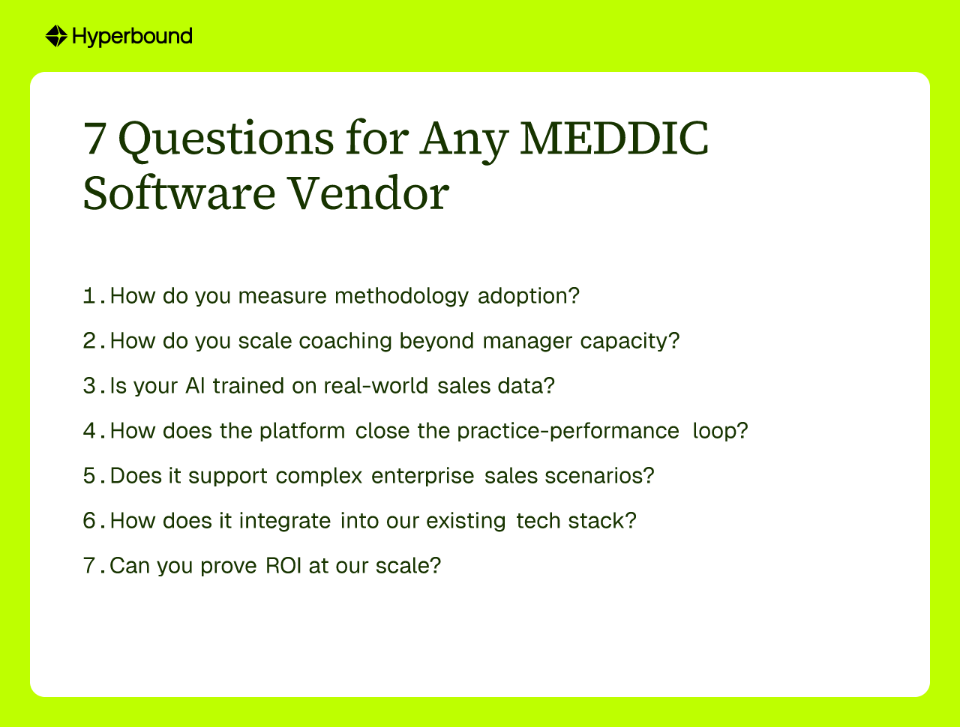
1. How do you measure methodology adoption? Does your platform score reps on real customer calls, or only in simulations? Simulation scores tell you what reps can do in a controlled environment. Real call scores tell you what they're actually doing with buyers.
2. How do you scale coaching beyond manager capacity? Can your platform automatically identify skill gaps from live deals and assign personalized practice exercises — without requiring a manager to manually review each call? If the answer is "managers get a dashboard," that's not scale.
3. Is your AI trained on real-world sales data? Are the AI roleplay personas built from analysis of actual B2B sales conversations, or are they based on generic scripts? Generic bots are easy to game and lose value quickly. Buyers should ask specifically how the vendor's AI was trained and what data it's based on.
4. How does the platform close the loop between practice and real performance? Is there a direct, automated workflow connecting poor performance on a real call to a targeted practice simulation? The gap between "we have roleplay" and "we have a closed-loop training system" is where most MEDDIC training software falls short.
5. Does it support complex enterprise sales scenarios? Can reps practice multi-stakeholder calls — simulating a champion and an economic buyer simultaneously? Can they share their screen to practice a full demo walkthrough? MEDDIC is designed for complex deals; the training environment should match that complexity.
6. How does it integrate into our existing tech stack? Specifically: Is it SCORM-compatible for your LMS? Does it have native CRM integrations with Salesforce or HubSpot? What is the security posture — SSO, SCIM, SOC 2 Type II, GDPR? For enterprise buyers, integration and security requirements are often the deciding factors.
7. Can you prove ROI with organizations of our scale? Ask for case studies from enterprise teams managing 100+ reps. Look for measurable outcomes: ramp time reduction, conversion rate improvement, pipeline impact. Vanta's 60% ramp reduction (210 → 72 days) and LinkedIn's 3,000+ seller deployment are the kinds of proof points that signal a platform built for enterprise — not just polished for a demo.
The Reddit thread that opened this article ends with one comment that cuts to the core of the issue:
"Sales methodologies die when they become a performance for management rather than a navigation system for the rep."
That's exactly what happens at most enterprise companies. MEDDIC gets implemented as a compliance layer — CRM fields get filled, pipeline reviews get survived, and actual deal-winning behavior never changes.
The platforms in this list exist to break that cycle. MEDDIC Academy and MEDDICC.com give teams the knowledge foundation. But knowledge alone doesn't change behavior at scale. For VPs of Sales and RevOps leaders managing 50 to 500+ reps, the missing piece is a system that enforces methodology on real calls, scales practice beyond manager bandwidth, and connects the two through automated coaching interventions.
That's the architecture Hyperbound was built to deliver — and why enterprises like Vanta and LinkedIn have deployed it across thousands of reps.
MEDDIC is a sales qualification framework designed for enterprise sales. It is an acronym for Metrics, Economic Buyer, Decision Criteria, Decision Process, Identify Pain, and Champion. The framework helps sales representatives accurately assess and navigate complex deals. Its expanded variant, MEDDPICC, adds Paper Process and Competition to provide even greater clarity in multi-stakeholder sales cycles.
MEDDIC adoption often fails in large teams because it becomes a compliance-driven CRM exercise rather than a practical tool for winning deals. Without a scalable system to enforce the methodology in real conversations, reps simply fill out fields to satisfy managers. Managers, in turn, lack the time to provide deep coaching on its application, focusing instead on CRM audits.
Enterprise-grade MEDDIC training software must go beyond simple courses and quizzes. Look for platforms that offer four key pillars: 1) AI-powered scorecards that analyze real customer calls, 2) Scalable AI roleplay for safe and repeatable practice, 3) Deep integration with your existing CRM and LMS, and 4) Robust enterprise security and compliance (like SOC 2, SSO, and SCIM).
AI roleplay provides sales reps with unlimited, on-demand opportunities to practice applying MEDDIC principles in realistic scenarios without risking live deals or consuming manager time. Unlike traditional roleplay, AI can simulate complex situations, like multi-stakeholder calls, and provide instant, objective feedback, allowing reps to master conversations around identifying the Economic Buyer or uncovering Decision Criteria at their own pace.
The primary difference is between knowledge and application. MEDDIC Academy provides the foundational knowledge and certification for the methodology (the "textbook"). Hyperbound is an enterprise technology platform that ensures the methodology is actually applied and adopted at scale through AI-powered practice, real-call scoring, and automated coaching (the "flight simulator" and performance analytics system).
You can measure the ROI of MEDDIC training software through key sales metrics that directly impact revenue. Track improvements in win rates, reductions in sales cycle length, and decreases in sales ramp time for new hires. Enterprise-grade platforms provide analytics to correlate methodology adoption with these performance outcomes, proving a direct link between the training investment and revenue growth.
Yes, leading MEDDIC training platforms like Hyperbound are designed to integrate seamlessly with your existing tech stack. They connect with popular call intelligence and engagement platforms to analyze real conversations, ensuring that performance scoring and coaching happen within your team's current workflow without requiring a disruptive change in tools.









Use Cases
Legal