
You spent months rolling out MEDDIC. The kickoff was energetic. Reps nodded along. Managers felt good about the investment. Six weeks later, forecasts are back to being gut feel, follow-ups live in people's heads, and when you ask someone to walk through a real deal, the answer starts with "it depends."
Sound familiar? You're not alone. As one sales rep put it bluntly on Reddit: "Reps fill out fields to make managers happy. Managers check boxes to survive pipeline reviews. Nobody actually uses it to decide the state of a deal."
The frustration runs deep. MEDDIC becomes a CRM exercise, not a sales methodology. Reps treat it like hard labor. And when the job of sales gets in the way of selling, people stop using the framework altogether. As another rep summarized it perfectly: "Sales methodologies die when they become a performance for management rather than a navigation system for the rep."
Here's the uncomfortable truth: the framework isn't broken. As the same Reddit thread concluded, "The frameworks are fine. The delivery mechanism is broken." The fix isn't another workshop, another certification, or another all-hands refresher. It's MEDDIC sales training software, like Hyperbound, that enforces the methodology on every single practice session, before reps ever get on a real call.
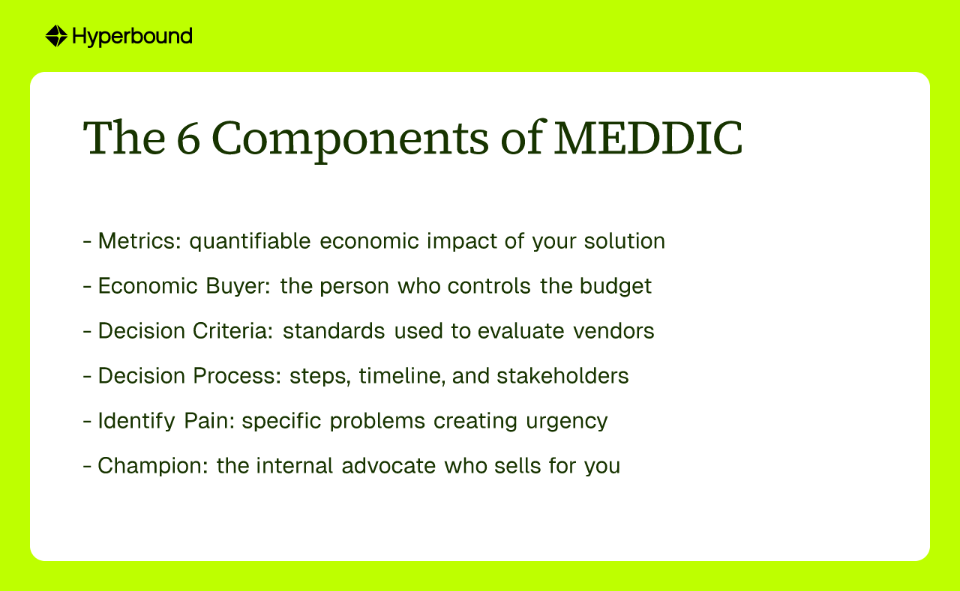
MEDDIC originated at PTC in the 1990s as a mental model for navigating complex B2B deals. The six components are:
When applied properly, MEDDIC can reduce forecast variance from 30-50% down to less than 10%. That's a dramatic improvement in pipeline predictability. So why does it so consistently fail in practice?
Two reasons.
The CRM compliance trap. When MEDDIC lives only inside Salesforce, it becomes a post-call data entry task. Nobody is tabbing over to their CRM mid-discovery call to think through deal strategy. The framework gets filled in retroactively, inaccurately, and reluctantly. As one rep described it: "It's literally a checkbox enforced by our PE firm, and I don't find it diagnostic in any way."
The coaching gap. Even when managers want to reinforce the methodology, most don't know how. As the Reddit thread observed, "Most sales managers don't know how to coach the methodology part; they only know how to audit the CRM part." They can tell you a field is blank. They can't tell you why a rep failed to uncover the Economic Buyer on the last discovery call.
The result? Manual tracking and ad hoc coaching produce inconsistent methodology adherence at best. Automated reinforcement systems, by contrast, create a consistent, measurable standard across every rep. That gap is where deals are lost.
The modern answer to methodology drift is configurable practice scorecards embedded directly into your sales training workflow. AI scorecards automatically evaluate sales conversations against your predefined methodology criteria and deliver immediate, personalized coaching feedback after every session.
This is what changes the game. Instead of waiting for a manager to spot-check a call recording three days later, reps get specific, objective feedback the moment a roleplay ends.
Think about what that looks like in practice: "You identified the Economic Buyer but failed to quantify pain. 3 opportunities missed." That's not vague praise or generic criticism. That's a precise diagnosis of what happened in that specific conversation, tied directly to the MEDDIC component the rep skipped over. It takes the guesswork out of coaching and puts the rep in the driver's seat of their own improvement.
A few features make this approach genuinely effective:
Total configurability. Hyperbound allows you to build scorecards for any framework your team uses, whether that's MEDDIC, MEDDPICC, SPICED, Challenger, or Sandler. Your scorecard reflects your exact playbook, not a generic template.
Instant feedback loops. Behavior change requires immediate reinforcement. When reps finish a roleplay and receive precise, methodology-aligned feedback within seconds, the connection between action and outcome is clear. They can practice again right away, applying the correction while the conversation is still fresh.
Data-driven objectivity. AI scorecards eliminate the human bias that often creeps into manager-led call reviews. Every rep is evaluated against the same criteria. Every missed opportunity is flagged consistently. There's no favoritism, no memory lapses, and no "well, they're usually pretty good at this" exceptions.
Hyperbound is built for organizations that need to standardize methodology coaching at scale, making it a strong fit for distributed or growing sales teams. Here's how it embeds MEDDIC into a rep's actual workflow rather than bolting it on as an afterthought.
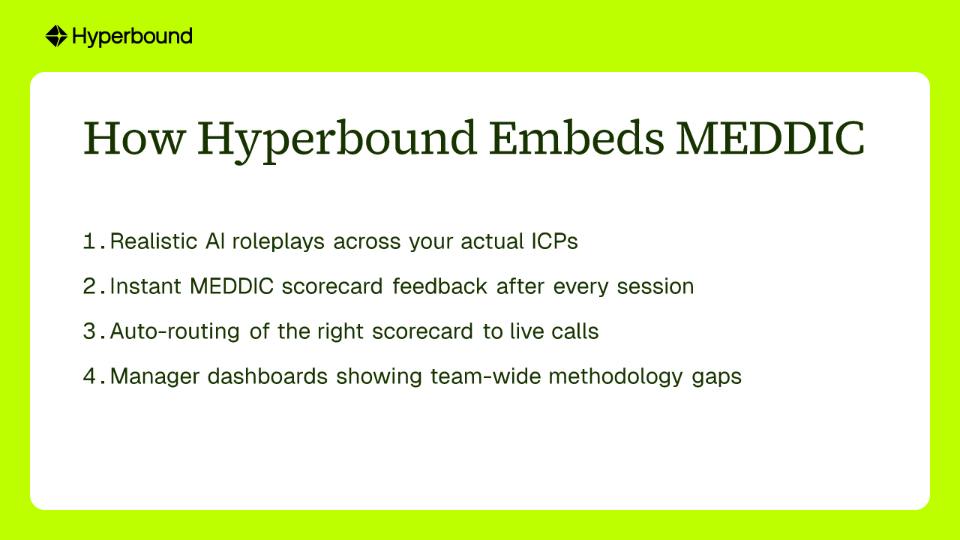
Step 1: Realistic roleplays. Reps practice in full-cycle AI roleplays that simulate real buyer conversations, from cold calls through demos and renewals. They can practice against any Ideal Customer Profile, which means the conversations feel true to their actual territory and buyer personas.
Step 2: Instant scorecard feedback. Immediately after each practice session, Hyperbound's Practice AI Scorecard grades the conversation against your MEDDIC criteria. It evaluates whether each component was addressed, flags weak responses, and calls out missed opportunities with specific, actionable language. Reps don't leave a session wondering how they did.
Step 3: Auto-routing on live calls. This is where practice connects to pipeline. For real customer conversations, Hyperbound automatically detects the meeting type based on the title and conversation content, then applies the correct scorecard. No manual tagging. No manager intervention required. The methodology is tracked on every important interaction without adding friction to the rep's day.
Step 4: Aggregate manager dashboards. Instead of auditing CRM fields, managers get a view of which MEDDIC components are weakest across the entire team. They can see trends at a glance: Are five reps consistently failing to establish Decision Criteria? Is one segment of the team struggling to identify a Champion? This kind of data makes coaching targeted and productive. Hyperbound allows managers to coach more reps with the same bandwidth by automating the identification and prioritization of coaching moments.
Methodology adherence is not an end in itself. It's a lever for revenue outcomes. When reps consistently apply MEDDIC across their pipeline, the downstream effects show up in ramp time, win rates, and deal predictability.
The CSO Insights 5th Annual Sales Enablement Study found a clear link between formal methodology implementation and improved win rates. But implementation alone isn't enough. It has to be reinforced consistently to deliver those results, which is exactly where software-based enforcement changes the equation.
Hyperbound's customers tell that story directly:
These aren't edge cases. They reflect what happens when methodology adherence is treated as a continuous practice, not a one-time training event. The correlation between consistent MEDDIC application and win rate improvement becomes measurable when you have the data infrastructure to track it.
The cycle is predictable. You invest in a MEDDIC rollout. The launch goes well. Six weeks later, reps are back to winging it, managers are back to auditing CRM fields, and your forecast accuracy looks exactly the same as it did before. The problem was never the framework. It was the absence of a system for consistent reinforcement.
The best MEDDIC sales training software doesn't just teach the methodology once. It enforces it on every roleplay, scores every live call against your criteria, routes the right scorecard to the right conversation automatically, and gives managers the aggregate visibility to coach with precision instead of guessing.
That's what separates a team that knows MEDDIC from a team that actually uses it. When a rep hears "you identified the Economic Buyer but failed to quantify pain" immediately after a practice session, that feedback sticks. When it happens after every session, it becomes instinct.
If you want MEDDIC to stick, stop treating it as a training event and start treating it as an operating system. Hyperbound gives you the enforcement layer your methodology has been missing: configurable scorecards, instant feedback, automatic routing on live calls, and manager dashboards that turn coaching from a guessing game into a data-driven practice.
The framework is ready. Now build the system that makes it impossible to ignore.

MEDDIC is a sales qualification framework that helps teams navigate complex B2B deals by focusing on six key components: Metrics, Economic Buyer, Decision Criteria, Decision Process, Identify Pain, and Champion. When used correctly, it creates a predictable pipeline and improves forecast accuracy by ensuring all critical aspects of a deal are thoroughly understood.
MEDDIC adoption often fails because it is treated as a CRM compliance task rather than a dynamic sales tool, and there is a significant gap in effective coaching. Reps fill out fields retroactively to satisfy managers, not to guide their sales strategy. This turns MEDDIC into an administrative burden instead of a navigation system for winning deals.
Software enforces MEDDIC by embedding it directly into a sales rep's workflow through automated practice, scoring, and instant feedback. Platforms like Hyperbound use AI roleplays where reps are evaluated against a configurable MEDDIC scorecard. They receive immediate, objective feedback after every session, reinforcing the methodology consistently and building the right habits before reps get on live calls.
The primary benefits of consistent MEDDIC adherence are improved forecast accuracy, higher win rates, and shorter sales cycles. By systematically qualifying opportunities, teams can reduce forecast variance from as high as 50% down to under 10%. This leads to a more predictable pipeline and better business outcomes, including significant increases in new-hire productivity and overall revenue.
Hyperbound integrates MEDDIC by providing realistic AI roleplay scenarios, instant scorecard feedback based on MEDDIC criteria, automatic scoring of live calls, and aggregate dashboards for managers. Reps practice against their specific customer profiles and get immediate, actionable feedback. The system then applies the same scoring to live calls, giving managers a clear view of team-wide methodology gaps for targeted, data-driven coaching.
Yes, this approach is effective for any sales methodology because the core technology is fully configurable. Platforms like Hyperbound allow you to build custom scorecards for any framework your team uses, whether that's MEDDPICC, SPICED, Challenger, Sandler, or a proprietary company methodology. The system enforces your specific playbook, ensuring consistency regardless of the chosen framework.










Use Cases
Legal