
You've mastered the MEDDIC acronym (Metrics, Economic Buyer, Decision Criteria, Decision Process, Identify Pain, Champion), but knowing the theory isn't the same as applying it effectively in high-stakes sales conversations.
Enterprise sales reps are always looking to "up their game," and while formal MEDDIC certification might help "sharpen your methodology," the $400+ price tag gives many pause. The real challenge isn't memorizing the framework—it's building the muscle memory to deploy it naturally during live calls.
Unfortunately, traditional roleplay methods fall short. Your manager doesn't have time for constant practice sessions, and peer roleplays often lack the consistency and objective feedback needed to improve. This leaves many reps feeling unprepared when it's time to execute MEDDIC principles in actual sales conversations.
This is where AI-driven practice becomes invaluable. While there's debate about the role of AI in context-based coaching, its value for deliberate practice is undeniable. In a controlled environment, it becomes a powerful tool for mastering frameworks like MEDDIC through repetition and instant feedback.
Below are 10 practical MEDDIC exercises you can practice with an AI roleplay partner to build confidence, improve outcomes, and close bigger deals—no certification required.
.png)
Before diving into exercises, let's quickly review the components of MEDDIC:
Challenge: Moving beyond features and benefits to articulate specific, quantifiable value (ROI) is difficult for many reps. This exercise helps you uncover the metrics that truly matter to your prospect's business.
Common Objections:
How to Practice with AI: Hyperbound's AI Sales Roleplays allow you to practice with personas programmed to be vague about their business metrics. The platform's customizable AI-Powered Scorecards track whether you successfully identified and quantified at least two key metrics during the conversation.
This provides a safe space to practice turning qualitative pain points into quantitative business cases—a core tenet of MEDDIC methodology. You can repeat the exercise with different industry scenarios until you've mastered the art of metrics discovery.
Challenge: Sales cycles often stall because reps engage with influencers or users, not the person who controls the budget. Identifying and gaining access to the true Economic Buyer (EB) is critical to MEDDIC success.
Key Questions to Practice:
Common Objections:
How to Practice with AI: Set up an AI roleplay where you're talking to an influencer or potential Champion. The goal is to skillfully map the organization and identify the EB without alienating your current contact. The AI can be programmed to respond as a gatekeeper, allowing you to practice navigating these common roadblocks.
Practice tailoring value propositions specifically for an EB, who cares about strategic objectives, P&L, and ROI—not just features and functionality.
Challenge: Prospects often provide generic technical requirements, but the real skill is uncovering hidden, often political or personal, decision criteria that truly influence the final choice.
Key Questions to Practice:
Common Objections:
How to Practice with AI: Create AI scenarios where the buyer persona has a pre-existing bias toward a competitor or a strong preference for their current tech stack. Practice asking questions that uncover these biases and allow you to reframe the criteria around your unique strengths.
Hyperbound's AI Coaching can provide instant feedback on your questioning technique—did you accept the surface-level criteria, or did you dig deeper to find what truly matters?
Challenge: Deals slip because reps don't have a clear understanding of the prospect's internal procurement, legal, and sign-off processes.
Key Questions to Practice:
Common Objections:
How to Practice with AI: Simulate a mid-stage sales call where the goal is to confirm the decision and paper process. The AI can be programmed to be unfamiliar with the process or to try and delay the conversation.
Practice framing these "operational" questions in a way that demonstrates experience and helps the prospect feel you are guiding them to a successful outcome. Use customizable scenarios to model different company sizes with varying levels of bureaucratic complexity.
Challenge: Identifying a surface-level problem is easy. The skill is to "implicate" the pain by exploring its negative consequences across the business, creating a powerful sense of urgency to act.
Key Questions to Practice:
Common Objections:
How to Practice with AI: Roleplay discovery calls where the AI persona downplays their business pain. Your task is to use implication questions to uncover the true cost of inaction.
Practice responding to deflections like "not interested" with follow-ups such as "Any reason for not being interested?" to probe for underlying pain. Hyperbound's AI Real Call Scoring can analyze your roleplay to see if you successfully moved the conversation from a problem to its quantifiable business impact.

Challenge: Many reps mistake a friendly contact for a true Champion who has the influence and personal motivation to sell for you internally. A Champion must be identified and tested.
Key Questions to Practice:
Common Objections (from a weak or non-Champion):
How to Practice with AI: Create a scenario where you believe you have a Champion. The exercise is to ask testing questions to confirm their influence and willingness to act. Practice co-creating a plan with your "Champion" to navigate their organization, brainstorm differentiators, and prepare for key meetings.
The AI can simulate the Champion getting cold feet, allowing you to practice re-selling them on the vision and reinforcing their personal win.
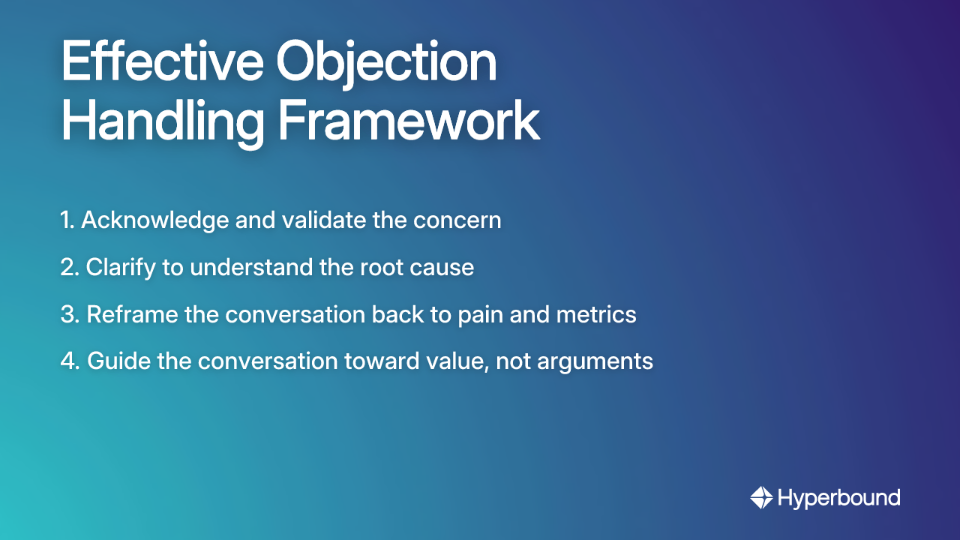
Challenge: Reps often react defensively to objections or use "canned responses" that "demonstrate to the prospect you actually have no desire to understand their actual situation." Effective objection handling requires empathy and reframing.
Key Objections to Practice:
Best Practices to Practice:
How to Practice with AI: Use Hyperbound's AI Sales Roleplays to get unlimited "at-bats" against the most common objections. Program the AI to be persistent. Remember, the goal isn't to "win" the argument but to practice de-escalating and guiding the conversation back to value. As one sales pro puts it, "You can't tell someone they're wrong and then think they will buy from you."
Challenge: Clearly articulating your unique value proposition when a prospect is actively evaluating competitors or is happy with an incumbent.
Key Questions to Practice:
Common Scenarios:
How to Practice with AI: Set up roleplays where the AI persona is a staunch advocate for a specific competitor. Practice positioning your solution without bad-mouthing the competition. Focus on your unique differentiators as they relate to the prospect's specific Decision Criteria and Pain.
Challenge: When the finish line is in sight, reps often give away unnecessary discounts under pressure, eroding deal value.
Key Scenarios to Practice:
Techniques to Practice:
How to Practice with AI: Hyperbound's AI can simulate a tough procurement officer or a budget-focused EB. Practice holding firm on your price and trading for concessions. Run scenarios where you have to walk away from a bad deal, helping you understand that not every deal is a good deal.
Challenge: Learning from mistakes and successes is crucial, but self-assessment is difficult, and manager feedback is a bottleneck.
Key Questions for Self-Review:
How to Practice with AI: After each roleplay session, use Hyperbound's AI Real Call Scoring and AI Deal Summary features to review your performance. The AI provides an objective analysis of your talk ratio, whether you covered key MEDDIC elements, and how you handled objections.
This creates a continuous feedback loop: practice with AI, get scored by AI, identify weak spots, and then launch a new roleplay to work on that specific skill. This is how "real learning happens on the job"—or in a simulation that's the next best thing.
Mastering the MEDDIC framework isn't about passing a test; it's about building the conversational habits and strategic thinking that close complex deals. Consistent, deliberate practice is the only way to achieve mastery.
AI-powered sales coaching platforms like Hyperbound remove the traditional barriers to practice, making it scalable, objective, and available 24/7. Stop theorizing and start practicing. Empower yourself to master MEDDIC not just in theory, but in every real-world sales conversation.

With these 10 exercises, you can build competence and confidence in applying the MEDDIC methodology—without the certification price tag. The key is consistent practice in a realistic environment with objective feedback, which modern AI tools can now provide more effectively than ever before.
MEDDIC is a sales qualification framework designed for complex, enterprise-level sales. It is an acronym that stands for Metrics, Economic Buyer, Decision Criteria, Decision Process, Identify Pain, and Champion, representing the key areas a sales representative must understand to effectively manage and close a deal.
Practicing MEDDIC is crucial because it helps sales representatives build the "muscle memory" needed to apply the framework naturally in live sales calls. While knowing the theory is helpful, consistent practice turns the framework from a checklist into an intuitive part of a salesperson's conversational toolkit, leading to better qualification, forecasting, and higher close rates.
AI can help you master MEDDIC by providing a safe, scalable, and objective environment for deliberate practice. AI-powered roleplay tools, like Hyperbound, allow you to run unlimited scenarios targeting specific MEDDIC components (e.g., identifying the Economic Buyer), receive instant, unbiased feedback on your performance, and repeat exercises until you achieve mastery, all without needing to schedule time with a manager.
No, a MEDDIC certification is not required to successfully apply the framework. While certification can help formalize your understanding, the key to success is practical application and skill development. Consistent practice, especially with AI roleplay tools, can build the necessary confidence and competence more effectively and affordably than a certification course alone.
The Champion and the Economic Buyer are two distinct and critical roles in a sales process. A Champion is an internal advocate who has a personal stake in your solution's success and will sell on your behalf within their organization. The Economic Buyer, on the other hand, is the individual with the ultimate financial authority to approve the purchase and sign the contract; they control the budget.
Identifying 'Pain' in MEDDIC creates urgency by connecting a surface-level problem to its broader business consequences. The goal is not just to find a problem but to "implicate" the pain by quantifying its negative impact on metrics like revenue, productivity, or customer satisfaction. This transforms the conversation from a "nice-to-have" solution to a "must-have" initiative that demands immediate action.









Use Cases
Legal