You've put in weeks of work on a promising deal. Multiple calls, custom demos, and even the prospect seemed excited. Then suddenly... silence. They're ghosting you. No responses to your emails or calls. Another deal slipping through your fingers.
If this scenario feels painfully familiar, you're not alone. As one sales professional noted, the key challenge is knowing "whether the deal you are working on is actually the real deal or just a bunch of time wasters and tire kickers."
That's where sales qualification frameworks like MEDDIC and MEDDPICC come in - battle-tested methodologies that help you identify real opportunities and stop wasting time on deals destined to go nowhere.
A qualification framework is your systematic approach to evaluating sales opportunities, ensuring you invest your precious time in prospects who are most likely to buy. It's the difference between being busy and being productive.
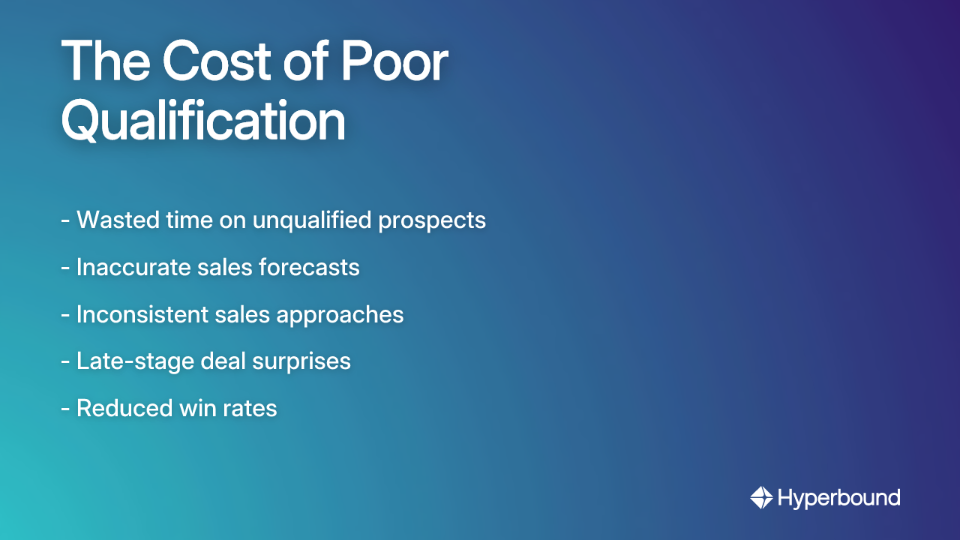
Without a structured qualification process, you risk:
According to studies, sales teams using formal qualification methodologies like MEDDIC report 28% higher win rates than those without structured approaches.
MEDDIC was created in 1996 by Dick Dunkel at PTC when the company needed a consistent way to identify winnable deals. The framework transformed their sales process and has since become a staple in B2B sales organizations.
Let's break down each component:
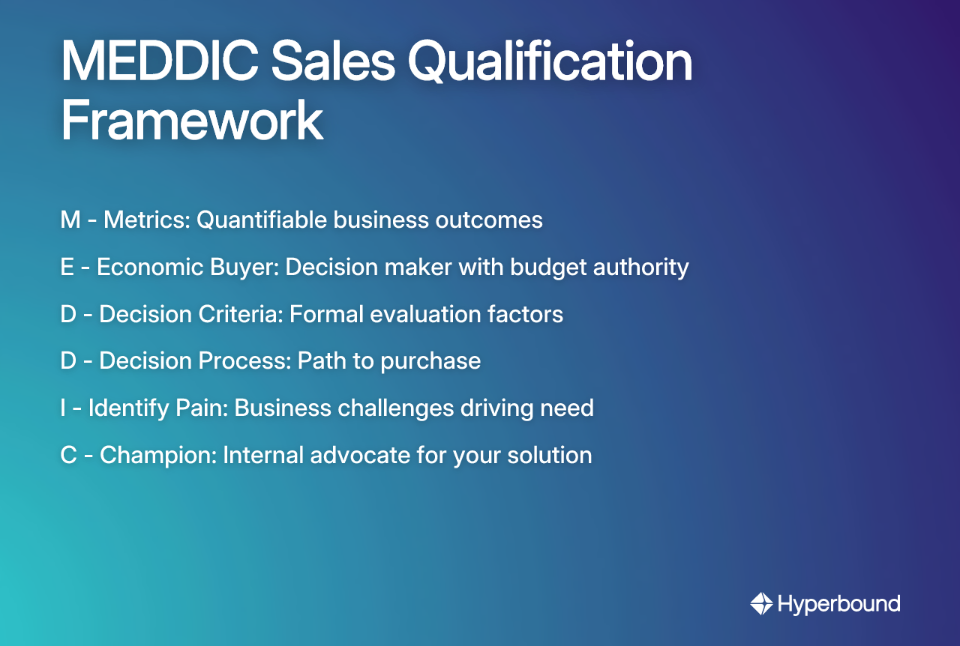
What it is: The quantifiable business outcomes your solution delivers. How will the customer measure success?
Why it matters: Metrics provide the logical justification for the emotional decision to purchase. They answer the crucial question: "How will we know this investment paid off?"
Example: A client wants to reduce customer churn. Your solution's Metric is demonstrating a potential 15% reduction in churn rate, translating to $1.2M in preserved annual revenue.
Natural conversation starter: "When we look back on this project in a year, what specific numbers would need to have improved for you to consider this a success?"
What it is: The person with ultimate budgetary authority who can say "yes" when everyone else says "no" (or "no" when everyone says "yes").
Why it matters: Without access to this decision-maker, your deal can be vetoed at the last minute.
Example: While the VP of Marketing champions your solution, the CFO is the Economic Buyer who must approve the unbudgeted expense.
Natural conversation starter: "Besides yourself, who typically reviews and approves investments of this size? Would it make sense to include them in our discussions early on?"
What it is: The formal factors the organization will use to evaluate potential solutions - their "shopping list."
Why it matters: Understanding these criteria lets you position your solution to meet or exceed them. Better yet, if you're early in the process, you can help shape these criteria to favor your solution's strengths.
Example: Technical criteria (must integrate with Salesforce), business criteria (must show ROI within 6 months), and vendor criteria (must have enterprise-level support).
Natural conversation starter: "What specific boxes does a solution need to check for you to move forward with it? What would make one option stand out from others?"
What it is: The step-by-step path an organization follows to make purchasing decisions. Who needs to be involved, what are the stages, and what's the timeline?
Why it matters: Navigating this process effectively is crucial for accurate forecasting and closing deals efficiently.
Example: A typical process might include technical validation, business case development, security review, legal approval, and final sign-off. Your job is to map who owns each step.
Natural conversation starter: "To make this as smooth as possible for you, could you walk me through how your team typically evaluates and decides on a new partner like us?"
What it is: The significant business challenges driving the need for your solution.
Why it matters: Pain creates urgency. Without it, prospects can indefinitely delay making a decision.
Example: Surface pain: "Our sales reporting is manual and time-consuming." Implicated pain: "Because reports take so long, we miss early warning signs of deal problems, resulting in a 22% drop in quarterly close rates and missed targets."
Natural conversation starter: "What happens if this problem isn't solved in the next 6 months? What's the real cost to the business if things stay as they are?"
What it is: A powerful, credible advocate inside the prospect's organization who is personally invested in your success and actively sells on your behalf when you're not there.
Why it matters: Your champion provides internal intelligence, helps navigate politics, and advocates for your solution.
Example: A Director of Operations who will personally benefit from your solution's success and has influence with the executive team.
Natural conversation starter: "Who else in the organization do you think would benefit most from solving this problem? Would you be comfortable introducing me to them?"

As B2B sales grew more complex, MEDDIC evolved into MEDDPICC by adding two crucial elements that often determine whether deals succeed or stall:
What it is: The series of steps, documents, and approvals required to get a contract signed after the decision to buy has been made.
Why it matters: This is where many deals die a slow death. Understanding procurement, legal review, and contract signing processes prevents late-stage surprises.
Example: The process might involve security questionnaires, Master Service Agreements (MSAs), data processing agreements, and multiple levels of signature authority.
Natural conversation starter: "Assuming we get to a point where this makes sense for both of us, what does the contracting process typically look like at your company? What departments get involved?"
What it is: Any person, vendor, or initiative competing for the same limited resources (budget, time, attention).
Why it matters: Competition isn't just other companies selling similar solutions; it can be the status quo, an internal build, or even unrelated projects competing for budget.
Example: Your primary competitor isn't another vendor but rather the prospect's belief that they can solve the problem with internal resources.
Natural conversation starter: "What other approaches are you considering to solve this challenge? How are you thinking about build vs. buy decisions?"
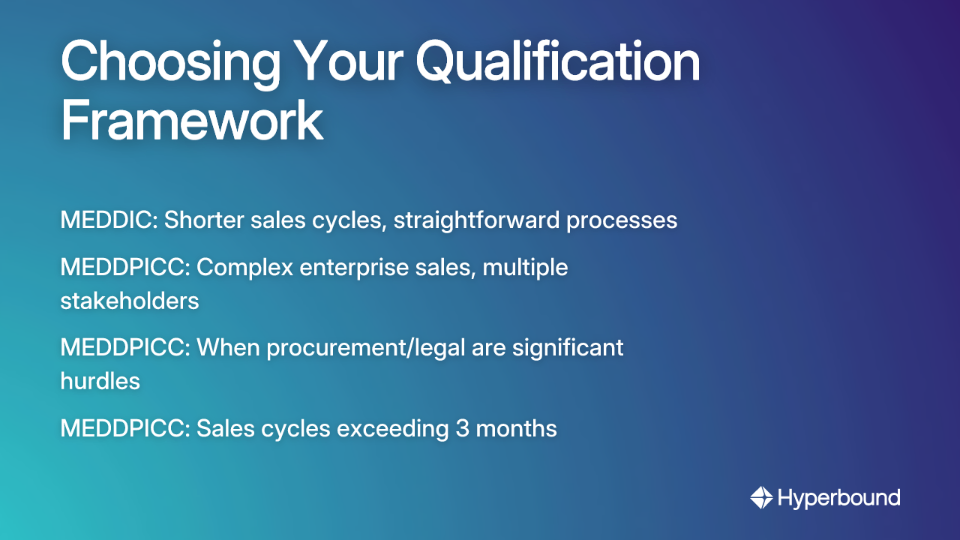
The choice depends on your specific sales environment:
Use MEDDIC when:
Use MEDDPICC when:
In today's increasingly complex B2B environment, MEDDPICC often provides the additional rigor needed for successful qualification, especially in solution selling and enterprise contexts.
The biggest criticism of frameworks like MEDDIC and MEDDPICC is that they can make salespeople sound robotic or interrogative. The key is weaving these qualification elements into consultative conversations that focus on value selling rather than procedural sales.
Here's how to transform each component from interrogation to conversation:
The mirror technique is particularly effective here – reflecting back what you've heard shows you're listening while subtly confirming qualification details.
Many sales leaders misuse MEDDPICC by treating it as a rigid checklist for their CRM rather than a framework for discovery. The solution is focusing on the quality of information, not just filling in blanks. This is where AI coaching can make a difference. Instead of just checking if a field is filled, tools like Hyperbound's AI Real Call Scoring can analyze actual conversations to see if reps are effectively applying the framework, turning MEDDPICC into a true coaching opportunity. Remember, it's a thinking tool, not just a reporting tool.
Start your discovery with clear agreements about what you'll discuss and what happens next. Give prospects permission to say no – it's better to disqualify early than waste time on deals that won't close. As one sales professional put it, "Upfront contracts changed my game completely."
A friendly contact who gives you information (a coach) is not the same as someone with power who actively advocates for you (a champion). Test your champions by asking them to take specific actions on your behalf. Their willingness and ability to deliver reveals their true status.
MEDDPICC works best when combined with other proven approaches:
Whether you choose MEDDIC or MEDDPICC, implementing a structured qualification framework transforms your sales approach in three critical ways:
The difference between average salespeople and top performers often comes down to qualification discipline. As one sales leader observed, "The best discovery call questions I've ever heard were all based on the MEDDPICC framework."
Start small – on your next discovery meeting, focus on identifying just the Metrics and the Pain. Notice how much deeper your conversation goes and how much clearer your opportunity becomes. Then gradually incorporate the remaining elements.
Your pipeline will thank you, your forecast will improve, and those ghosting prospects will become a thing of the past.
The primary difference is that MEDDPICC adds two extra components: 'Paper Process' (P) and 'Competition' (C). These additions help salespeople navigate the complexities of modern B2B sales, specifically the contractual and procurement hurdles (Paper Process) and the full competitive landscape, which includes internal solutions and the status quo (Competition).
Using a sales qualification framework like MEDDIC or MEDDPICC is important because it helps sales teams focus their efforts on deals that are most likely to close, leading to higher win rates and more accurate forecasting. It provides a systematic approach to evaluating opportunities, preventing wasted time on unqualified prospects and ensuring consistency across the sales team.
To use MEDDPICC naturally, integrate its principles into consultative, value-focused conversations rather than treating it as a checklist. Instead of asking "What are your decision criteria?", try a more conversational approach like, "To make sure we're on the right track, could you share what factors are most important to your team when evaluating a new partner?" The goal is to guide the conversation to uncover the MEDDPICC elements organically.
A Champion is an influential advocate who actively sells on your behalf internally, while a Coach is a friendly contact who provides information but lacks the power to influence the deal's outcome. A true Champion is personally invested in your solution's success and has the credibility to influence key decision-makers. A coach might give you useful insights but won't risk their political capital for you.
It is better to use MEDDPICC for complex enterprise sales with long cycles, while MEDDIC is often sufficient for simpler, high-velocity sales environments. MEDDPICC provides the extra rigor needed when you face significant procurement and legal hurdles (Paper Process) and a crowded competitive landscape (Competition). If your average sales cycle is over three months and involves multiple stakeholders, MEDDPICC is the more appropriate framework.
The Economic Buyer is the individual with the ultimate authority to approve the budget and can veto the decision. You can identify them by asking questions about the approval process for investments of a similar size, such as, "Who typically needs to give the final sign-off on initiatives like this?" The Economic Buyer is often a C-level executive or department head focused on the strategic impact of the purchase.

Remember: Qualification isn't about filling in CRM fields. It's about developing a genuine understanding of your prospect's situation so you can determine if and how you can truly help them succeed.









Use Cases
Legal