
Your new VP just walked in and asked a question that made your stomach drop: "Can you show me exactly how our sales training is impacting revenue?"
If you've been in sales enablement for more than a week, you know this feeling. You've run workshops, built certification programs, and rolled out new playbooks. Reps completed the courses. Managers signed off. And yet — when someone asks you to prove it worked, you're left staring at a completion rate dashboard that tells you absolutely nothing about whether your training actually changed rep behavior, improved deal execution, or accelerated ramp time.
Here's the uncomfortable truth: as one sales ops professional put it, "the gap is you're measuring coaching… but not behavior change on calls." The internet is full of articles telling you how to train your reps. Almost none of them tell you how to know if it's working.
That's the gap this article closes.
The science backs up the urgency. Research consistently shows that 80% of training content is forgotten within 30 days without reinforcement and measurement built into the learning system. You're not just dealing with a measurement problem — you're dealing with a retention problem that compounds every time a new hire ramps up or a new product launches.
This article gives you a 3-layer measurement model to close that gap:
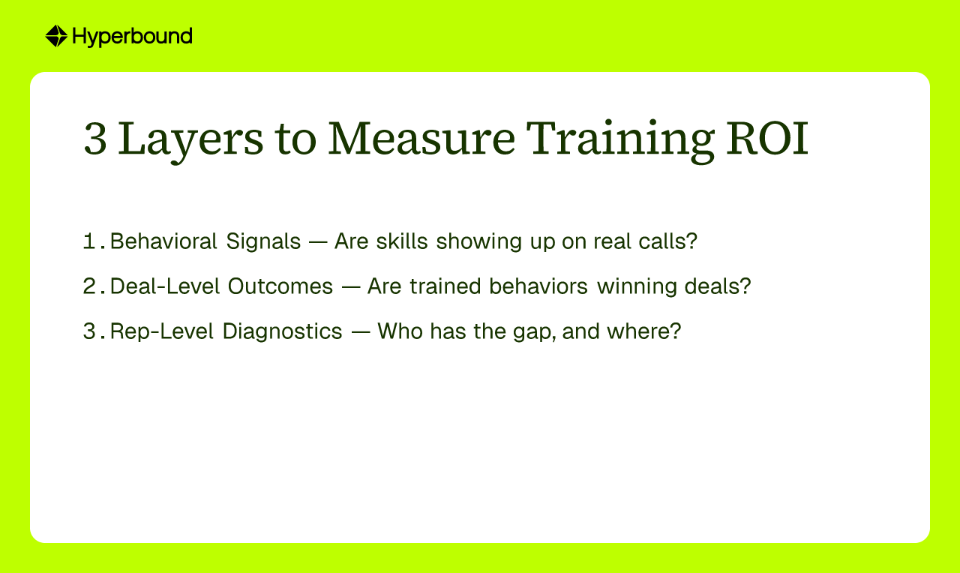
Let's break each one down.
Most teams measure training using the Kirkpatrick Model — a four-level framework that moves from Reaction → Learning → Behavior → Results. In theory, it's solid. In practice, the vast majority of organizations only ever reach Level 1 (did reps like the training?) or Level 2 (did they pass the quiz?).
That's not measurement. That's false comfort.
The problem gets worse when you layer in common assessment methods:
The result is what one sales trainer described on Reddit: "It's tough to see what actually caused an increase or decrease in sales." You end up with noisy data that can't tell you whether training moved the needle or whether quota attainment this quarter was just a market tailwind.
The solution isn't better surveys. It's a fundamentally different measurement architecture.
This framework connects training directly to revenue outcomes.
Behavioral signals are your leading indicators. They don't tell you whether a deal closed — they tell you whether trained behavior is showing up in real conversations before you see the revenue impact.
This is the layer most teams completely skip.
What to measure:
AI Scorecard Adherence Rate — How consistently are reps following your prescribed methodology (e.g., MEDDPICC, value-based selling) on live calls? Manual call review captures less than 1% of conversations. AI scorecards change that by scoring every call against your playbook automatically.
Roleplay Score Trends — Track each rep's performance in simulated environments over time. Are scores improving week-over-week after training? Stagnation here is a leading signal that the training isn't converting to skill.
Behavior Adoption Rate — A clean formula from Federico Presicci's sales training metrics framework:
Behavior Adoption Rate = (Number of Reps Observed Using New Behavior ÷ Total Reps Observed) × 100
Knowledge Lift — While not sufficient on its own, pre/post assessment scores give you a baseline:
Knowledge Lift = Post-Training Assessment Score − Pre-Training Assessment Score
Use Knowledge Lift as a floor, not a ceiling. A rep can ace a quiz and still bungle every discovery call.
How Hyperbound operationalizes Layer 1:
Hyperbound Perform deploys AI scorecards across 100% of your real calls — using the native Hyperbound Call Recorder or by pulling from other platforms like Gong, Salesloft, and Chorus. Unlike tools that analyze calls in isolation, Perform rolls up behavior signals across all touchpoints in a deal, giving you a fuller picture of how trained skills are (or aren't) showing up.
Hyperbound Practice runs on the other side of the loop — giving reps a risk-free environment to build the skills before they show up on live calls. Analytics track roleplay score trends over time, so managers can see skill development in motion rather than guessing at it.
The loop: real call data from Perform flags a behavioral gap → rep goes into Practice to drill it → their next real call is scored again. That's a measurement system, not a measurement hope.

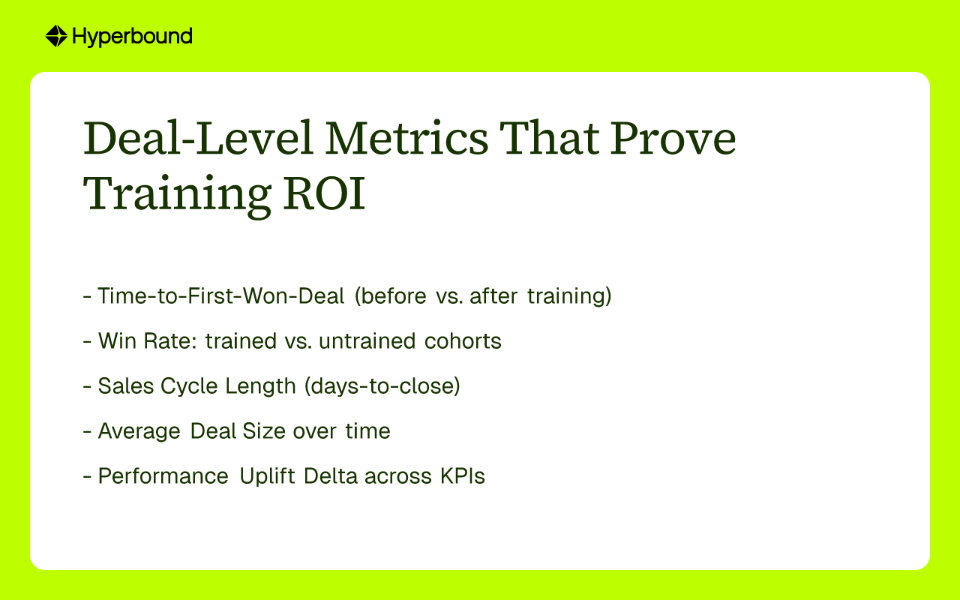
Behavioral signals tell you if reps are using the skills. Deal-level outcomes tell you whether those skills are working. This is where training measurement crosses into revenue measurement — and where leadership starts paying attention.
As one r/SalesOperations contributor put it: "You just need to show better training is better rep behavior that leads to better conversions." Layer 2 is exactly that proof.
What to measure:
Time-to-First-Won-Deal (Before vs. After Training) — One of the most direct measurements of training ROI for new hires. If reps trained on your new discovery framework are closing their first deal 3 weeks faster than the previous cohort, that's not a coincidence — that's a result.
Win Rate (Trained vs. Untrained Cohorts) — Compare win rates for reps who completed targeted training versus those who didn't. Even a 3–5% lift in win rate at scale represents significant revenue.
Sales Cycle Length — Are improved objection handling and champion-building skills accelerating deal velocity? Track average days-to-close before and after training rollout.
Average Deal Size — Better discovery and value-selling skills should translate to larger contracts. Track this over time across trained cohorts.
Performance Uplift Delta — Another clean metric from Federico Presicci:
Performance Uplift Delta = Trained Group KPI − Untrained Group KPI
Apply this to any of the metrics above. The delta is your training ROI.
What this looks like in practice — the Nivoda result:
Nivoda, a B2B diamond marketplace, needed to accelerate rep ramp time and improve early-stage conversion. By connecting training directly to behavioral measurement and deal-level outcomes, Director of Sales Performance Rob Rangel achieved:
This is the model. Behavioral training isn't a soft investment — it's a lever with measurable, revenue-tied outcomes when you build the measurement infrastructure around it.
Layers 1 and 2 tell you what is happening across the team. Layer 3 tells you who has a specific gap and exactly where in the sales process it lives. This is where measurement turns into targeted, scalable coaching.
This layer directly solves two of the most painful realities in sales enablement:
As one practitioner noted: "You can't put a spreadsheet together that proves a 1:1 session actually worked." Layer 3 is the antidote.
How to run rep-level diagnostics:
Correlate scorecard data with deal outcomes. Identify reps with low adherence on specific playbook elements (e.g., competitor handling, multi-threading, pricing conversations) who also have higher-than-average deal slippage or churn. The intersection of behavioral weakness and commercial impact tells you exactly where to coach.
Analyze roleplay data for consistent failure points. Is a rep strong in the opener but consistently missing the ask for next steps? Does another rep nail discovery but collapse under pricing objections? Simulation data reveals this before it costs you a deal.
Build competency-based cohorts. Group reps who share the same gap — say, everyone struggling with executive-level discovery — for targeted workshops. This is a scalable way to lift entire segments of a team without burning manager time on generic all-hands sessions.
How Kota Activate orchestrates this layer:
Kota Activate is Hyperbound's AI assistant that sits above Practice and Perform — analyzing performance data across your entire team simultaneously. A manager can ask Kota directly in Slack: "Which AEs are struggling to articulate our pricing model on late-stage calls?" and get an answer grounded in actual call and roleplay data, not anecdote.
But Kota doesn't just report. It acts. It can automatically assign a targeted Bite-Sized Roleplay to the struggling rep — a short, focused simulation built around the exact scenario where they're losing momentum. The rep practices. Their next real call gets scored. The cycle repeats.
This is what Hyperbound calls "Revenue Activation" — not just surfacing insights, but operationalizing them into behavior change.
The three layers aren't sequential — they're a flywheel. Here's what the full cycle looks like in practice:
This loop makes sales training knowledge retention a system rather than an event. Research makes this clear: without consistent reinforcement and behavioral measurement built into the workflow, training doesn't stick. The 80% forgetting curve isn't a rep failure — it's a systems failure.
For each stakeholder in your organization, this framework answers a different question:
Every sales training program needs three things to actually work: delivery, reinforcement, and measurement. Most teams have the first. Some have the second. Almost none have the third in a form that connects to revenue.
The 3-layer framework — Behavioral Signals, Deal-Level Outcomes, and Rep-Level Diagnostics — is the architecture that closes that gap. It moves you from asking "Did they complete the course?" to asking "Did the training change what reps do on calls in ways that win more deals?"
That's the question your VP is actually asking. That's the question leadership will always ask. And now you have a framework to answer it with data.
The 3-layer framework is a model designed to directly connect sales training to revenue outcomes. It consists of:
Measuring rep behavior is better because it focuses on application and impact, not just consumption. A high course completion rate doesn't guarantee that reps have retained the knowledge or can apply it effectively in real-world scenarios. By analyzing on-call behaviors, you can see if the training actually changed how reps sell, which is the necessary link to improving deal outcomes.
AI can dramatically improve sales training measurement by providing scale, objectivity, and speed. AI tools can analyze 100% of sales calls to score reps against your sales methodology, eliminating the manual effort and bias of traditional call reviews. This allows you to identify behavioral trends, pinpoint specific skill gaps at the individual and team level, and automatically recommend or assign targeted coaching.
The most critical metrics connect behaviors to outcomes. Start with a leading indicator like AI Scorecard Adherence Rate to see if skills are being used. Then, connect this to lagging, deal-level indicators like Win Rate (for trained vs. untrained cohorts), Sales Cycle Length, and Time-to-First-Won-Deal for new hires. The goal is to show a direct correlation between the adoption of trained behaviors and improvements in key revenue metrics.
While more labor-intensive, you can measure effectiveness without AI by implementing a structured manual review process. This involves using a standardized scorecard for managers to review a sample of recorded calls, conducting regular roleplay sessions with clear grading rubrics, and manually tracking deal-level metrics for cohorts of trained reps in your CRM. The key is to maintain consistency in evaluation and systematically track the data over time.
Leading indicators are predictive metrics that measure the adoption of new skills and behaviors before the final results are in. An example is the "Behavior Adoption Rate" on live calls. Lagging indicators are output-focused metrics that measure past results, such as "Win Rate" or "Average Deal Size." A strong measurement framework uses leading indicators to understand if the training is being applied and lagging indicators to prove it's delivering financial results.
If you want to see how this loop works in practice — from scoring real calls to identifying skill gaps to routing reps into targeted practice and measuring the improvement — explore how Hyperbound's Revenue Activation Platform brings all three layers together in one continuous cycle.










Use Cases
Legal