
You invest significant time and resources into role playing for sales training, but can you answer a simple question: Is it actually working?
This is the challenge that haunts sales leaders everywhere. While nearly everyone agrees that role playing is valuable for developing sales skills, most organizations struggle to measure its effectiveness in a way that connects practice scenarios to tangible business outcomes.
"We're overwhelmed by excessive metrics and analysis leading to inaction," admitted one sales director in a recent Reddit discussion about sales KPIs. This sentiment echoes across the industry—leaders want clear data on training effectiveness without overcomplicating the process.
The problem is clear: Traditional role play assessment is subjective, inconsistent, and disconnected from real-world performance. When feedback relies solely on a manager's gut feeling, you're left without concrete data to prove ROI or identify specific skill gaps across your team.
This article provides a framework to move beyond subjective feedback to objective measurement, helping you track the effectiveness of your role playing exercises and connect them directly to improved win rates, shorter sales cycles, and increased revenue.
Before we dive into solutions, let's understand why measuring role play effectiveness has been so challenging:
In traditional role playing for sales training, assessment quality varies dramatically based on who's evaluating:
This inconsistency means reps receive conflicting feedback and organizations lack standardized benchmarks for performance improvement.
Manager-led role plays are inherently time-intensive. It's simply impossible for sales managers to:
Without consistent, repeatable practice and reinforcement, reps forget approximately 70% of what they learn within a week of training. Without measurement, you can't determine if the skills taught are actually being retained and applied.
Perhaps most critically, traditional role play assessment fails to draw a straight line from practice sessions to actual sales performance. This disconnect makes it nearly impossible to justify the time and resources invested in role playing activities to executive leadership.
Effective measurement starts with designing role plays that have clear, objective criteria. You can't measure what you haven't defined.
Here's a step-by-step approach to crafting role plays built for measurement:
.png)
Create a detailed buyer persona that closely matches your Ideal Customer Profile (ICP). Define:
Define the specific objective for the sales rep in concrete terms. Examples include:
Provide detailed context that mirrors real-world situations:
Create a binary (yes/no) scoring system for core competencies. For example:
Include the top 3-5 objections your team faces in the real world to test their handling skills:
Moving beyond simple "pass/fail" evaluations, here are specific metrics that provide actionable insights into role playing effectiveness:
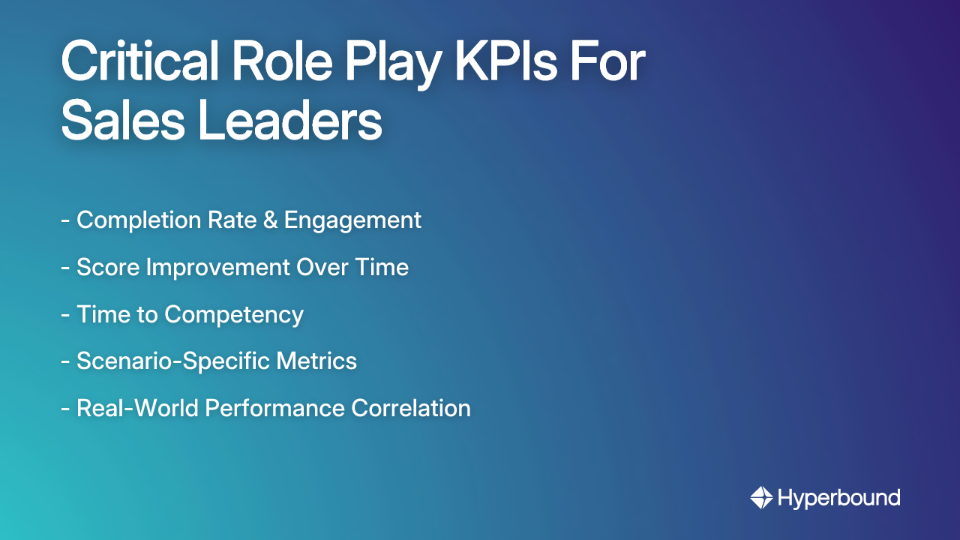
Different types of role plays require different measurement approaches:
As one sales leader noted on Reddit, "Most of this nonsense overcomplicates things." Traditional measurement approaches often create more work than value. This is where technology, specifically AI, transforms the equation.
Hyperbound's AI-powered platform solves the core challenges of manual role play assessment by providing:

The ultimate goal is to see if practice translates to reality. This is where tools like Hyperbound's AI Real Call Scoring come in, by:
With AI-powered measurement, managers are no longer just listeners; they become strategic coaches who can:
As one sales professional bluntly stated on Reddit, "Renewals, upsells, contracts signed, and revenue should be the end all be all." This section addresses how to connect your role playing metrics directly to these business outcomes.
Before implementing a structured role play program, get a baseline of your key business metrics:
Use a platform like Hyperbound to track the role play KPIs mentioned earlier, particularly focusing on:
After 60-90 days of consistent role playing and tracking, compare the two sets of data to test hypotheses such as:
Frame your measurement approach as a relationship between:
By improving the leading indicators through targeted role playing, you can reliably influence the lagging indicators that matter most to the business. This creates a compelling narrative for executives who care primarily about bottom-line results.
Effective measurement of role playing for sales training is not just possible—it's essential for building a high-performing sales team in today's competitive environment.
The key takeaways:
As sales environments become increasingly complex, the ability to systematically measure and improve role playing effectiveness will separate leading organizations from those left behind. With the right framework and tools, you can transform role playing from a subjective exercise into a data-driven engine for sales performance improvement.
Stop guessing if your sales training is working. Start measuring.
You can make role plays more measurable by creating a structured framework with objective, binary (yes/no) winning criteria. This involves preparing detailed buyer personas and realistic scenarios, setting clear goals for the rep (e.g., "book a discovery call"), and defining specific success metrics like successfully handling a key objection or maintaining a target talk-to-listen ratio. Moving away from subjective "gut feelings" to a defined scorecard is the first step toward effective measurement.
The most important KPIs include completion rates, score improvement over time, time to competency for new hires, and scenario-specific metrics like objection-to-next-step conversion rates. Foundational metrics like completion rates show engagement, while tracking score improvements demonstrates skill development. For specific scenarios, you should measure outcomes like the number of pain points uncovered in a discovery call or the successful repositioning rate when a competitor is mentioned.
Measuring role-play effectiveness is crucial because it connects training activities directly to tangible business outcomes and proves the ROI of your sales coaching efforts. Without objective measurement, role-playing remains a subjective exercise. By tracking specific metrics, you can identify skill gaps across your team, provide targeted coaching, and demonstrate to leadership how improved role-play scores (leading indicators) lead to better win rates and shorter sales cycles (lagging indicators).
AI improves sales role-play by providing objective, consistent scoring at scale and offering instant, personalized feedback without requiring a manager's presence. Unlike manager-led sessions, which can be subjective and time-consuming, an AI platform can score every session against a consistent methodology. This allows reps to practice far more frequently, receive immediate feedback to accelerate learning, and frees up managers to focus on strategic coaching rather than repetitive evaluations.
You can connect role-play performance to business outcomes by correlating improvements in role-play scores (leading indicators) with changes in your key sales metrics (lagging indicators) over time. First, benchmark your current performance on metrics like conversion rates, average deal size, and win rates. Then, track improvements in role-play KPIs over a 60-90 day period. By analyzing the data, you can prove the direct impact of training on revenue.
You can increase sales team engagement by making role-playing a valuable, low-pressure learning tool rather than a high-stakes performance evaluation. Using AI for practice allows reps to fail and learn in a safe environment without feeling judged by a manager or peers. When reps see that practice is directly tied to improving their real-world calls and their commission checks, they are far more likely to see it as a valuable tool for their own success.











Use Cases
Legal