
You ran the training. You tracked completions. You sent the follow-up survey. And when the CFO asks, "Did it work?" — you're stuck staring at a dashboard full of numbers that don't tell the story you need to tell.
This is the sales training accountability crisis, and it's more common than most enablement leaders want to admit. As one RevOps practitioner put it in a widely-shared Reddit thread: "most teams don't have a metric problem; they have a decision problem... lots of numbers, very few that are wired to actual moves."
The problem isn't a lack of data. It's that most sales training ROI software measurement approaches stop at activity metrics — completions, quiz scores, attendance rates — and never connect to the numbers a CFO actually cares about: win rates, ramp time, revenue per rep, and CAC payback period.
Meanwhile, research consistently shows that sales leaders can verify training took place but struggle to show how it translates to financial metrics that matter to the C-suite. Add in the fact that 80% of training content is forgotten within 30 days, and suddenly the ROI case gets even harder to make.
The fix isn't a better spreadsheet. It's a structured, three-stage measurement framework that connects training activity to business results — with automation doing the heavy lifting.
Think of measuring training ROI in three distinct layers:
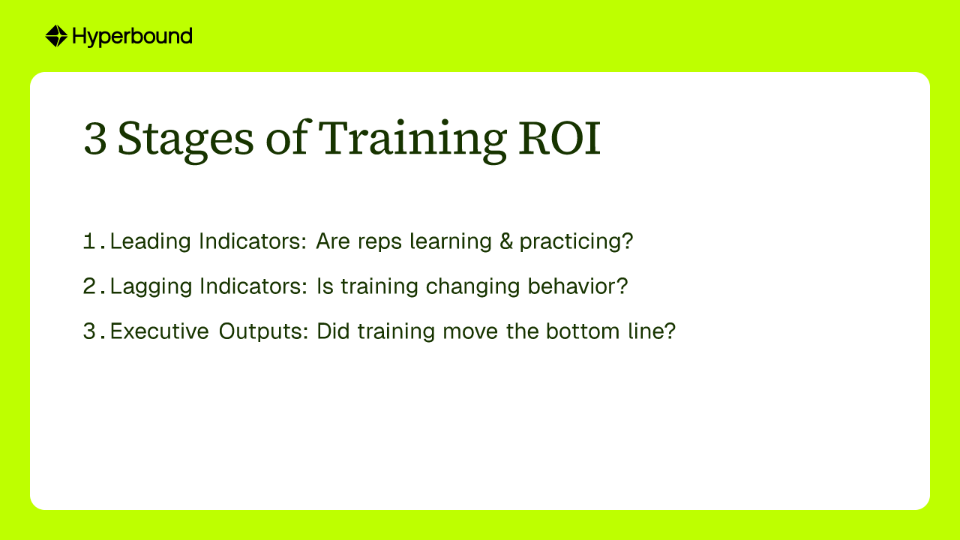
Each stage builds on the previous one. Better leading indicators predict better lagging indicators, which drive better executive outputs. Without the chain, you're just reporting vanity numbers. With it, you have a defensible story — one that justifies your budget and earns your seat at the revenue table.
Leading indicators are predictive metrics. They tell you — right now, before you lose a deal — whether reps are equipped to execute. They give you time to correct course.
The three most important ones:
1. Completion Rates Table stakes. Did reps finish the assigned modules? This tells you if training is being taken seriously but tells you nothing about whether it's working.
2. Assessment and Scorecard Grades A step further — did reps understand the material? Scored assessments move you from measuring attendance to measuring comprehension. But they're still not enough on their own.
3. Roleplay Performance This is the metric that matters most at this stage. Can a rep apply the skill in a simulated high-pressure conversation? Roleplay scores are the first real test of practical readiness — and the closest proxy you have to performance before a rep touches a live deal.
The problem? Manually running and scoring roleplays across a team of 50+ reps is impossible without the right infrastructure.
This is where Hyperbound Practice comes in. Hyperbound's AI roleplay platform lets reps practice cold calls, discovery, objection handling, and demos against AI buyer personas built from 2M+ hours of real B2B sales conversations — not generic scripts. Every session is automatically scored using AI Scorecards that track talk ratios, key selling moments, and methodology adherence.
Instead of burning pipeline while learning, reps can fail safely, get instant objective feedback, and certify on new messaging before they talk to a single prospect. For teams launching a new product or rolling out a competitive playbook, Hyperbound Certifications ensure every rep can actually articulate the value proposition — measurably and at scale.
Lagging indicators measure what already happened. They confirm whether the skills practiced in training are actually being used — and winning — in real deals. They're retrospective by nature, which means you need leading indicators to give you early warning. But they're the proof that moves a CFO.
1. Ramp Time (Ramp-to-First-Win) How long does it take a new rep to close their first deal? As one RevOps leader noted, the misalignment between projected and actual ramp-up times is one of the most expensive operational blind spots a sales org can have. Effective training should shorten ramp time — and if it doesn't, your content isn't translating to live conversations.
For context: Vanta used Hyperbound to achieve a 60% ramp reduction, cutting time-to-productivity from 210 days down to 72.
2. Win Rate Delta Track win rate changes for a specific cohort of reps after a training intervention — not org-wide, but for the exact segment where you deployed the program. Isolating the variable is what makes this a credible metric rather than a coincidence. A consistent uptick in win rate for certified reps versus non-certified reps is the kind of proof that ends budget conversations.
3. Deal Velocity / Time-in-Stage Are deals moving through the pipeline faster? Track time-in-stage for the specific stages where your training focused — if you ran objection-handling training, are deals moving through the technical evaluation stage more quickly? If stage conversion drops from 35% to 15% in a segment, that's not a reporting problem. That's a messaging or skill problem — and you should be fixing it this week.
The challenge here is that most teams measure training in one system and deals in another. The connection between "rep scored 88 on discovery roleplay" and "rep's discovery calls are now producing 20% more qualified opps" doesn't happen automatically.
Hyperbound Perform bridges that gap. Unlike call-level coaching tools that analyze conversations in isolation, Perform rolls up insights across all touchpoints in an entire deal — from the first cold call to the closing conversation. It surfaces deal-level coaching insights and flags early risk signals while they're still actionable.
After a training on champion building, for example, Perform can score live calls to see whether reps are successfully identifying and enabling champions — and flag the deals where they aren't before those deals go cold.
Having roleplay scores and win rate data in separate silos is better than nothing — but it's not enough. The real power comes from connecting them in a feedback loop that runs continuously, without requiring a manager to manually pull reports.
The operational cycle looks like this:
Score Real Calls → Identify Skill Gaps → Practice Roleplays → Score Again
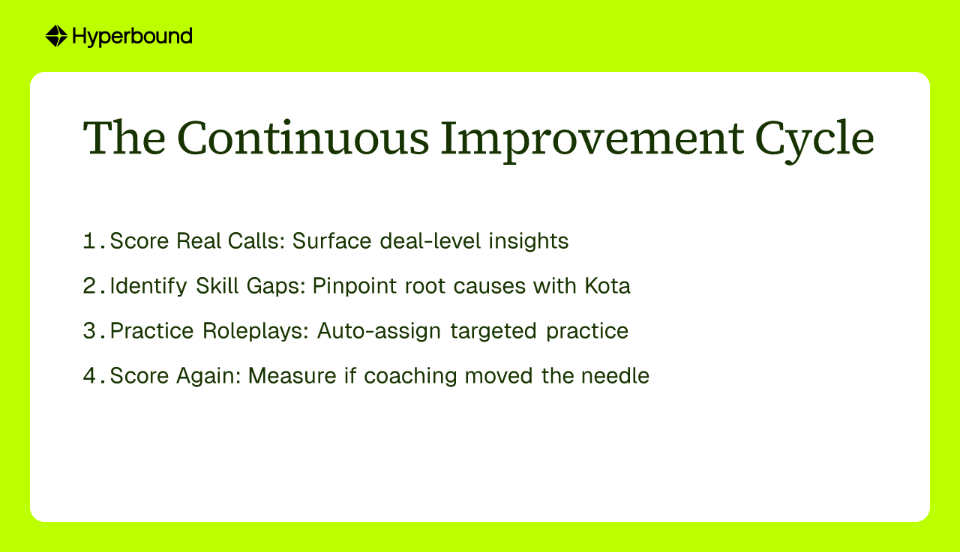
This automated cycle replaces weeks of manual analysis. Hyperbound customers have reported saving 3.5 workweeks of coaching time through this loop — time managers can redirect toward the conversations that actually require human judgment.
This is where your measurement framework becomes a business case. Stage 3 metrics are what the CFO is actually asking about — and they're only credible if you've built the foundation in Stages 1 and 2.
1. Revenue per Rep The North Star for sales productivity. When ramp time shortens and win rates improve, the revenue contribution of each individual seller increases. If you can show that certified reps generate $X more per quarter than non-certified counterparts, that number speaks for itself in any budget conversation.
2. CAC Payback Period How quickly does your company recoup the cost of acquiring a customer? Shorter ramp times and higher rep productivity mean you're recouping that investment sooner — improving capital efficiency in a way that's deeply relevant to CFOs, especially in SaaS businesses where CAC payback directly affects unit economics and growth runway.
The logical chain is clear: better roleplay scores (Stage 1) → higher win rates and faster ramp (Stage 2) → greater revenue per rep and shorter CAC payback (Stage 3). Each stage is the mechanism that drives the next.

To solve the accountability crisis for good, stop presenting a 30-slide deck and start bringing a one-page ROI Readout into every budget review. Here's the structure:
.png)
One page. Six numbers. A clear before-and-after story your CFO can read in 60 seconds.
The catch? Manually compiling this data across a disconnected stack of tools — your LMS, CRM, a separate call recorder, and a content-only enablement tool — is a full-time job. By the time you've assembled it, the budget meeting is over.
With Hyperbound's Revenue Activation Platform, this data is produced automatically. Kota Activate connects the dots between Practice (roleplay scores, certifications) and Perform (real call behavior, deal outcomes) so you can pull your ROI Readout on demand — directly from Slack. No spreadsheets, no chasing RevOps for exports, no scrambling the night before a board review.
The most effective method is to use a three-stage measurement framework that connects training activities to business outcomes. This framework begins by tracking leading indicators (like practice and certification scores), links them to lagging indicators (like on-field behavior and win rate changes), and ultimately ties them to executive outputs (like revenue per rep and CAC payback period).
Traditional measurements often fail because they focus solely on activity metrics, such as course completion rates and quiz scores. While easy to track, these numbers don't prove that training has changed a rep's on-the-job behavior or impacted bottom-line results like revenue, which is what the C-suite and financial leaders care about.
Leading indicators are predictive metrics that measure if reps are learning and can apply new skills, while lagging indicators measure past performance to confirm if those skills were used effectively in real deals. For example, a high score on an AI roleplay is a leading indicator of readiness, while an increase in the win rate for those reps a quarter later is a lagging indicator of success.
AI improves measurement by providing a scalable and objective way to assess skill application before reps interact with live prospects. AI roleplays, for instance, can automatically score a rep's performance on a new talk track, providing an immediate, data-driven leading indicator of their readiness and connecting practice to real-world performance data without manager bias.
A CFO is most concerned with executive-level metrics that directly impact the company's financial health. The most important metrics include revenue per rep, CAC (Customer Acquisition Cost) payback period, improvements in win rates, and reductions in sales cycle length. These outputs show a clear, financial return on the training investment.
To prove causation, you must isolate the variable by comparing a trained group of reps against a control group that did not receive the specific training. By tracking the win rate delta between the "certified" cohort and the "non-certified" cohort for similar types of deals, you can build a credible case that the training intervention was the primary driver of the performance lift.
The companies winning the enablement ROI argument aren't the ones with the best training content. They're the ones with the measurement infrastructure to prove it. Hyperbound's Revenue Activation Platform transforms sales enablement from a cost center into a measurable, repeatable revenue driver — with the data to back it up every single quarter.
Ready to automate your ROI Readout? See how Hyperbound works →









Use Cases
Legal