
You've invested in a hospitality sales training workshop. Your team attended, the facilitator got great reviews, and everyone walked out energized. Then six weeks later, you check the numbers — and booked room nights, group sales, and corporate account conversion look exactly the same.
Sound familiar?
If you're a hotel L&D manager or VP of Sales, this scenario is painfully common. And the frustration runs deeper than just "the training didn't work." As one learning leader put it in a candid online discussion: "It's tough to see what actually caused an increase or decrease in sales." Market fluctuations, seasonality, a competitor opening nearby — there are always a dozen variables ready to muddy the water.
Meanwhile, management isn't particularly interested in hearing about engagement scores or workshop satisfaction ratings. As one practitioner bluntly stated: "Managers don't care about training. They care about improved performance." And yet, the tools most L&D teams rely on — post-training surveys, self-assessments, smile sheets — measure exactly the wrong thing. They tell you if people liked the training, not if it changed anything.
The core problem isn't your training program. It's your measurement strategy.
To actually prove (and improve) the ROI of your hospitality sales training, you need to stop relying on lagging revenue indicators and start building a layered framework that connects learned behaviors to pipeline momentum to revenue outcomes. The standard formula is a useful starting point:
ROI (%) = [(Net Profit from Training – Training Cost) ÷ Training Cost] × 100
But accurately calculating "Net Profit from Training" is where most programs fail. The fix is a structured, 3-tier framework — and the infrastructure to make each tier measurable.
Think of this framework as three connected lenses — each one validating the next. Behavior drives pipeline. Pipeline drives revenue. If you're only looking at revenue, you're flying blind on the other two.
.png)
This is the most critical and most commonly skipped layer of hospitality sales training ROI measurement. It answers a deceptively simple question: Are your reps applying what they learned on real calls?
As one training professional put it: "It doesn't matter how good your training is — if they aren't doing it on the job, it doesn't matter."
Behavior metrics are your leading indicators. If these don't move after training, nothing downstream will either. The key metrics to track include:
Tracking these metrics manually is nearly impossible at scale. That's where Hyperbound becomes essential infrastructure.
Establishing a Baseline with Hyperbound Practice: Before training begins, have reps run through AI-powered roleplay simulations of common hospitality scenarios — negotiating a group rate, handling a corporate pricing objection, converting an inquiry call into a site visit. Hyperbound Practice's AI Scorecards provide objective, instant feedback on talk ratios, objection handling, methodology adherence, and key selling moments. This gives you a data-driven baseline for every rep before a single training dollar is spent.
Measuring Application with AI Real Call Scoring: Post-training, Hyperbound's AI Real Call Scoring deploys AI scorecards on 100% of real prospect calls — automatically. You can see, in concrete numbers, whether objection handling adherence improved from 40% pre-training to 75% post-training. No guesswork. No survey fatigue. Just behavioral data tied directly to real conversations.

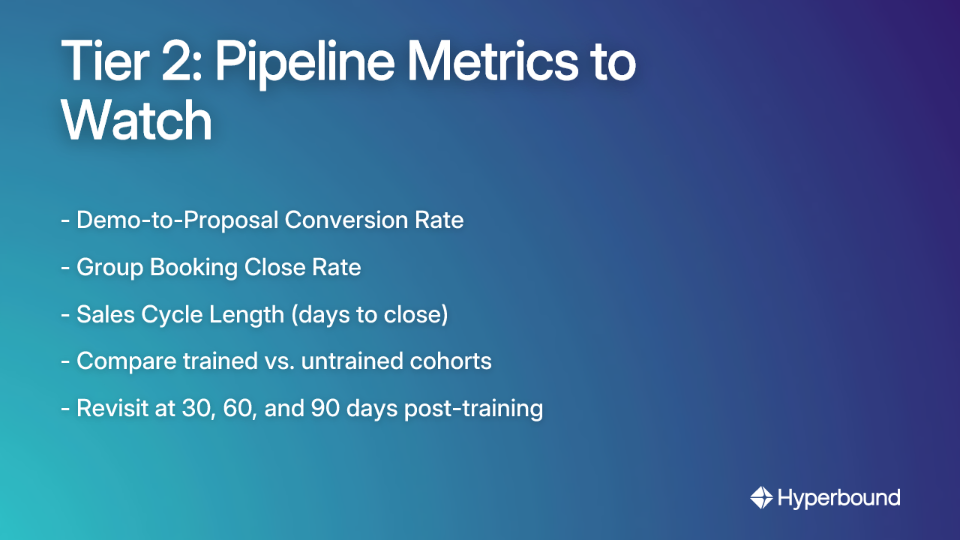
Once you can see that reps are executing skills differently, the next question is: Is it moving deals forward? Pipeline metrics connect improved behaviors to measurable progress in your sales funnel. If Tier 1 is moving in the right direction, you should start seeing Tier 2 shift within 30–60 days.
Key pipeline metrics to track for hospitality sales training ROI:
The key to measuring these accurately is establishing a control group benchmark: track pipeline metrics for trained reps vs. a comparable cohort of untrained reps, and revisit the data at 30, 60, and 90 days post-training. Your CRM is your source of truth here — which is why making sure your reps are actually logging activity is a prerequisite for any ROI measurement effort.
This is the layer your CFO and General Manager actually care about. These are lagging indicators — they take longer to materialize — but they're the ultimate proof of whether your hospitality sales training investment paid off.
Key revenue metrics to track:
ADR × Occupancy Rate. By segmenting the contribution of your trained sales team versus baseline performance, you can attribute RevPAR lift directly to the program.The critical discipline here is attribution. You won't be able to claim that 100% of a RevPAR increase came from training — and claiming so will undermine your credibility. Instead, focus on differential performance: the gap between trained reps and your baseline, over a consistent timeframe, controlling for market variables as much as possible.
.png)
A 3-tier framework is only valuable if the data feeds back into your training program. Measurement without action is just reporting. The real ROI unlock comes from building a continuous improvement loop — and that requires infrastructure that connects all three tiers.
Here's how Hyperbound's Score → Identify → Practice → Activate loop works in practice for hospitality sales teams:
This model isn't theoretical. The outcomes it drives are validated across industries with analogous sales complexity:
These aren't outliers. They're the predictable result of connecting training to measurable behavior, and behavior to pipeline outcomes — which is exactly what this framework is designed to do.

Investing in hospitality sales training without a clear measurement strategy is like renovating a hotel without a blueprint. You're spending real money with no way to know what worked, what didn't, or what to do next.
By adopting the 3-tier framework — tracking behavior change, pipeline movement, and revenue outcomes — and using technology like Hyperbound to make the "soft skills" measurable and traceable, you can transform your training program from a recurring cost center into a predictable engine for booked room nights, group sales growth, and corporate account wins.
The key shift is this: stop treating training ROI as something you calculate after the program ends. Start treating it as something you design from the beginning — with baseline metrics, clear benchmarks, and a closed-loop system that tells you exactly what's working in real time.
The primary difficulty in measuring hospitality sales training ROI is over-reliance on lagging indicators like revenue, which are influenced by many external factors like seasonality and market changes. This makes it difficult to isolate the training's true impact. To get an accurate picture, you must also measure leading indicators, such as changes in sales rep behavior on actual calls and subsequent improvements in pipeline momentum.
The 3-tier framework measures training effectiveness by connecting learned behaviors to business outcomes in three sequential layers: Behavior Change, Pipeline Metrics, and Revenue Outcomes. Tier 1 (Behavior) tracks if reps are applying new skills on calls. Tier 2 (Pipeline) measures if these new behaviors are moving deals forward (e.g., higher conversion rates). Tier 3 (Revenue) assesses the final financial impact (e.g., increased RevPAR or booking value).
The most critical behavior metrics to track are Call Quality Scores, Talk Ratios (listening vs. talking), and Objection Handling Adherence. These metrics provide objective data on whether reps are actually using the methodologies they were taught. For example, tracking if a rep uses a specific technique to handle pricing objections shows direct application of the training, which is a powerful leading indicator of future success.
You can prove training effectiveness early by focusing on Tier 1 (Behavior) and Tier 2 (Pipeline) metrics, which are leading indicators that shift faster than revenue. Within 30-60 days, you can demonstrate improvements in call quality scores and talk ratios (Tier 1). Shortly after, you can show a corresponding lift in pipeline metrics like demo-to-proposal conversion rates or a shorter sales cycle (Tier 2). These early data points build a strong case for the training's eventual impact on revenue.
AI helps measure sales training ROI by automating the analysis of sales conversations at scale, providing objective data on behavior change. Tools like Hyperbound use AI to score 100% of real sales calls against a predefined scorecard, tracking metrics like methodology adherence and objection handling. This replaces manual call reviews and subjective feedback with consistent, data-driven insights, making it possible to accurately measure Tier 1 behavior metrics before and after training.
To isolate the impact of training, you should compare the performance of the trained group against a baseline or a control group of untrained reps over the same period. By measuring the differential performance between these two groups across all three tiers (behavior, pipeline, and revenue), you can more accurately attribute the lift to your training program. This approach helps control for external variables like market upswings, seasonality, or new competitor activity.
Ready to stop flying blind? Use this free scorecard template to establish your baseline metrics across all three tiers before your next training initiative — and set clear, defensible benchmarks for what success looks like.
What's included:
.png)
Copy this table into a spreadsheet, populate your pre-training baselines before the program launches, and revisit it at each interval. This single document will give you everything you need to build a compelling business case — whether you're justifying last quarter's investment or securing budget for the next one.
If you want to see what the continuous measurement loop looks like in practice — with AI scorecards running on real calls and roleplay analytics tracking skill development — explore Hyperbound's platform and see how teams are already using it to turn training investment into measurable revenue outcomes.










Use Cases
Legal