Summary
- MCP is an open standard that enables any AI agent to securely access company tools and data, creating a universal connector across vendors.
- Adopting MCP shifts sales enablement from content retrieval to performance support, enabling agents to pull account notes, risk signals, and guidance in real time.
- Governance is the key barrier: roughly 50 percent of MCP adopters cite security complexity as a top challenge, and ungoverned content makes agent errors faster and harder to trace.
- Revenue teams should prioritize structuring and governing sales knowledge before connecting agents, ensuring content is versioned, owned, approved, and scoped.
- Hyperbound is building its Revenue Activation Platform as a governed knowledge foundation for agentic sales, using MCP as a foundational component.
MCP for Sales: Why Your Knowledge Has to Be Ready Before You Connect Anything
Sales teams have more AI tools than ever, but each tool operates in a separate environment. Sales teams might work with Microsoft Copilot, marketing teams with ChatGPT, and operations teams with Gemini. Every agent needs access to the same product knowledge, pricing guidance, and competitive intelligence, but there is currently no standard method for providing it. Knowledge that lives in one agent's workflow is invisible to every other.
The Model Context Protocol (MCP) is the open standard designed to close that gap. MCP is a universal connector that enables any AI agent to securely reach a company's tools and data. With MCP, any agent can connect to an organization's approved knowledge, whether that is its CRM, content library, or playbooks, and act on it in real time. Anthropic donated MCP to the Linux Foundation's new Agentic AI Foundation (AAIF), the same neutral body that stewards Linux and Kubernetes. The protocol was co-founded with Block and OpenAI, and carries the backing of Google, Microsoft, and AWS. ChatGPT, Cursor, Gemini, and Microsoft Copilot have already adopted it. Within its first year, the protocol reached more than 10,000 active public MCP servers.
For revenue teams, this is an operational decision about how sales knowledge gets built and governed.
From content retrieval to performance support
The traditional model of sales enablement stores content in a library and requires reps to locate what they need before a call. That model does not support agentic workflows.
When an agent is connected to live systems via MCP sales tools, the workflow shifts from content retrieval to performance support, as sales enablement analyst James Barton describes. For a renewal call, an agent can review account notes, detect risk signals from recent call recordings, retrieve negotiation guidance, select a relevant customer story, draft a meeting plan, and generate a follow-up email, without a rep navigating a single folder.
This capability is the logical outcome of connecting governed knowledge to agents over a reliable, open standard.
The productivity evidence is already visible outside sales. Block reports that its employees save 50 to 75 percent of time on common tasks when using MCP-powered tooling. MCP server downloads grew from roughly 100,000 to over 8 million between November 2024 and April 2025, an increase of approximately 8,000 percent. Enterprise adoption is measurable: 80 percent of Fortune 500 companies are deploying active AI agents in production. Source
Vendor neutrality is an ownership argument
Building a content strategy around a single AI vendor creates a dependency that is difficult to unwind. Prompt formats change, platforms are deprecated, and licensing terms shift. Revenue teams that have wired their knowledge into one proprietary environment face a rebuild every time the vendor market shifts.
MCP's open-standard design removes that constraint. Knowledge published through an open protocol remains reachable by any agent, independent of any single vendor's tool. The Agentic AI Foundation's charter is explicitly vendor-neutral, with community governance rather than a single company's product roadmap driving the specification forward.
For sales content programs, this is a portability and ownership argument. Structured, governed knowledge exposed over MCP stays usable regardless of which agent a team uses next year.
The governance gap
The promise of MCP depends on connecting agents to clean, reliable data. Most sales knowledge does not meet that bar.
Boye & Co. observe that most organizations do not use their CMS to manage content. The management layer is orchestrated in email, spreadsheets, and Word documents. That unstructured reality is precisely what makes content agent-unready.
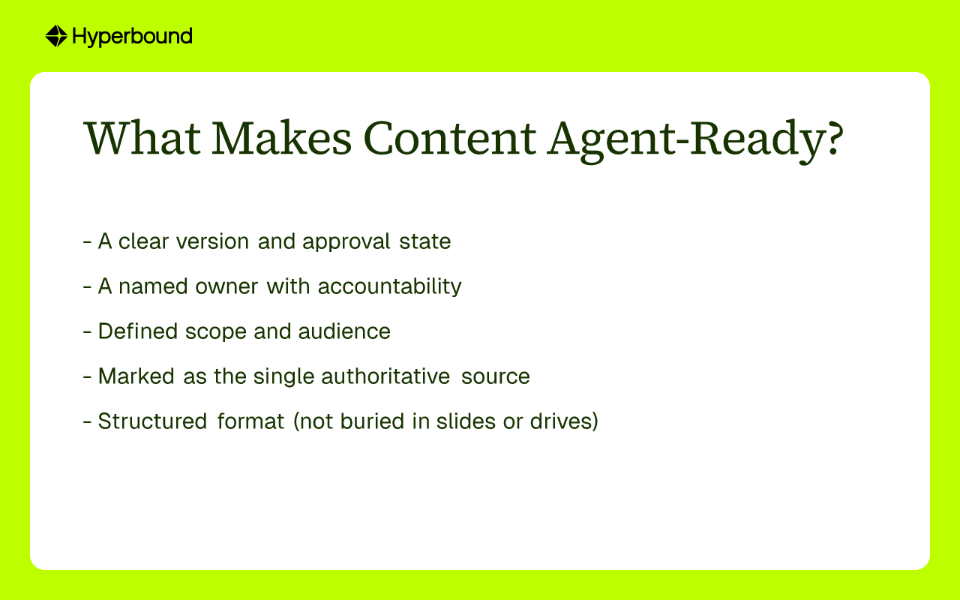
For an agent to retrieve approved pricing guidance, that guidance cannot be buried in a presentation on a shared drive. It requires a version, an owner, an approval state, and a clear scope. Without that structure, agents will surface outdated rates, superseded product claims, or information intended for internal use only.
Approximately 50 percent of MCP adopters cite security complexity as their top challenge. That figure reflects what happens when connectivity is treated as the goal and governance is treated as an afterthought. Exposing ungoverned content over MCP does not improve agent usefulness; it makes errors faster and harder to trace.
Agentic content management
The category that addresses this gap is agentic content management. For the definition and the four shifts behind it, start with What Is Agentic Content Management for Revenue Teams?. Boye & Co. define an agentic CMS as a content system containing autonomous AI agents that handle tasks such as content generation, compliance checking, and governance. The distinction from a conventional CMS is that governance work, content audits, compliance reviews, expiry management, and access controls become automated and continuous rather than manual and periodic.
This matters because governance is the prerequisite for safely exposing content to agents. Before a knowledge asset can be published over MCP, it must be structured, approved, scoped to the right audience, and clearly marked as the authoritative version. An agentic CMS handles that preparation at scale.
It also reframes what content investment produces. As Kontent.ai's VP of Product notes in the same analysis, in a saturated information environment the winning strategy is better content. Governance creates that quality distinction. A well-governed asset is useful to an agent. An ungoverned one is a liability.

Hyperbound and the direction toward MCP
Hyperbound is building toward this model with its Revenue Activation Platform, which helps sales teams use conversation data to improve execution.
The direction Hyperbound is exploring is a system designed to be the single source of truth for sales knowledge: structured, governed, and built with MCP as a foundational component for how that knowledge is exposed to agents. The vision is that whether a sales team adopts Microsoft Copilot, Google's latest agent, or a purpose-built sales assistant, all of those systems connect to the same approved, current, and effective content managed within the Hyperbound platform, avoiding content migration, workflow rebuilding around a new vendor, and divergence between what different agents retrieve.
Agentic content management and MCP sales tools converge as a single infrastructure decision rather than two separate problems.
Hyperbound is currently exploring this direction, and existing customers can express interest through their account manager.
What revenue teams should watch for
MCP is an open standard with deep institutional backing, rapid enterprise adoption, and support from every major AI platform. Revenue teams that build their knowledge on a governed, structured foundation are positioned to connect that knowledge to any agent they choose, now or as the market evolves.
The teams that will find the transition hardest are those whose content still lives in unstructured formats with no ownership layer. The content an agent retrieves is only as reliable as the governance behind it.

To learn how Hyperbound is building the content foundation for the agentic sales team, request access through a Hyperbound account manager.
Frequently Asked Questions
What is the Model Context Protocol (MCP)?
MCP is an open standard that functions as a universal connector, enabling any AI agent to securely access a company's tools and data. It was donated to the Linux Foundation's Agentic AI Foundation and has backing from Google, Microsoft, AWS, OpenAI, and Block. For revenue teams, it means sales knowledge can be made available to any agent without rebuilding for each vendor.
How does MCP change sales workflows?
MCP shifts sales enablement from content retrieval to performance support. Instead of searching a library before a call, connected agents can pull account notes, risk signals, negotiation guidance, and customer stories in real time, then draft meeting plans and follow-ups automatically.
Why is content governance important when using MCP?
Governance ensures that only approved, current, scoped, and authoritative content is exposed to agents. Without it, agents may surface outdated pricing, superseded claims, or internal-only information. About 50 percent of MCP adopters cite security complexity as a top challenge, often because governance was treated as an afterthought.
What makes sales content agent-ready?
Agent-ready content requires a clear version, named owner, approval state, defined scope and audience, and a structured format. It is not stored in slide decks, emails, or shared drives. These attributes allow agents to reliably retrieve and act on the correct information.
What is agentic content management?
Agentic content management is a content system where autonomous AI agents handle tasks such as content generation, compliance checking, and governance continuously. Unlike a conventional CMS, it automates audits, expiry management, and access controls, making governance scalable for agent retrieval.
Is MCP secure for enterprise sales data?
MCP is a protocol rather than a security policy; security depends on how servers and access controls are implemented. Because MCP uses open standards, organizations can enforce their own governance and audit trails, but exposing ungoverned content over MCP increases risk. Many adopters cite security complexity as a top challenge, reinforcing the need for governed content.
Which AI platforms support MCP?
ChatGPT, Cursor, Gemini, and Microsoft Copilot have already adopted MCP. The MCP server market includes more than 10,000 active public MCP servers, and the protocol is backed by Google, Microsoft, AWS, OpenAI, and Block, making it a broadly supported standard.
Who governs the Model Context Protocol?
The Linux Foundation's Agentic AI Foundation governs MCP, with community governance rather than a single company controlling the specification. Anthropic donated MCP to this neutral body, and it was co-founded with Block and OpenAI, with backing from Google, Microsoft, and AWS.
How can revenue teams prepare for MCP adoption?
Revenue teams should start by auditing their sales content for governance: assign owners, versions, approval states, and clear scopes. Then they can structure that knowledge in a system designed to expose it over MCP, such as an agentic CMS or a Revenue Activation Platform. Starting with clean, well-governed content is more important than wiring up agents immediately.
Want to see Hyperbound in action?
Try it now