
You've dialed the number. The phone is ringing. Your heart rate quickens. Then suddenly—they answer. In that instant, your mind goes blank and you feel the awkwardness creep in. Sound familiar?
The truth is, nobody wakes up excited to receive your cold call. As one seasoned SDR put it, "Nobody is excited to hear your name, company name, or sales pitch." Yet despite this universal challenge, 66% of companies consider voice calls essential for achieving their sales goals according to Hiya's 2024 State of the Call report.
The disconnect? Most sales reps struggle with those critical first moments. When someone picks up, "they get off on telling you to pound sand. I don't even get to shoot my shot," as one frustrated rep vented on Reddit.
This guide will transform those awkward opening seconds into your most powerful asset. We'll break down A/B tested scripts, tonality hacks, and confidence-building techniques that top-performing SDRs use to get past the initial resistance and into meaningful conversations.
Before diving into tactics, understand this: your goal in the first 15 seconds isn't to sell your product—it's to sell the next 15 seconds of the conversation.
The prospect's brain is making a snap judgment: "Is this worth my time or should I hang up?" Your opening moments need to overcome their initial indifference and earn you the right to continue.
According to Albert Mehrabian's 7-38-55 Rule, over the phone, where body language is absent, your tone of voice accounts for 38% of communication. As highlighted by Close.com, this means how you say something is far more important than what you say in these opening moments.
Let's break down the four essential components of a successful cold call opener:
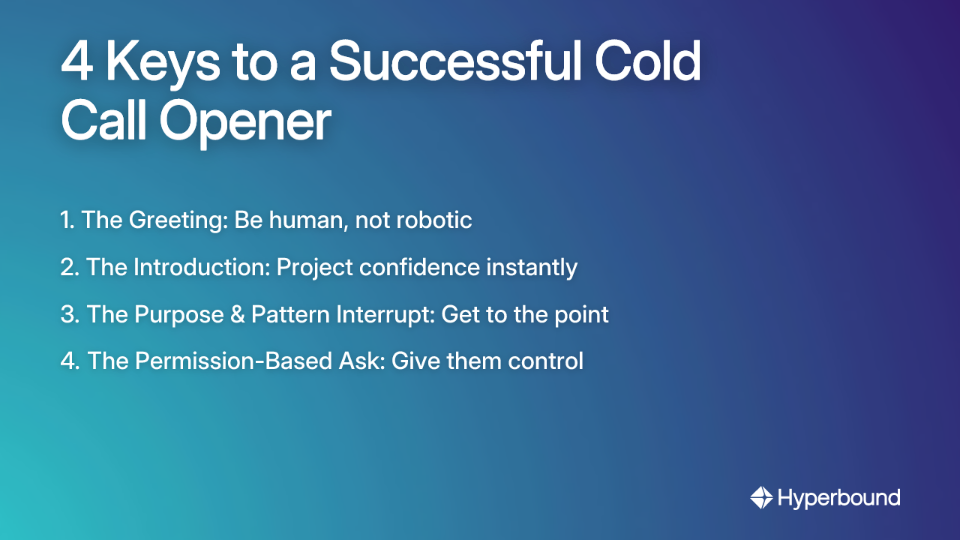
Problem: Many SDRs sound scripted and transactional, creating immediate resistance.
Solution: Adopt a casual, friendly tone that disarms the prospect immediately.
One of the best pieces of advice from a veteran salesperson is to "Talk to them like they're your favorite cousin that just showed up on Thanksgiving." This immediately shifts the energy from a transactional sales call to a human conversation.
When you sound like you're working through a list of calls for a salary, prospects can sense it. The less robotic you sound, the more success you'll have in your lead generation efforts.
Problem: A hesitant or doubtful voice signals weakness and triggers rejection.
Solution: Use assumptive language with confident delivery.
When introducing yourself, state your name and company clearly and firmly. As one successful SDR advises, "Do not have any doubts in your voice during the intro, you should sound as if they should be expecting your call!" This embodies the "assumptive close" mentality that top performers use to project authority.
Remember: confidence isn't about being aggressive or delivering a "pitchslap"—it's about speaking with conviction that what you offer has genuine value.
Problem: Prospects are busy and have zero patience for vague introductions.
Solution: Use a "pattern interrupt" to disarm the prospect by acknowledging the nature of the call.
Lead with refreshing honesty. Try these proven openers:
This approach builds trust by showing you respect their time and intelligence. It also differentiates you from the typical salesperson who tries to disguise their intentions.
Problem: Pushing for a pitch without permission creates immediate resistance.
Solution: Ask for a small amount of their time, giving them an easy "out."
Create an upfront agreement by asking permission to continue:
This permission-based approach respects their autonomy and increases the likelihood they'll grant you more time.
Here's a library of proven scripts that have been A/B tested across thousands of calls. Choose one that matches your style and situation:
"Hello, [Prospect's Name]. This is [Your Name] from [Company Name]. I'll be brief—[specialty] is what we do best. In just three minutes, I can share how we help businesses like yours [solve issue] using [features]. Does that sound fair?" (Zendesk)
"Hello, [Prospect's Name]. This is [Your Name] from [Company Name]. I saw on LinkedIn that you [fact about prospect, e.g., 'recently spoke at the SaaS conference']. I am calling to discuss [subject]. Do you have three minutes to talk about how we can help?" (Zendesk)
"Hi [NAME], Mike and I are seeing great results with [CLIENT]. Your name came up, and I wanted to reach out. Would this be of interest?" (Pipedrive)
"Hi, this is Jess from XYZ. We're working on solutions to help you recruit and train a new generation of salespeople. Is that something you'd like to hear more about?" (Pipedrive)
According to research from Close.com, the way you deliver your message has a far greater impact than the actual words you use. Here are the key tonality types that successful SDRs employ during cold calls:
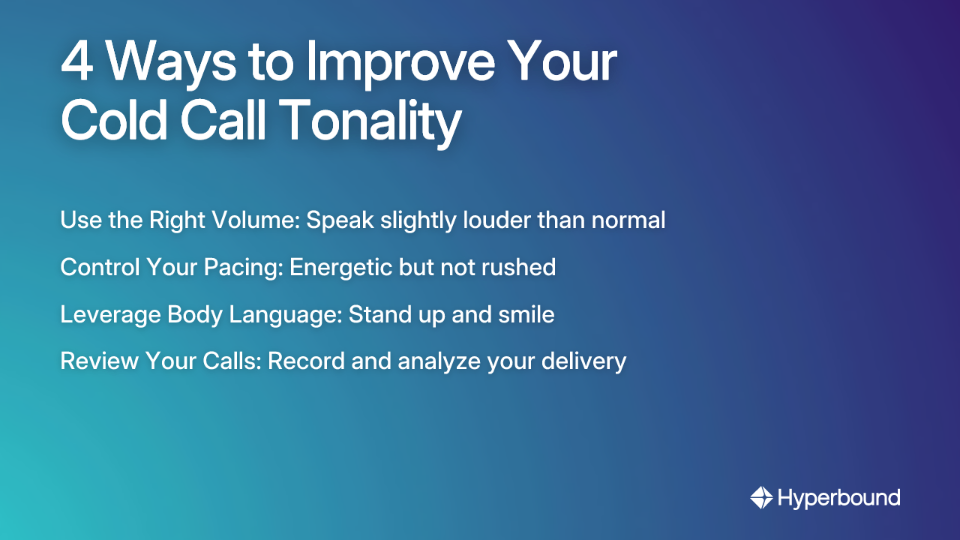

Cold calling requires resilience, especially during the onboarding phase when you're still building skills. As one successful rep advised, "Don't think about your last 80 calls, every connected call is the one. This is YOUR livelihood."
Building confidence requires smart preparation. Here are proven techniques to get your reps ready for any conversation:
One of the most common frustrations is not knowing how to respond when prospects say, "I don't take cold calls." Follow this advice from a top performer: "Write down the top five brush offs and objections you get, plan out how you'd like to respond going forward, and practice it over and over again until you have it memorized."
Example Objection Handle for "I don't have time": "I understand this may not be a top priority right now; however, our discussions often lead to valuable insights in just a few minutes." (Pipedrive)
The opening of a cold call is a skill, not an art. Success hinges on a human-centric greeting, a confident introduction, a clear purpose, and a permission-based ask. Tonality is your most powerful tool, and confidence is built through preparation and practice.
The cadences you establish and the value proposition you deliver all start with those critical first 15 seconds. Master them, and you'll transform from just another SDR making calls to a trusted advisor who prospects actually want to speak with.
Your challenge: Choose one new opener from this guide and use it for your next 10 calls. Record yourself and focus on one aspect of your tonality to improve each day. Remember that each call is a fresh opportunity to connect, regardless of how the last one went.
With these techniques, you'll no longer dread those first moments of a cold call—you'll embrace them as your greatest opportunity to stand out and succeed.










Use Cases
Legal