
You just wrapped up your third 1:1 of the week. You covered every open opportunity, talked through a few pricing objections, maybe flagged a couple of deals that need follow-up. It felt productive.
But here's the uncomfortable truth: that wasn't coaching. That was a deal review with your rep's name on the calendar invite.
If that sounds familiar, you're not alone. Most manufacturing sales managers default to this pattern — and it costs them. Win rates stay flat. Reps plateau. And when you dig into why a deal fell apart, everyone shrugs because the real problem — a skill gap that showed up across ten different calls — was never identified, let alone addressed.
The frustration is especially acute in manufacturing, where the stakes of every conversation are high. As one business owner in the plastic injection molding space put it, "I'm not a salesman, I can make shit but I can't sell it." That's the raw reality for too many manufacturing sales teams — technically excellent, but without a repeatable system for developing the sales behaviors that actually win deals.
Industry research shows that 88% of reps believe additional coaching would help them meet their goals, and 84% say it would help them close more deals. Yet most managers only spend 5–8% of their time on actual coaching. The gap isn't intention — it's structure.
The fix isn't more 1:1s. It's the right operating rhythm: a manufacturing sales coaching cadence built around skill development, not just deal status. Here's how to build one from scratch.
Before building the cadence, it's worth understanding why the current approach fails — and why it's particularly damaging in manufacturing sales.
A deal review is backward-looking. It answers: Where is this deal right now? Coaching is forward-looking. It answers: What skill does this rep need to develop so they can win more deals in the future?
The confusion between the two is costing manufacturing teams in a very specific way. In this industry, trust is the primary currency. As buyers themselves have noted, "Nobody picks their injection molding supplier from a cold email. Manufacturing buyers need to trust you won't screw up their production runs." Winning that trust requires behavioral skill — the ability to ask the right questions, navigate procurement teams, handle lead time objections credibly, and build rapport with engineering contacts over a long sales cycle.
Those skills don't get developed by reviewing a pipeline report. They get developed through deliberate, structured coaching tied to real call behavior.
Think of this as your weekly operating rhythm — a system that replaces reactive deal reviews with proactive skill development. Each component plays a different role, and together they create a compounding effect on rep performance.
This is your micro-coaching session. The goal is simple: focus on one specific skill per rep, per week. Not the pipeline. Not the forecast. One skill.
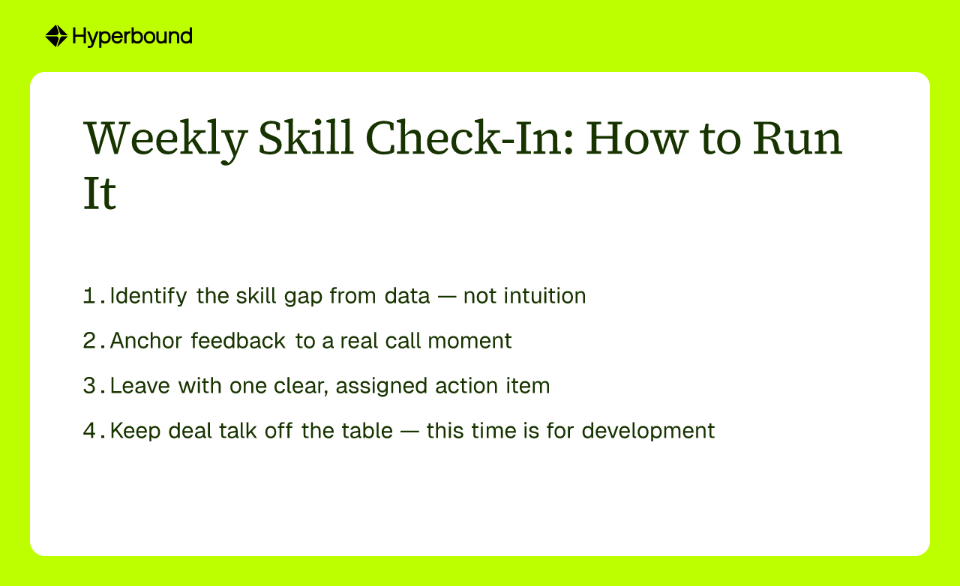
How to run it:
The key discipline here: do not let the conversation drift into deal status. If a rep brings up a deal, acknowledge it and table it. This time is for development, not inspection.
Once every two weeks, bring the full team together for a "film room" session. Select one real call — good or bad — that illustrates a challenge your entire team is navigating: handling a price pressure conversation, managing long lead time objections, or building credibility with an engineering firm contact who's skeptical of switching suppliers.
How to run it:
As SalesGrowth notes, this kind of structured group review helps reinforce learning from real customer interactions in a way that individual coaching sessions simply can't replicate.
Once a month, take the skill gaps you've identified across weekly check-ins and bi-weekly reviews, and build a focused roleplay scenario around them.
This is your team's "scrimmage" — a chance to practice high-stakes conversations before they happen in front of a real buyer. In manufacturing sales, those high-stakes moments are very specific: handling a prospect who's been burned by a supplier before, navigating a competitive RFQ situation on plastic injection molding, or making a warm intro to a new stakeholder halfway through a long sales cycle.
Traditional roleplay is hard to scale and often feels contrived when a manager plays the buyer. That's where Hyperbound Practice changes the dynamic. Reps practice against AI buyer personas built from over 2 million hours of real B2B sales conversations — not generic scripts. Each session ends with instant, objective feedback from AI Scorecards that track talk ratios, key selling moments, objection handling, and methodology adherence. The result is realistic, repeatable practice without burning manager time or real pipeline in the process.
The cadence above only works if you know what to coach. And this is where most manufacturing sales managers hit a wall.
Without data, coaching defaults to recency bias — you coach on whatever deal is top of mind, not on the behavioral pattern that's costing your team the most. One rep might be struggling to establish credibility in early discovery calls. Another might be great at building trust but consistently loses control of the conversation when procurement teams enter the picture. A deal review will never surface either of those patterns.
Hyperbound Perform's AI Real Call Scoring solves this by automatically scoring 100% of your real customer conversations against your custom sales methodology. It integrates with your existing call recording tools, so you're not adding another tool to your team's workflow — you're adding intelligence on top of the data you're already collecting.
The output is specific: which reps need coaching on which behaviors, ranked by impact. Instead of sitting down to a 1:1 and wondering what to focus on, you walk in knowing that this rep is under-indexing on multi-threading with engineering contacts, while another is losing control of lead time conversations in the later stages of the sales cycle. That precision is what transforms weekly check-ins from generic conversations into high-leverage coaching moments.
This removes the guesswork — and with it, the manager bias that often means top-of-mind reps get the most coaching while quieter performers get overlooked.

Here's the honest challenge with any structured coaching program: connecting the dots manually is unsustainable. Reviewing call scores, identifying the right skill gap, finding the right practice scenario, tracking whether the rep improved — each step is valuable, but stringing them together takes time most manufacturing sales managers don't have.
Kota Activate, Hyperbound's AI Revenue Analyst, acts as the orchestration layer that eliminates that manual overhead. Kota sits above both Perform and Practice, connecting real call performance data to personalized coaching recommendations automatically. If Perform flags that a rep is consistently struggling to handle competitor comparisons in the CNC machining space, Kota can surface the right practice scenario in Hyperbound Practice — prompting targeted roleplay before the next live call, not after a deal is already lost.
This is what turns a three-part cadence from a manager's good intention into a self-reinforcing system. The loop looks like this:
Score Real Calls → Identify Skill Gaps → Practice Targeted Roleplays → Score Real Calls Again
Every cycle tightens the feedback loop. Reps improve on the specific behaviors that matter, managers coach with precision instead of instinct, and the entire sales org builds a consistent capability baseline — rather than relying on a few top performers carrying everyone else.
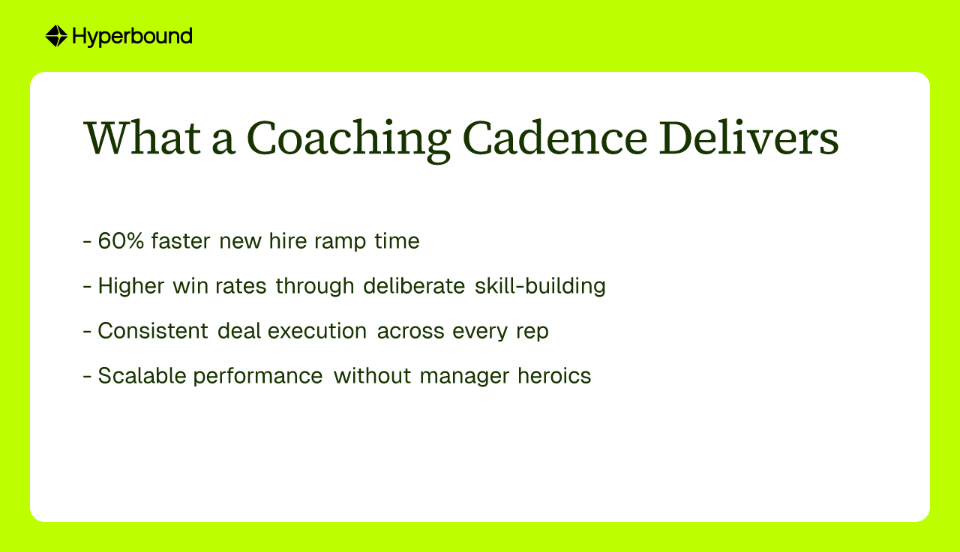
A coaching cadence isn't a training expense. It's a revenue driver — and the data backs this up.
Hyperbound customer Vanta implemented a structured, AI-powered coaching cadence and achieved a 60% reduction in new hire ramp time, taking reps from 210 days to just 72 days before reaching full productivity. That kind of compression directly reduces your cost of growth and accelerates the point at which new reps are generating meaningful pipeline.
In manufacturing sales, where ramp time is notoriously long — new reps have to learn the product, the industry jargon, the procurement process, the competitive landscape, and how to build trust with buyers who've been let down before — a 60% reduction isn't marginal. It's transformational.
Beyond ramp time, a well-executed cadence delivers:
The core problem isn't that manufacturing sales managers don't care about coaching. It's that the system defaults to deal reviews because they're familiar, they fill the time, and they feel productive. But deal reviews don't develop reps. They don't build the trust-oriented, consultative skills that manufacturing buyers actually respond to. And they don't explain why win rates stay flat despite full calendars.
The fix is a deliberate operating rhythm:
Pair that cadence with Hyperbound Perform's AI Real Call Scoring to surface exactly where each rep needs development, and Kota Activate to orchestrate the coaching interventions automatically — and you've built a system that continuously converts call data into rep capability and rep capability into closed deals.
Manufacturing sales is built on trust, long-term relationships, and the confidence of knowing your supplier won't screw up a production run. Building that kind of rep takes more than good hiring. It takes consistent, structured, data-driven manufacturing sales coaching — and a cadence that makes it impossible to skip.

A manufacturing sales coaching cadence is a structured schedule of regular, focused coaching sessions designed to develop specific sales skills, rather than just reviewing deals. It's an operating rhythm that moves managers from reactive deal inspection to proactive skill development. The cadence proposed in this article includes weekly rep-level skill check-ins, bi-weekly team call reviews, and monthly roleplay challenges, creating a system for continuous improvement.
Deal reviews are not effective for coaching because they are backward-looking and focus on the status of a deal, not the forward-looking development of a rep's skills. A deal review answers, "Where is this deal right now?" Coaching answers, "What skill does this rep need to win more deals in the future?" By focusing only on the pipeline, managers miss the underlying skill gaps (e.g., handling objections, building trust with engineers) that cause deals to stall or be lost in the first place.
The most effective way to identify skill gaps is by using data from real customer conversations, rather than relying on intuition or gut feel. Tools like AI Real Call Scoring can automatically analyze 100% of your team's calls against your sales methodology. This surfaces specific, recurring behavioral patterns—like a rep struggling with lead time objections or failing to multi-thread—so you can focus your coaching on the areas with the biggest impact on performance.
An effective sales coaching cadence consists of three main components: a weekly individual skill check-in, a bi-weekly team call review, and a monthly roleplay challenge. The weekly check-in focuses on one skill per rep. The bi-weekly team review uses a real call to facilitate peer-to-peer learning. The monthly roleplay allows reps to practice high-stakes scenarios in a safe environment. Together, these elements create a comprehensive system for skill development.
AI roleplay helps by providing a scalable and realistic way for reps to practice critical conversations without risking live deals or burning manager time. In manufacturing, reps face specific, high-stakes scenarios like navigating RFQs or building rapport with skeptical engineers. AI-powered platforms allow them to practice against realistic AI buyer personas, receive instant, objective feedback on their performance, and build muscle memory for handling these tough conversations effectively.
Implementing a structured coaching cadence drives significant business impact, including faster new hire ramp times, higher win rates, and more consistent deal execution across the entire team. For example, companies that adopt this system have seen up to a 60% reduction in the time it takes for a new rep to become fully productive. By systematically improving the skills that win deals, you create a more predictable revenue engine that doesn't rely on a few top performers.
You can start this cadence by dedicating about one to two hours per rep, per month, spread across different activities. This breaks down into a 15–30 minute weekly check-in per rep, a 45–60 minute team call review every two weeks, and a monthly roleplay session. While this is a time investment, it's far more efficient than unstructured 1:1s that devolve into deal reviews. Using AI tools to surface insights and orchestrate practice can further reduce the manual preparation time for managers.










Use Cases
Legal