You've set up a dedicated block of time for call reviews with your sales team. But as you listen to the recorded calls, you notice something troubling: your reps have that glazed-over look in their eyes. They're nodding politely, but mentally they've checked out. They're suffering from that fact that feedback delivered days after the fact simply doesn't register.
Meanwhile, your calendar is packed with these review sessions, stealing precious hours you could spend actually driving revenue. You're left wondering: is this really the best use of everyone's time?
The hard truth is that traditional call reviews are a low-ROI activity. Despite being gospel in sales management circles, they're plagued by fundamental issues:
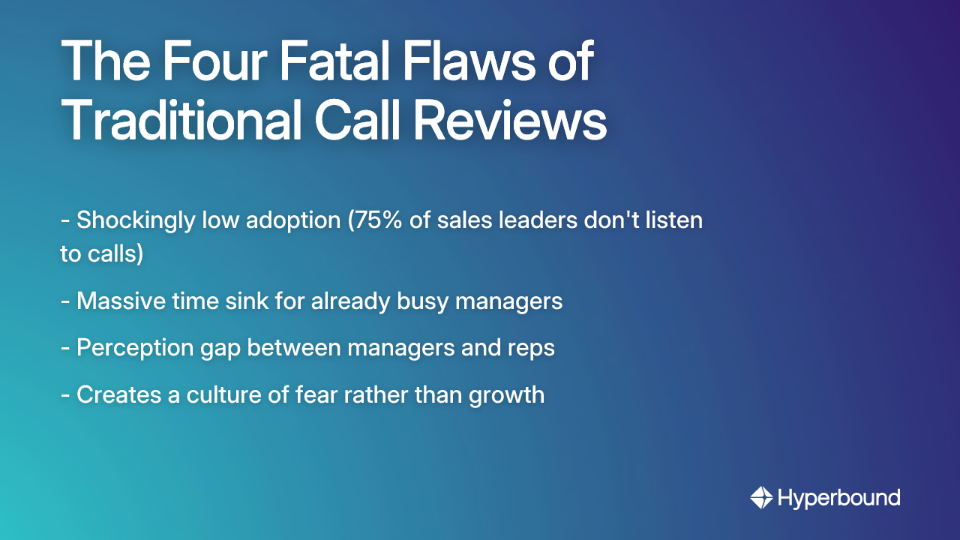
Shockingly low adoption: Approximately 75% of sales leaders don't actually listen to sales calls, and most companies review less than 1% of all recorded calls. This signals a fundamental breakdown in the process that goes beyond individual discipline.
The time sink: Let's be honest – time is money in sales. Manually reviewing hours of calls is unsustainable for managers already juggling competing priorities. As one sales leader on Reddit put it, AI call analyzers are worth their weight in gold. Time is money, and if a tool can remove that task off your plate, you can focus more on your team.
The perception gap: While 80% of sales managers believe they are effective coaches, only 38% of their reps agree. This massive disconnect suggests that the feedback delivered via call reviews isn't landing as intended.
The culture of fear: Traditional reviews often create an environment where reps feel scrutinized rather than supported. Instead of fostering growth, they trigger defensive responses and undermine the psychological safety needed for honest feedback.
But there's an even deeper problem lurking beneath the surface.
Here's a provocative question: If you find yourself constantly reviewing the same basic sales skills with certain team members, is that really a coaching issue – or a hiring one?
When managers spend hours reviewing fundamental skills like asking basic discovery questions or handling common objections with reps in quota roles, it might indicate you've hired someone who isn't naturally suited for sales.
Look at it this way: If you hired a developer who couldn't code or an accountant who couldn't add, would you spend hours reviewing their work, hoping they'll eventually get it? Probably not. Yet in sales, we often use intensive coaching as a band-aid for poor hiring decisions.
Smart sales leaders recognize patterns across their teams rather than focusing on individual call issues. They ask themselves:
These questions help distinguish between training issues and hiring misalignments. They also point toward a more effective approach: coaching in real-time.
The most forward-thinking sales managers are shifting away from traditional review sessions to live coaching during actual meetings with prospects. This approach offers several powerful advantages:
Immediacy vs. Delay: Live coaching allows you to provide guidance when it matters most – during the call when the rep can immediately apply it. Compare this to call reviews where you're discussing missed opportunities days after they've passed.
Application vs. Theory: Feedback retention skyrockets when reps can implement suggestions instantly. Live coaching transforms abstract feedback into concrete action, which is crucial for adult learning patterns.
Engagement vs. Passivity: Live coaching transforms you from critic to co-pilot. This addresses the fact that 74% of reps feel underutilized due to a lack of development opportunities. When you're in the trenches with them, they're more engaged and receptive.
Solving the Self-Discovery Problem: Many reps struggle to identify their own mistakes in recordings. Instead of forcing this painful self-discovery process, live coaching allows you to gently guide them in the moment, asking a critical question via chat that helps them see a new angle without breaking their stride.

The biggest objection to live coaching is the fear of disrupting the sales process or undermining the rep's authority. With the right framework, however, you can provide powerful hands-on training during live calls without derailing conversations:
Before the call, align with your rep on:
This pre-call alignment ensures you're not just a lurker but a strategic resource.
When coaching live, timing and subtlety are everything:
Use Private Chat: Tools like Zoom, Teams, or specialized sales platforms allow you to send private messages with suggestions. For example: "Great discovery so far. Now might be a good time to explore their decision timeline."
Establish Non-Verbal Cues: If you're physically present, develop subtle signals with your team. A simple gesture can indicate "dig deeper" or "move to the next topic" without interrupting flow.
Leverage Technology: Many platforms offer "whisper" features where only your rep can hear your guidance. Solutions like Hyperbound's AI Coaching can even provide AI-powered suggestions that pop up during calls.
The moment the call ends, conduct a 5-minute debrief:
This immediate feedback loop cements the learning while the experience is fresh.
When giving feedback, don't just say "Don't do A, do B." Explain why B is more effective. As one sales leader on Reddit advised, "Instead of saying don't do A, try doing B as advice, focus on why B works better or the downfalls of A. Teaching in this way may cause them to come up with answer C, which neither of you thought of before."
Artificial Intelligence isn't replacing managers; it's giving them superpowers to coach more effectively and efficiently.
AI tools can transform traditional call reviews when you do need them:

Automated Triage: Instead of listening to hours of calls, use an AI tool like Hyperbound's AI Real Call Scoring to score calls and flag the ones that actually need your attention.
Pattern Recognition: AI can identify trends across hundreds of calls that would be impossible to spot manually, helping you focus coaching on systemic issues.
The real game-changer is how AI enables better live coaching:
Real-Time Assist (RTA): AI can listen for keywords (e.g., a competitor's name, pricing objections) and automatically surface relevant talking points on the rep's screen.
Live Sentiment Analysis: AI can track customer sentiment in real-time. If it detects rising frustration, it can alert you to step in before the situation deteriorates.
Speech Coaching: AI can monitor filler words, speaking pace, and talk-to-listen ratios, helping reps improve communication clarity on the fly.
The goal isn't to eliminate call reviews entirely but to use them strategically as part of a broader, more dynamic coaching toolkit. Here's a framework for choosing the right approach for different situations:
Use Live Coaching for:
Reserve Call Reviews for:
Use Live Coaching for:
Use Call Reviews for:
New Reps:Require more intensive hands-on training and live coaching to ramp up quickly. For these team members, consider a 2:1 ratio of live coaching to call reviews.
Veteran Reps:Shift to a more collaborative model. Have experienced salespeople bring 1-2 calls they want feedback on to your 1:1s. As one sales manager on Reddit suggested, "Instead of doing random reviews, get your reps to bring 1-2 calls to your 1-on-1. Ask them to identify what they think went wrong or right and give feedback on areas they want to improve on."
This approach respects their expertise and fosters ownership of their development.
Different reps have different strengths and weaknesses. Some may excel at building rapport but struggle with technical explanations. Others might be great closers but weak on discovery. Tailor your coaching approach to individual needs:
The most successful sales organizations don't just focus on individual performance – they build a coaching culture where improvement is continuous and collaborative:
Peer-to-Peer Live Coaching: Pair reps with complementary skills to observe and coach each other during calls. This spreads institutional knowledge and builds team cohesion.
Group Learning Sessions: Use recordings of particularly successful (or challenging) calls as teaching tools for the whole team, focusing on specific skills or scenarios.
Coach the Coaches: Sales managers need coaching too. Consider how your organization can help managers improve their live coaching skills through training and feedback.
The role of a sales manager is evolving from an inspector of past mistakes to a co-pilot helping navigate complex sales conversations in real-time. By embracing live coaching, leveraging AI, and using reviews strategically, you can stop policing yesterday's calls and start building tomorrow's successes.
This shift creates a virtuous cycle: reps feel supported rather than scrutinized, managers spend their time more effectively, and customers experience more polished, confident interactions with your team.
The best part? Unlike traditional call reviews, live coaching creates engagement, ownership, and actionable improvement in the moment when it matters most.
Your challenge: This week, try live coaching on one call with each of your direct reports. Focus on providing one piece of non-disruptive, actionable advice during the call, and see the difference it makes in both performance and engagement. Then ask yourself: how much of my coaching time should shift from reviewing the past to shaping the future?
Your reps – and your sales results – will thank you.
Traditional sales call reviews are often ineffective because the feedback is delivered days after the event, making it less impactful. They are also a massive time sink for managers, have very low adoption rates across sales organizations, and can create a culture of fear where reps feel scrutinized rather than supported for growth.
Live sales coaching is the practice of providing real-time guidance to a sales representative during an actual call with a prospect. Instead of reviewing a past recording, the manager acts as a "co-pilot," offering immediate, actionable advice through non-disruptive means like private chat, helping the rep apply feedback when it matters most.
A manager can coach a live call effectively by using subtle, non-disruptive methods. This includes preparing with the rep beforehand, using private chat tools to send suggestions, establishing non-verbal cues for in-person coaching, and leveraging "whisper" features in sales platforms that only the rep can hear.
Call reviews are best reserved for specific strategic situations rather than routine coaching. You should use them to analyze highly complex, multi-stakeholder negotiations, conduct deep post-mortem analyses of won or lost deals, or identify widespread patterns of behavior by reviewing a curated set of calls.
Artificial Intelligence supercharges sales coaching by automating analysis and enabling real-time assistance. AI tools can automatically score and triage calls that need review, identify trends across thousands of conversations, and provide live assistance to reps during calls by suggesting talking points, analyzing customer sentiment, and monitoring speech clarity.
If a sales rep consistently fails to improve on fundamental skills despite repeated coaching, it may indicate a hiring problem rather than a coaching one. When a manager spends excessive time on basic skills with a tenured rep, it's worth considering if the individual is truly suited for the sales role, similar to how you wouldn't endlessly coach a developer who can't code.











Use Cases
Legal