
You've probably seen it happen countless times. Your LinkedIn inbox fills with generic connection requests followed by immediate pitches that make you question the sender's intentions. We have all gotten those scammy direct messages that make us question every connection request we get. As a sales professional, you might even be guilty of sending some yourself.
Here's the hard truth: If you message a pitch to a prospect, 97% of the time they won't be ready to buy. And when you reach out again? They still won't be ready. This results in a LinkedIn mailbox that's a graveyard of unsuccessful, automated, thoughtless pitches.
The problem isn't LinkedIn – it's the approach. Too many SDRs (Sales Development Representatives) and sales professionals view the platform as a quick-win prospecting tool rather than what it truly is: the most powerful personal branding platform in the B2B space.
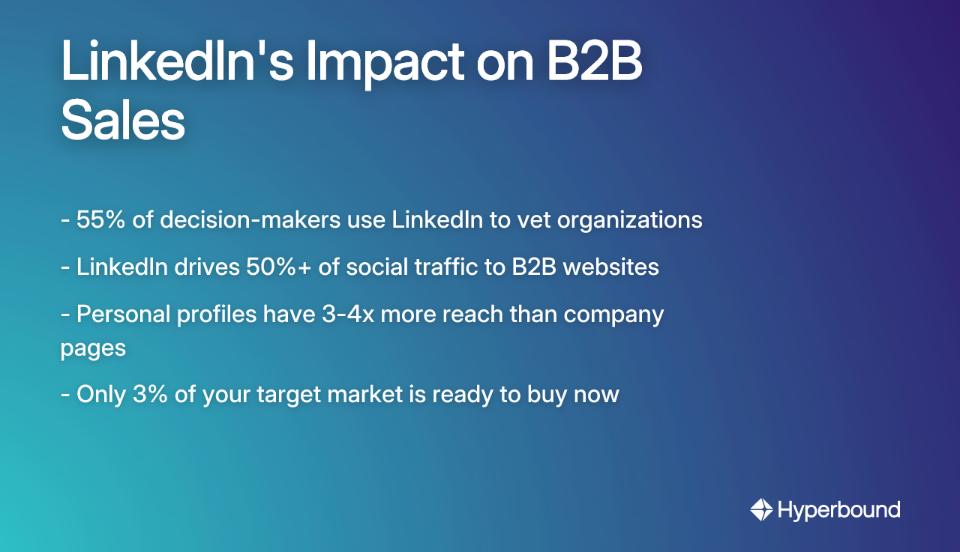
Let's start with a fundamental truth: only 3% of your target market is ready to buy now. This single statistic explains why the "connect and pitch" strategy fails so spectacularly.
The alternative? Position yourself as a trusted advisor and industry thought leader who brings value consistently, so when that 3% enters their buying window, you're already top of mind.
Personal profiles on LinkedIn have 3-4 times more reach than company pages, making you – the individual sales professional – the most powerful branding asset your company has. This isn't just feel-good advice; it's backed by hard data:
As one experienced sales leader puts it on Reddit: "LinkedIn is not cohesive with a quick win strategy." The platform rewards consistency and value over volume and velocity. It's a marathon, not a sprint.
Before you start creating content, you need to build a solid foundation:

You can't be everything to everyone. Define specifically:
Create a semi-fictional buyer persona based on real customer data. Understand their roles, industries, and pain points deeply.
A smart strategy from successful LinkedIn prospectors is to build an audience of both decision-makers (e.g., CMOs, 20%) and end-users (e.g., Marketing Managers, 80%). This allows you to create content for the end-user while building credibility to eventually engage the decision-maker.
Your LinkedIn profile isn't a resume; it's a mini landing page that should speak directly to your ICP's problems.
Remember, when prospects visit your profile, they're asking one question: "Can this person help me solve my problem?" Every element should answer with a resounding "yes."
One of the biggest objections to building a personal brand is: "Creating high-quality content requires a large time investment. It also requires expertise in a specific industry."
Good news: You don't need to be the ultimate subject matter expert. Your role is to be a valuable curator and conversation starter. Here are practical content strategies that require minimal time investment:
Reach out to CEOs, internal experts, or influencers in your field. Record a short video call or transcribe their insights into a text post. This approach:
Example: "I spoke with [Company]'s CTO about the biggest data security challenges facing [industry] in 2023. Here are the three trends every decision-maker should know..."
Read an industry report, listen to a podcast, or watch a webinar, then share a concise summary of the key takeaways. This positions you as a knowledgeable professional who stays current without requiring you to be the original source.
Example: "Just finished reading Gartner's latest report on [topic]. The three key takeaways for [your ICP] are..."
This is perhaps the lowest-effort, highest-engagement strategy. Post thought-provoking questions that get your network talking.
Examples:
Remember to engage with the responses to keep the conversation going and build relationships.
Collaborate with your company's subject matter experts (engineers, product managers, marketers) to co-create content. This enhances your brand and showcases your team's collective knowledge.
When creating content that addresses specific pain points:
Of course, speaking your ICP's language confidently in writing comes from mastering it in conversation. This is where practice becomes crucial. Platforms like Hyperbound allow sales teams to use AI-powered roleplays to perfect their messaging and objection handling based on real-world scenarios. By practicing how to articulate value and address pain points verbally, reps can more effectively translate those skills into compelling written content for LinkedIn.
The challenge isn't just creating content – it's doing it consistently. "Dedicating time daily for outreach can be hard to maintain," as many sales professionals have noted.
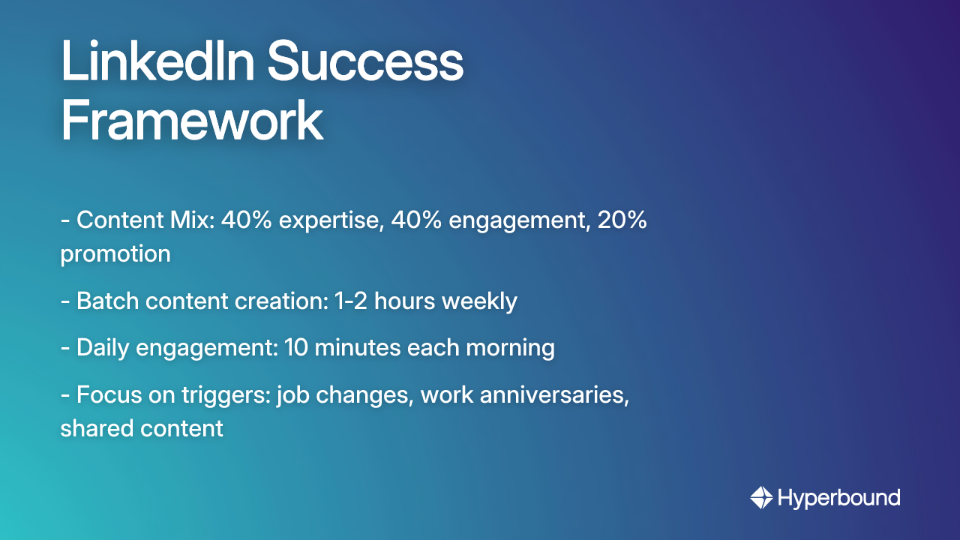
Structure your content mix with this simple ratio:
As recommended by successful LinkedIn prospectors: "Every morning for 10 minutes, check your LinkedIn activity feed and respond to triggers." If you're using Sales Navigator, these triggers are conveniently displayed on your home dashboard.
Look for:
Meaningful engagement with your prospects' content is as important as creating your own. Sending thoughtful comments on their posts builds familiarity and trust before you ever send an InMail.
"How do I know if this is working?" This question stops many sales professionals from investing in their LinkedIn presence. Unlike traditional prospecting efforts that yield immediate metrics (calls made, meetings booked), personal branding is a longer-term investment.
Here's how to measure its impact:
Start with clear objectives. A goal isn't "get more leads," it's "gain 10 new clients via LinkedIn in one year" or "increase inbound inquiries by 25% in six months."
Track a mix of leading and lagging indicators across the funnel:
Awareness Metrics: Are people seeing you?
Engagement Metrics: Are people interacting?
Conversion Metrics: Is it turning into business?
Retention Metrics: Is it building long-term value?
Don't forget the qualitative ROI – those moments when a prospect says, "I've been following your content for months and really appreciate your insights." These are the early indicators that your brand-building efforts are working.
Building a personal brand on LinkedIn is the antidote to the "LinkedIn mailbox that's a graveyard of unsuccessful, automated, thoughtless pitches." It transforms you from just another SDR sending InMails into a trusted advisor that decision-makers actively seek out.
Remember:
As one experienced B2B sales professional notes: "Having a reputation of providing value that's relevant to the industry you serve will not only help you succeed as an SDR or AE but will follow you throughout your career."
Start small. Commit to one high-value post per week and spending 10 minutes a day engaging with triggers in your network. Track your progress using the metrics above. Within 90 days, you'll start seeing the compound effect of consistent brand-building efforts.
Sales professionals should build a personal brand on LinkedIn to establish themselves as trusted advisors, which keeps them top-of-mind with potential buyers long before they are ready to purchase. Since only about 3% of your target market is ready to buy at any given time, building a brand allows you to nurture the other 97% by consistently providing value and building credibility.
Personal branding is a long-term strategy focused on providing value and attracting inbound interest, while traditional prospecting often relies on short-term, high-volume outbound messages like the "connect and pitch" method. The goal of personal branding is to become a recognized authority in your niche, making prospects come to you.
You can effectively build a personal brand on LinkedIn by dedicating just 2-3 hours per week. The key is consistency. This time can be broken down into 1-2 hours for "batching" content creation for the week and about 10 minutes daily for engaging with your network’s content and responding to comments.
You don't need to be the ultimate expert to create valuable content; instead, you can act as a knowledgeable curator and conversation starter. Effective strategies include interviewing industry leaders, summarizing key takeaways from reports or webinars, asking engaging questions to your network, and collaborating with internal experts at your company.
Optimize your LinkedIn profile by treating it as a landing page for your ideal customer, not as a resume. Your headline should clearly state who you help and how (e.g., "Helping B2B SaaS companies reduce churn"). Use your "About" section to tell a story with case studies and testimonials, and use the "Featured" section to pin your best content or helpful resources.
While early indicators like increased engagement can appear within weeks, tangible business results from personal branding typically begin to show after 90 days of consistent effort. Personal branding is a long-term investment that builds over time, leading to more inbound messages from qualified prospects and a stronger sales pipeline.
What's one question you can ask your network this week to start a valuable conversation? Post it today, and take the first step toward transforming your LinkedIn presence from a prospecting tool into a powerful personal brand asset.










Use Cases
Legal