Summary
- Sales methodology adoption fails in the gap between training and live calls because fragmented tools create competing versions of the same framework.
- Measurable results from a single source of truth include Vanta's 60% ramp reduction, Klaviyo's 42% new-hire productivity increase, and ALKU's time to first deal falling from 6 months to 3 months.
- A unified knowledge source must govern the three surfaces: Practice for building muscle memory, Perform for real-call scoring and coaching loops, and Activate for in-deal guidance.
- Treat methodology adoption as an architecture problem, not a training problem; Hyperbound's Kota CMS is available in private preview to start unifying sales knowledge.
Sales methodology adoption fails between training and live-call execution. Training rooms produce reps who can recite the framework, handle objections on cue, and pass certification. Live-call pressure replaces process, and reps default to whatever they can remember.
The cause is systemic rather than individual. Altisima Advisory identifies a system design problem: organizations invest in methodology but lack the operating system to reinforce it. Training creates awareness. It does not create behavior change. Awareness is inexpensive. Behavior change moves revenue.
The system failure has a specific shape. Each surface a rep touches carries its own version of the methodology: a simplified scorecard in the practice tool, a different rubric in the call-coaching platform, a disconnected battlecard in the CRM. No two surfaces agree or reinforce each other. The methodology becomes, in Altisima's framing, decorative.
The solution is architectural rather than pedagogical. The same knowledge must govern every surface a rep encounters across the revenue cycle.
Why Fragmentation Happens
A methodology turns decorative when it lives outside the daily sales process. If reps can execute their jobs without consulting it, the methodology has already failed.
The fragmentation is structural. Each tool in the enablement stack gets its own copy of the methodology, simplified to fit its interface and maintained by the team responsible for that tool. Over time, those copies drift. The practice bot scores on criteria the call-coaching platform does not use. The in-deal guidance references a framework the scorecard does not mention. Sifthub notes that siloed knowledge grows slowly and invisibly, but its impact on sales productivity is substantial.
Incumbent platform architectures reinforce this. Highspot presents AI Role Play, Sales Coaching, and Sales Content Management as separate adjacent tabs rather than as a unified flow from a shared knowledge source. Its coaching product aggregates signals from three distinct products, each with its own scorecard layer: Rep Scorecards, Initiative Scorecards, and Play Scorecards. A single, consistent measurement of methodology adherence across practice and live performance is absent from that model's design.
These platforms do not lack features. The limiting factor is an architecture that assumes each surface will manage its own knowledge. That assumption is where enablement investment goes to die.
The Three Surfaces: Practice, Perform, Activate
Closing the gap between awareness and behavior requires the same knowledge to operate consistently across three surfaces. Each surface has a distinct function. All three must draw from the same source.
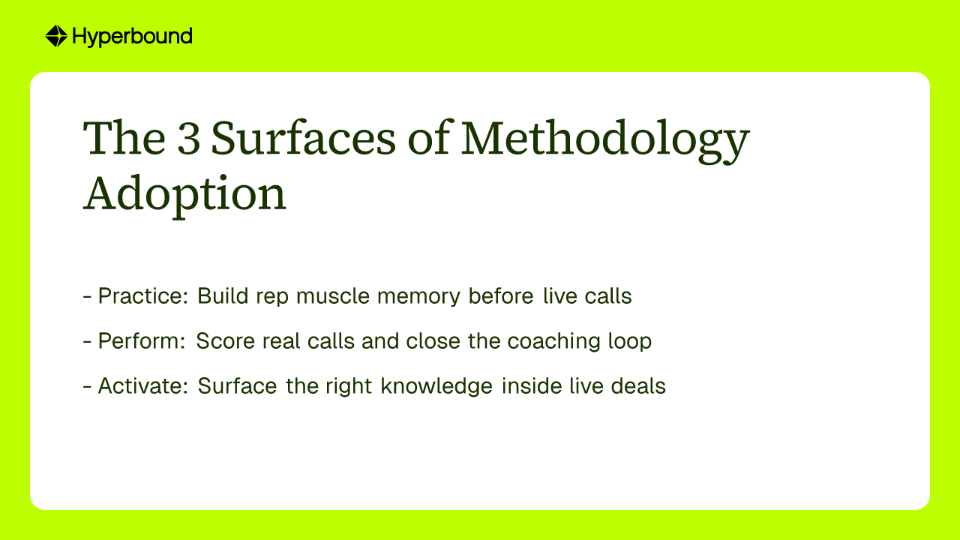
Practice is the safe-to-fail environment where reps build muscle memory before a live call. AI roleplay, certification, objection drills, and scenario repetition all belong here. The constraint on traditional practice is manager bandwidth. Every rep who needs a roleplay partner, a coached debrief, or a certification review competes for a limited pool of manager time. That model breaks as teams scale.
The teams that solve this embed practice into daily workflow rather than treating it as an occasional exercise. finally requires SDRs to complete 60 Hyperbound reps per day, split across morning and afternoon sessions, and to pass a cold call certification with the VP of Sales and CRO before learning any other tool. Staff Domain built 568 custom bots and instituted a non-negotiable daily morning warm-up ritual for every rep. Practice at that frequency requires a knowledge base that can generate consistent, methodology-aligned bots and scorecards without manual rebuilding each time.
Perform is the live call environment where behavior is measured and coaching opportunities are identified. This surface does not stand alone. Its function within an effective revenue cycle is to close the loop back to practice: Score Real Calls -> Identify Gaps -> Practice -> Repeat.
ALKU had no call recording before adding Hyperbound Perform. The addition gave managers real-call visibility and allowed coaching to target actual conversations rather than hypothetical ones. That loop, from real-call scoring back to targeted practice, is what converts performance data into behavior change.
Activate is the surface most enablement architectures neglect. It is the delivery of the right knowledge at the right moment within the flow of a live deal: contextual talking points, competitive guidance, qualification criteria surfaced in the CRM or dialer without requiring the rep to leave the workflow. Altisima Advisory identifies this as the condition under which adoption is highest: when the methodology is inseparable from the work itself, mapped to CRM qualification fields, deal review criteria, and stage advancement checkpoints.
When all three surfaces draw from the same knowledge object, the methodology is no longer a document. It is the environment the rep operates in.
Agentic Content Management for the Revenue Cycle
Governing three surfaces from one knowledge source requires a different category of technology than what most enablement stacks were built on. Agentic content management is the relevant category.
Forrester VP and Principal Analyst Chuck Gahun describes agentic content management as the third generation of content platforms, following the shift from monolithic systems to headless and composable architectures. The defining characteristic is structural governance rather than AI assistance layered on top of existing content tools. Sengo defines an agentic CMS as a platform in which AI agents can read, write, and orchestrate content with structural awareness of the data model, acting as a governing intelligence rather than a suggestion engine.
Applied to the revenue cycle, the implication is direct. A structurally-aware knowledge object does not produce a separate copy of the methodology for each surface. It produces the bot, the scorecard, the real-call rubric, and the in-deal guidance from a single governed source. When the methodology updates, every surface updates. Drift is eliminated by design. The model is covered in depth in Structured Revenue Knowledge; the rules that make it operational are in How to Give an AI Your Sales Methodology Without Retyping It.
Kota CMS: A Single Source of Truth for Sales Knowledge
Kota CMS is Hyperbound's agentic content management system, the knowledge layer behind the Revenue Activation Platform. It is the operating layer designed to maintain a single source of truth for sales knowledge across Practice, Perform, and Activate.
The Kota CMS private preview is available now as a paid add-on. The current private preview covers the Practice surface: AI roleplay bot creation and methodology-aligned scorecard generation from a centralized knowledge base.
The practical impact on content creation is significant: Klaviyo reduced roleplay creation time from weeks to approximately 5 minutes using Kota. That compression in creation time means enablement teams can keep bots and scorecards current without the maintenance overhead that previously caused copies to drift.
Kota CMS is designed to extend across Perform and Activate. The same knowledge object that builds a practice bot will score live calls in Perform and will surface real-time deal guidance in Activate. The direction is a single governing source for the entire revenue cycle rather than a better-integrated set of separate tools.
Private preview capabilities, scope, and availability are subject to change as we continue development and incorporate customer feedback.
What a Unified Knowledge Source Produces
The outcome of operating from a single source of truth for sales knowledge is measurable across ramp time, conversion, and pipeline.
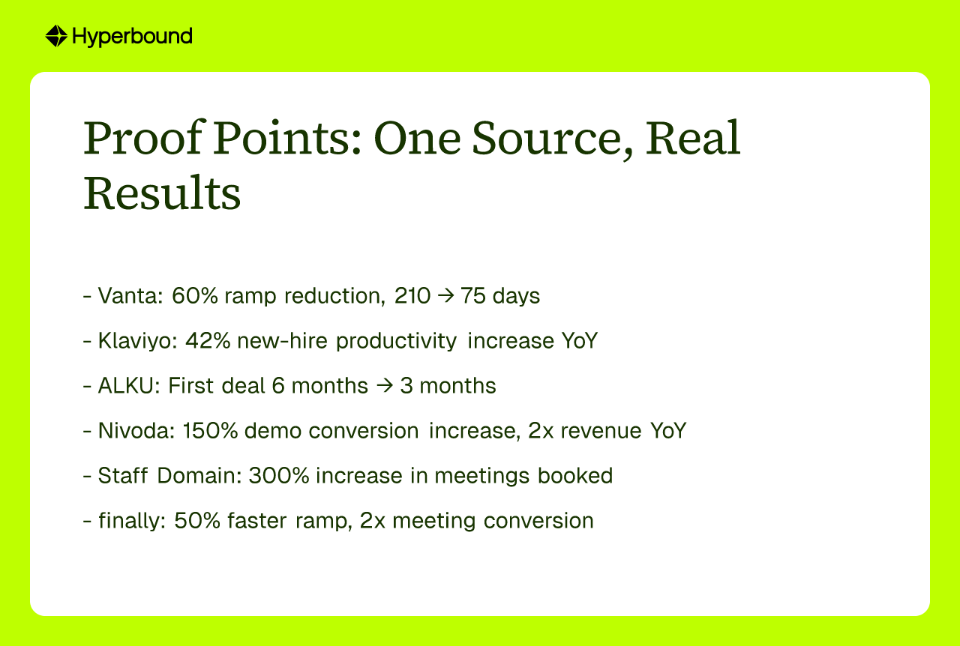
Vanta reduced ramp time from 210 days to 75 days, a 60% reduction, achieved 30% faster time to first meeting and first opportunity, and influenced more than $125M in pipeline. Klaviyo achieved a 42% increase in new-hire productivity per rep year over year and saved managers 5 to 7 hours per week. ALKU cut time to first deal from 6 months to 3 months and scaled its internship program to more than 300 participants without adding coaching capacity.
Conversion metrics follow the same pattern. Nivoda doubled revenue year over year and increased demo conversion rate by 150%, from 20% to 50%. Staff Domain recorded a 300% increase in meetings and identified coaching needs in 4 weeks rather than 90 days. finally achieved 50% faster ramp time and a 2x improvement in meeting conversion rate, with SDRs completing more than 160,000 scorecard questions.
The manager bandwidth constraint, which breaks every enablement model at scale, is also addressed directly. Klaviyo's 5 to 7 hours saved per manager per week is a core benefit. It is what makes daily practice sustainable at volume. When managers are not consumed by manual roleplay coordination and ad hoc reporting, they coach from data. That is the model that scales.
What to Do Next
The fragmentation in most enablement stacks is predictable. It results from building each surface independently, with its own knowledge, its own scoring, and its own version of the methodology. The gap between training and behavior persists because the architecture requires it.
A single governed knowledge source eliminates that architecture. Practice bots, live-call scoring, and in-deal guidance all pull from the same object. When the methodology changes, every surface reflects it. Reps encounter a consistent framework whether they are drilling objections at 8 a.m., being scored on a discovery call, or pulling up a competitive play mid-conversation.
Kota CMS is where that architecture begins. The private preview covers Practice today, with Perform and Activate the designed direction.
To request access, contact your Hyperbound account manager.
Frequently Asked Questions
Why does sales methodology adoption fail?
Sales methodology adoption fails primarily because organizations invest in training but not in the operating system needed to reinforce it. Training creates awareness, but behavior change requires consistent reinforcement across every tool and surface reps use daily. When each enablement tool uses its own version of the methodology, reps default to old habits under live-call pressure.
What is the difference between sales training and behavior change?
Sales training teaches a framework; behavior change occurs when reps consistently apply that framework in live conversations. Training alone is insufficient because awareness is cheap and behavior change requires daily reinforcement, system alignment, and a shared knowledge source across practice, live calls, and deal execution.
What are the three surfaces of sales methodology adoption?
The three surfaces are Practice, Perform, and Activate. Practice builds muscle memory through roleplay and certification; Perform scores live calls and closes the coaching loop back to practice; Activate surfaces the right knowledge inside live deals without forcing reps to leave their workflow.
What causes sales methodology fragmentation?
Fragmentation happens when each enablement tool maintains its own simplified copy of the methodology. Over time, scorecards, coaching rubrics, and CRM battlecards drift apart because no single source governs them. This makes the methodology decorative rather than operational and is a core reason enablement investment fails.
What is agentic content management for sales?
Agentic content management is a third-generation content platform where AI agents can read, write, and orchestrate content with structural awareness of the data model. In sales, it governs a single knowledge source that generates bots, scorecards, real-call rubrics, and in-deal guidance from the same methodology, eliminating drift by design.
What is Kota CMS?
Kota CMS is the knowledge layer behind Hyperbound's Revenue Activation Platform. It maintains a single source of truth for sales knowledge across Practice, Perform, and Activate. The current private preview covers Practice, including AI roleplay bot creation and methodology-aligned scorecard generation, with Perform and Activate as the designed next steps.
How can a single source of truth improve sales ramp time and productivity?
A unified knowledge source eliminates methodology drift and ensures every surface reinforces the same framework. This has produced measurable results such as Vanta’s 60% ramp reduction, Klaviyo’s 42% new-hire productivity increase, and ALKU’s time to first deal cut from 6 months to 3 months.
How do AI roleplays reinforce sales methodology adoption?
AI roleplays provide a safe-to-fail practice environment where reps build muscle memory through daily repetition. When roleplay bots and scorecards are generated from the same knowledge object as live-call scoring and in-deal guidance, practice and performance stay aligned, making the methodology stick before it is needed on a live call.
Want to see Hyperbound in action?
Try it now