
We did not expect the webinar to land the way it did.
The premise was simple: ask two of our own AEs — Ece Uyanik and Luke Quesnell — to show exactly how they use Hyperbound to work their deals. Live. Real accounts. Real pipeline. Real conversations with Kota, our AI revenue agent.
What came out was less a product walkthrough and more an unintentional diagnosis of something most revenue teams have quietly accepted as normal: the space between knowing what needs to happen in a deal and actually making it happen before the window closes.
Ece said it best, early in the session:
"A couple of weeks into the job, I told Luke: if I didn't have Hyperbound, I would probably not be able to do this job."
That line stuck. Not because it was a great quote for a marketing slide, but because of what it implies. She wasn't talking about automation or saved time. She was talking about a system that closes a loop that most reps are left to close on their own — often badly, often too late.
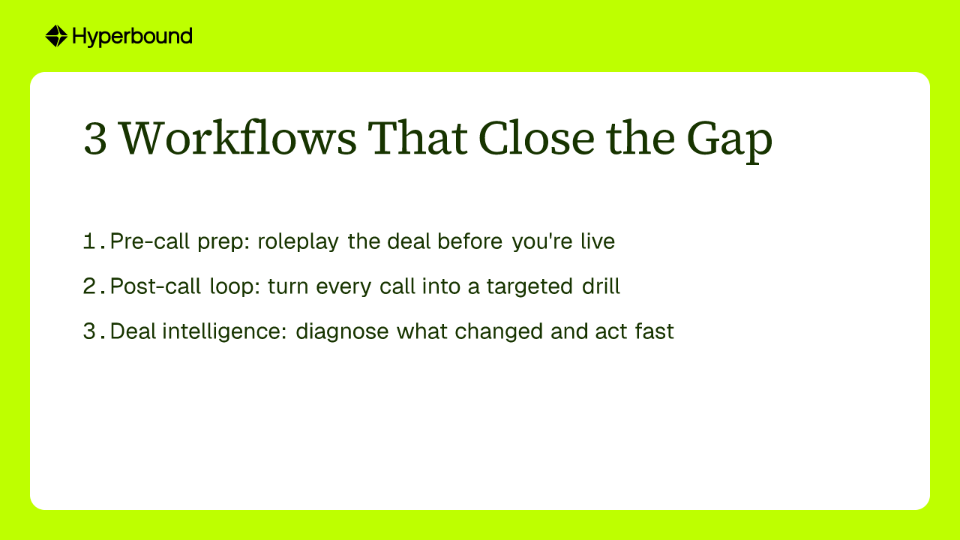
Before every first call, Luke goes into Hyperbound and asks Kota to build a roleplay based on the specific deal he is about to work. Not a generic cold call sim. A scenario grounded in the prospect company's LinkedIn profile, the specific stakeholder he is meeting, and likely objections Kota has surfaced from similar deals in the pipeline.
He runs through it. Then he runs through it again.
"By the time I actually speak with a prospect for the first time, I've already had that conversation four times."
Think about what that means structurally. By the time Luke opens his mouth on a live call, the surprise has already been removed. The awkward transition, the objection he hadn't thought through, the moment he usually stumbles — he has already been through it. Multiple times. With a version of the actual prospect, not a hypothetical.
Most reps do none of this. Not because they don't want to, but because there was never a fast, frictionless way to do it that was grounded in the real deal context rather than made-up scenarios. The gap between "I should practice this" and "I just did practice this" has always been wide. Luke's routine closes that gap before every single call, across every deal in his pipeline. That compounds.
After every call, Ece does something most reps don't.
She checks the call scorecard inside Hyperbound, finds her weakest moment, reads Kota's diagnosis of what went wrong, and then asks Kota to generate a targeted AI sales roleplay for that specific gap. Not a general "work on discovery" prompt. A drill built around the exact moment where the call lost momentum.
The whole process takes a few minutes.
This matters because of what most reps do instead. They make a mental note. They tell themselves they will work on it. Then they carry the same gap into the next ten conversations, compounding the error across every deal it touches before a manager eventually catches it — if they catch it at all.
Ece's loop turns every real call into a practice rep before the week ends. The call generates the data, the data generates the drill, and the drill tightens execution on the next call. No waiting for a 1:1. No depending on a manager to notice and find time to address it.
This is especially precise for reps working structured methodologies like MEDDPICC. Kota scores the call against the methodology and builds targeted drills for the specific qualification gap — whether it is identifying the Champion, quantifying the Metric, or surfacing the Decision Criteria early enough to matter. The system doesn't just flag that something was missing. It builds the practice around closing that specific gap.
The third moment was the one that surprised me most.
Luke pulled up an active deal live on camera — a real account, no staging — and asked Kota a single question: "What changed after the pricing call?"
In under thirty seconds, Kota returned an answer. Not a summary of what was said. Not a transcript highlight reel. A diagnosis. Evidence-based, cross-referenced against the deal's history and what similar deals at that stage typically look like.
"I probably spend more time in the deal page inside of Hyperbound than I actually do in HubSpot."
That is a significant statement. HubSpot is where the data lives. Hyperbound is where the data becomes useful. Luke is not pulling reports or scrolling through notes — he is having a conversation with an agent that has already synthesized everything relevant and can tell him what changed, why it matters, and what to do next.
This is the kind of deal intelligence most reps can only approximate. They re-read their notes, maybe skim the transcript, make a judgment call. Luke gets a diagnosis. Every time.
Revenue teams today have more call data, pipeline data, and coaching infrastructure than at any point in the history of the profession. They also have a quota attainment rate that has dropped to 43%.
Those two facts live together comfortably because data and execution are not the same thing.
Most conversational intelligence tools surface what happened. They are good at that. They can tell you what was said, when it was said, and how long the rep talked versus the prospect. What they don't do is automatically convert that signal into a practice rep, a pre-call brief, or a targeted coaching intervention before the next meeting.
That last step — the activation step — still requires a manager. The manager has to find the moment, make time in an already full schedule, and orchestrate the coaching conversation. That's a manual process, and it leaks constantly. Reps carry gaps longer than anyone intends. Managers coach reactively instead of proactively. The lag between "a problem exists" and "a rep changed their behavior" stretches out across weeks.
Ece and Luke don't live in that lag. The system closes the loop for them.
That is not a small thing. It is the difference between a coaching infrastructure that works at the speed of a rep's improvement curve versus one that works at the speed of a manager's calendar.
The webinar focused on the AE experience, but the implications travel up the org chart.
For a sales manager, the shift is immediate. Instead of reviewing five calls to prepare for a 1:1, a manager can ask Kota what a rep needs to work on this week and arrive at the meeting with specific examples and a proposed practice scenario already built. Coaching shifts from reactive — catching problems after they've already cost deals — to precise and proactive.
For a CRO, the value is visibility. The ability to ask Kota for the state of every active deal and receive health scores, predicted close dates, flagged risks, and priority actions in plain English, in two minutes, is not a reporting upgrade. It is a different relationship with the pipeline entirely.
Will Jenkins, CEO of Journey, described it clearly:
"At the highest level, I probably know what's going on with 10% of the pipeline in actuality. A lot of it has to do with stuff being in your sales reps' heads. This is access to information I've never had before."
That is the version of the problem that lives in every boardroom. Leadership makes decisions based on what they can see. Most of what drives deals forward or backward lives in conversations, relationships, and context that never makes it into the CRM. Kota surfaces that context. It does not replace judgment — it gives leadership enough to actually use it.
Vanta ran this experiment at scale.
When they built their sales coaching and ramp infrastructure around Hyperbound, the results were not incremental. Ramp time dropped 60% — from 210 days to 72 days. Their BDR team grew 4x without the coaching infrastructure collapsing under the weight of that growth. Pipeline influenced crossed $125M.
Stevie Case, Vanta's CRO, described it as coaching that worked at the scale their growth required, instead of breaking down under it.
The mechanism behind those numbers is straightforward. Every call generates a practice opportunity. Every practice opportunity tightens execution on the next call. Every deal is actively coached by an agent that never runs out of time or bandwidth. There is no manager dependency holding up the cycle.
Kota connects training to execution automatically. The loop that Ece and Luke demonstrated — from real call to scorecard to targeted drill to next call — is not a personal habit they developed. It is a system anyone on their team can run. That is what makes it scale.
If my reps were using Kota this way, what would I see in my pipeline in 90 days?
Honest answer: faster improvement cycles. More consistent execution before high-stakes calls. Less lag between a manager noticing a problem and a rep actually changing their behavior.
The harder version of the question: what is the current system costing you for every month that gap between knowing and doing stays open?
Every deal that slips because a rep was underprepared for an objection. Every coaching conversation that happened two weeks too late. Every gap that got carried into the next ten calls before anyone caught it. That is not a theoretical cost. It is a pipeline number.
Hyperbound is a Revenue Activation Platform designed to help sales teams close the gap between knowing what to do in a deal and actually doing it effectively. It provides tools, including an AI revenue agent named Kota, to improve sales execution through roleplays, deal intelligence, and automated coaching loops. The platform focuses on activating the data sales teams already have to drive better performance and increase quota attainment.
Kota helps sales reps with pre-call preparation, post-call analysis, and real-time deal intelligence. Reps can use Kota to run realistic roleplays based on specific deal contexts, diagnose weak moments from past calls to generate targeted practice drills, and have conversational Q&A sessions to understand what's changed in a deal. This allows reps to remove surprise from live calls and continuously improve their skills.
Hyperbound solves the problem of the persistent gap between having sales data and effectively executing on it to close deals. Most revenue teams have access to call recordings and pipeline data, but there's a delay in turning those insights into behavioral changes for reps. Hyperbound closes this loop automatically, connecting call analysis directly to targeted practice and coaching without waiting for a manager's intervention, thus shortening rep improvement cycles.
While standard conversational intelligence tools report on what happened in a call, Hyperbound focuses on activating that information to improve future performance. Traditional tools can surface what was said or who talked the most. Hyperbound goes a step further by using its AI, Kota, to diagnose performance gaps from call data and automatically generate targeted practice roleplays and coaching interventions. It turns passive data into an active coaching system.
Hyperbound improves pre-call preparation by allowing AEs to roleplay the specific deal they are about to work on with an AI agent. As demonstrated in the article, reps can ask Kota to create a practice scenario based on the prospect's company details, the stakeholder's profile, and likely objections. By running through the conversation multiple times before the actual call, reps can eliminate surprises, refine their messaging, and handle objections more effectively.
For sales managers, Hyperbound makes coaching more precise and proactive. For CROs, it provides unprecedented visibility into pipeline health and deal context. Managers can use Kota to quickly identify what reps need to work on, saving time on call reviews and enabling targeted coaching. CROs can query Kota for the status of any deal, receiving health scores, risk flags, and priority actions, allowing for more informed strategic decisions based on context that typically never makes it into a CRM.
Businesses using Hyperbound can expect significantly faster ramp times for new hires, more consistent sales execution, and substantial growth in influenced pipeline. For example, Vanta implemented Hyperbound and reduced their new hire ramp time by 60% (from 210 to 72 days). They were also able to scale their BDR team 4x while influencing over $125M in pipeline, demonstrating that the platform's automated coaching loops can drive scalable and measurable improvements in revenue team performance.
The full webinar is available on demand. Ece and Luke walk through their actual workflows on camera, with real accounts and real Kota conversations. It is worth watching if you want to see what this looks like in practice rather than in description.
Kota Activate is available now for all Hyperbound customers.
New to Hyperbound? Book a demo at hyperbound.ai/book-a-demo.
Hyperbound is the Revenue Activation Platform — built for revenue teams who are tired of watching deals slip. Learn more at hyperbound.ai.









Use Cases
Legal