Revenue teams aren’t lacking data.
Dashboards show pipeline movement. Transcripts capture every word. Objection tags categorize friction. Forecast reports break down risk by stage and segment.
There is no shortage of information.
But when a rep or manager has a specific question, the workflow still looks like this:
Open the CRM.Open the call recorder.Search transcripts.Scan summaries.Cross-reference notes.Try to piece together a pattern.
The insight exists — but it requires effort to extract.
Most tools are designed to surface information. They assume the user will interpret it. They show charts, timelines, and transcripts, but they don’t actively explain what those signals mean in context.
So when someone asks, “Why is this deal stalling?” or “What changed after that pricing call?” the answer isn’t immediate.
It requires digging.
And that friction matters.
Because the harder it is to get clarity, the less often teams go looking for it.
Kota is a conversational layer on top of your real sales conversations.
Instead of clicking through dashboards or searching transcripts manually, you can ask questions directly — and get answers grounded in your call data.
It’s not a generic chatbot. It’s trained on your team’s conversations, your opportunities, your execution patterns. That means the answers aren’t theoretical. They’re contextual.
You can ask about a single deal:
Or you can zoom out to the team level:
Kota doesn’t replace your dashboards.
It gives you a faster way to access what they’re trying to show.
Instead of manually interpreting information, you can ask for what you want to understand — and get a structured answer tied to real execution signals.
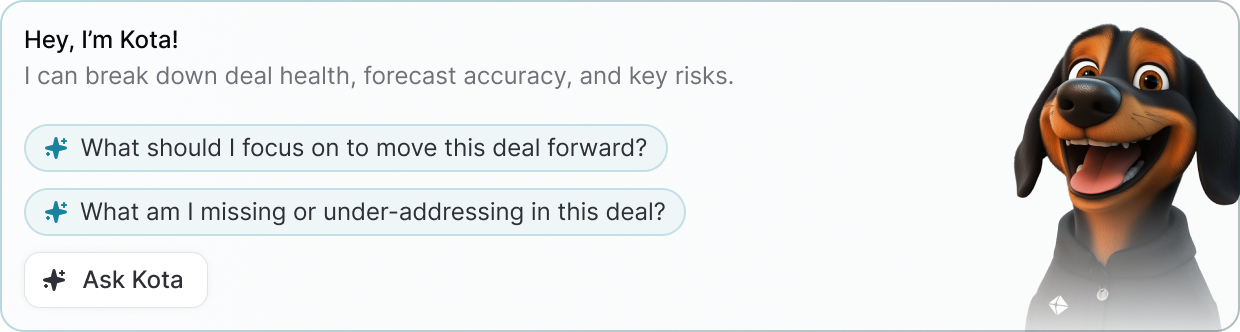
The pressure isn’t just understanding what happened. It’s preparing for what’s next.
Before a live conversation, reps don’t want to sift through transcripts or relisten to full calls. They want clarity on the trajectory of a deal — or a cold-call pattern — and what needs attention right now.
Whether you’re closing opportunities or generating pipeline, Kota helps you move from hindsight to preparation.
And if risk is emerging, Kota can generate a deal-specific roleplay tied to that exact moment — so preparation reflects the reality of the opportunity.
Kota surfaces conversion patterns across real outcomes — and can generate cold-call roleplays based on those patterns.
Insight shows you what’s happening.
Practice helps you change it.
Managers don’t struggle with a lack of visibility.
They struggle with time.
Between pipeline reviews, 1:1s, forecast calls, and internal meetings, there isn’t room to manually dig through transcripts or listen to multiple calls across every active deal.
Kota compresses that workflow.
Instead of piecing together context manually, managers can ask:
Instead of reviewing five calls to understand momentum, they get a structured answer grounded in conversation data.
And because Kota can generate roleplays based on those surfaced gaps, managers don’t just identify where execution is slipping — they can immediately direct reps toward targeted practice.
That means coaching becomes focused.
Not reactive.
Not intuition-driven.
Not dependent on listening to every call.
Just faster clarity and preparation tied to what actually needs to improve.
Sales leaders don’t need more dashboards.
They need to understand whether execution inside live deals is strengthening or weakening — before it shows up in the forecast.
Kota gives leadership direct access to behavioral signals across the pipeline.
Instead of relying solely on stage movement and commit calls, leaders can ask:
This shifts deal inspection from narrative to evidence.
Not just “How does it feel?”
But “What are buyers actually signaling?”
Kota gives leadership earlier visibility into execution gaps — while there’s still time to intervene.
RevOps teams have built the visibility layer.
Pipeline dashboards update in real time. Forecast models are managed. Fields are enforced. Hygiene is monitored.
But CRM data shows structure — not behavior.
Kota gives RevOps insight grounded in real buyer conversations.
Instead of asking:
RevOps can ask:
It moves RevOps from monitoring data integrity to understanding execution integrity.
That’s a different level of control.
Enablement leaders care about one thing: whether training shows up in live deals.
Most programs rely on certification, roleplays, and manager feedback.
But it’s difficult to see whether those skills translate under real buyer pressure.
Kota surfaces where execution actually breaks down.
Instead of guessing what to reinforce, enablement can ground coaching programs in live opportunity data.
And because Kota can generate roleplays tied to those surfaced gaps, reinforcement becomes targeted — not generic.
Training stops being theoretical.
It becomes directly connected to revenue.
Kota wasn’t built to be impressive.
It was built to be useful.
Here’s how teams describe it in their own words:
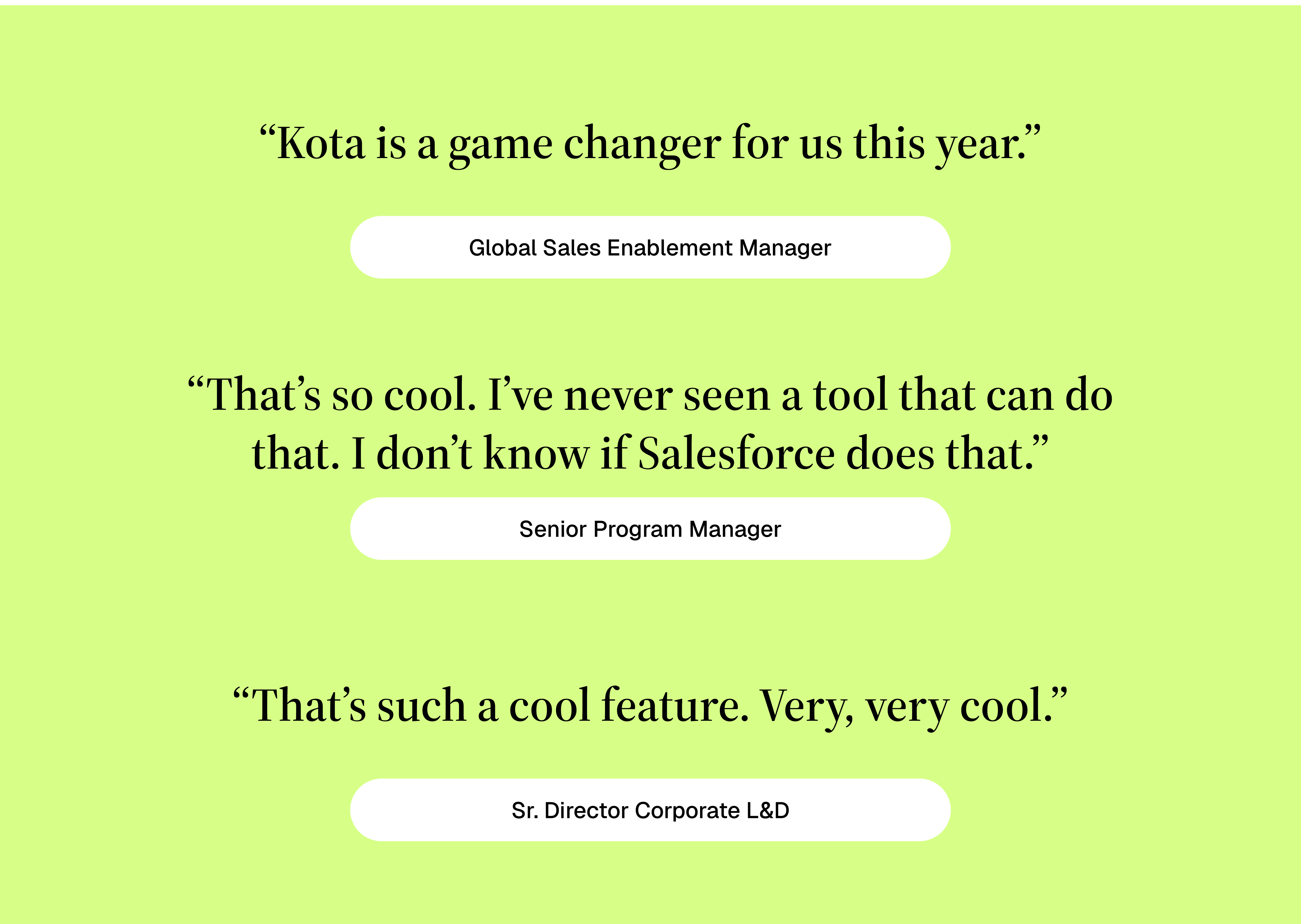
Across reps, managers, and leadership, the theme is consistent:
Kota doesn’t replace dashboards.
It makes them usable.
Sales teams don’t need more data.
They need easier access to what it means.
Kota doesn’t replace your CRM. It doesn’t replace your call recorder. It doesn’t introduce another dashboard to manage.
It simply makes the intelligence already inside your conversations usable.
Reps get clarity before their next call.
Managers get faster answers across deals.
Teams turn patterns into preparation.
When insight is hard to access, it gets ignored.
When it’s conversational, it gets used.
And when it gets used, execution improves.
If your team is already sitting on thousands of recorded conversations, the question isn’t whether the insight exists.
It’s whether it’s accessible.










Use Cases
Legal