You've been asked to introduce a speaker at an upcoming event. Now you're staring at a blank page, wondering how to craft an introduction that doesn't sound like a boring resume recitation or create an awkward moment for everyone involved.
Whether you're introducing a keynote speaker at a conference, a guest lecturer for your class, or a presenter at a community event, this critical moment sets the tone for the entire presentation. A great introduction isn't just a formality—it's your opportunity to build credibility, focus the audience, and create anticipation for what's to come.
In this guide, you'll discover five proven methods for introducing speakers, complete with templates and scripts you can customize for any occasion. Say goodbye to awkward, rambling introductions and hello to confident, engaging speaker setups that serve both your audience and your presenter.
Before you craft a single word of your introduction, you need to lay the groundwork. The most polished delivery can't compensate for poor preparation.
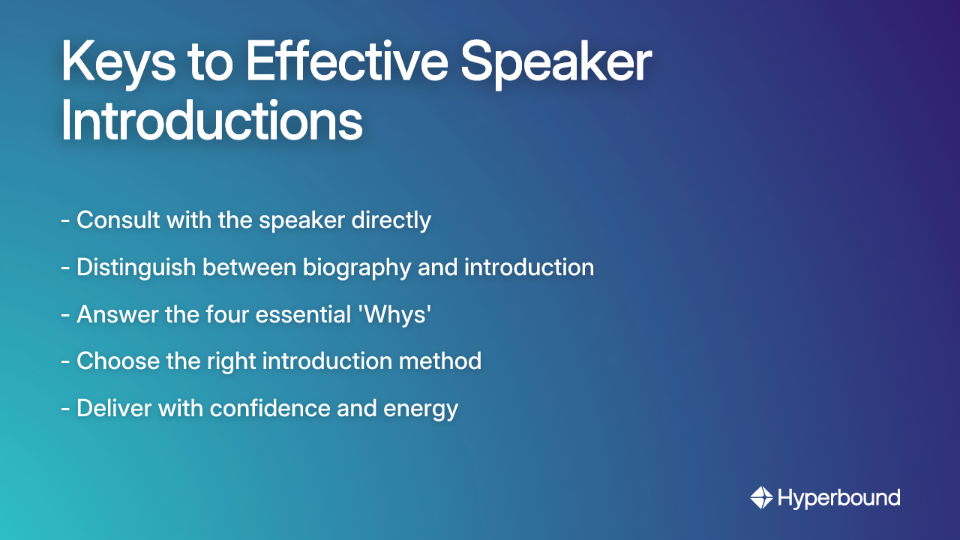
Your first step should always be to connect with the speaker directly:
This crucial distinction is often overlooked. As Expert MC emphasizes, your job as an emcee isn't to read a CV—it's to build a bridge between the speaker and the audience.
If a speaker provides a lengthy biography or one with an unusual tone, you have options:
This approach respects the speaker's preferences while freeing you from feeling responsible for content you didn't create.
Before writing your introduction, answer these four essential questions that will structure your thinking:
With this foundation in place, you're ready to craft a compelling introduction using one of these five proven methods.
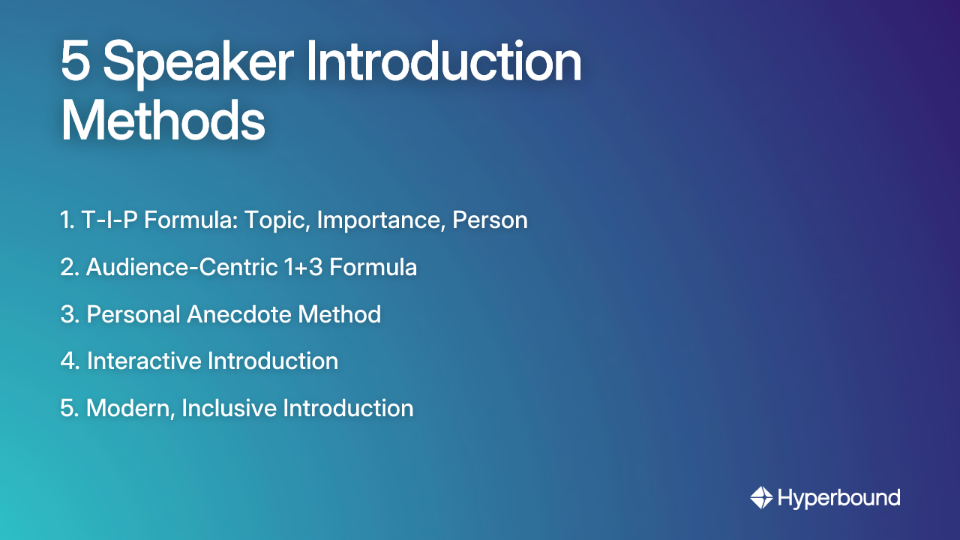
This straightforward structure answers the key questions your audience needs addressed: What's this about? Why should I care? Who's qualified to speak on it?
T - Topic: Start by introducing the subject, using a hook to grab attention.
I - Importance: Explain why this topic matters specifically to this audience. Connect it directly to their challenges, goals, or the event's purpose.
P - Person: Now introduce the speaker, highlighting their relevant credentials and expertise. Build anticipation by saving their name for last.
Sample Script:
"Good morning! In today's digital marketplace, the ability to create content that actually engages your audience is the difference between thriving and merely surviving. This challenge affects every business in this room, regardless of your industry or size. Our next speaker has helped over 200 companies triple their engagement rates using her proprietary framework. She's advised Fortune 500 companies, written the bestselling book 'Content That Converts,' and maintains one of the most-followed industry blogs on this topic. Please join me in welcoming our expert on strategic content creation, Sarah Johnson!"
This powerful technique from Devon Brown shifts focus from the speaker's past to the audience's future benefits.
The structure is simple but effective:
Sample Script:
"Our next speaker is here to show you exactly how to double your client retention rates in the next 90 days without hiring additional staff. He's not just sharing theories—he's implemented these strategies in over 50 small businesses just like yours, his methods have been featured in Entrepreneur and Forbes, and today he's giving you the exact same blueprint his private clients pay thousands for. Please help me welcome, Michael Chen!"
Notice how different this feels from a typical biography-based introduction. It's entirely focused on what the audience will gain.
This method creates a warm, human connection by sharing a brief, genuine story about the speaker or their work.
Sample Script:
"Good evening, everyone. When I first encountered Dr. Rivera's research on sustainable architecture, I was skeptical that one design approach could simultaneously address climate concerns, reduce costs, and improve aesthetics. Then I visited one of her building projects in Seattle. The transformation was so remarkable that I immediately invited her to speak with us today. Her expertise in environmental design has influenced projects across three continents. Please join me in welcoming Dr. Sophia Rivera, who will be sharing her groundbreaking approach to urban sustainability."
Important tip: Keep the story brief and make the speaker the hero, not yourself. Your personal connection should serve to elevate their expertise, not showcase your own.
Get the audience engaged from the very beginning with this technique that makes them active participants before the speech even starts.
Sample Script:
"Hello, everyone! Before I introduce our next speaker, I'd like you to raise your hand if you've ever struggled to find qualified candidates for open positions. [Pause for response] Now, keep your hand up if this challenge has cost your organization money or opportunities in the past year. [Pause again] Our next speaker, Taylor Washington, has dedicated the past decade to solving exactly this problem. As the founder of TalentBridge and author of 'The Hiring Revolution,' Taylor has helped companies reduce their hiring time by an average of 37%. Please welcome to the stage, Taylor Washington!"
This approach immediately connects the audience to the topic through their own experience, making them more receptive to the speaker's message.
This method addresses one of the most common concerns in contemporary introductions: how to handle pronouns naturally and respectfully.
The key is to weave, not state. Rather than awkwardly announcing pronouns, incorporate them naturally into your narrative flow:
Sample Script:
"Our next speaker is Alex Martinez, a pioneer in digital accessibility. They have advised over 100 organizations on creating truly inclusive online experiences for all users. In their bestselling book, 'Design for Everyone,' they outline principles that have become industry standards. Their work has been recognized with multiple innovation awards, and we're fortunate to have them with us today. Please welcome Alex Martinez!"
This approach normalizes pronoun usage while keeping the focus on the speaker's expertise and value to the audience.
Even the best introduce speaker template can fall flat with poor delivery. These final tips will help you nail your presentation:
Your energy sets the tone for the entire presentation. The Speaker Lab emphasizes the importance of smiling and showing genuine enthusiasm. If you seem bored or disengaged, the audience will follow your lead.
A great introduction is impactful but concise. Aim for under two minutes to maintain audience attention. As Expert MC notes, "The audience came to hear the speaker, not the introducer."
As you announce the speaker's name, begin clapping to set the energy level in the room and encourage the audience to join in. This creates momentum and a warm welcome.
Stay at the lectern until the speaker arrives, greet them with a handshake or nod, and only then move away. This prevents an awkward gap and shows respect. The physical handoff should be as smooth as your verbal one.
Rehearse the introduction until it feels natural. If possible, practice with the actual microphone and in the venue where you'll be speaking. Tools like Hyperbound can help you identify filler words and improve your delivery through AI-powered feedback.
For your convenience, here are condensed templates for each introduction style:
[Introduce TOPIC with a hook]
[Explain the IMPORTANCE to this specific audience]
[Introduce the PERSON, highlighting relevant credentials]
"Please join me in welcoming [Speaker's Name]!"
"Our next speaker is here to show you [ONE big benefit to audience].
They've [Qualification 1], [Qualification 2], and [Qualification 3].
Please help me welcome, [Speaker's Name]!"
"[Brief personal story connecting you to the speaker or their work]
[Transition to their relevant expertise]
[Connect to today's topic]
Please welcome [Speaker's Name]!"
"[Question that engages audience in a show of hands]
[Follow-up question or observation]
[Connect questions to speaker's expertise]
Please welcome [Speaker's Name]!"
"Our next speaker is [Name], a [role/title].
[Sentence using their pronoun]
[Another sentence using their pronoun]
Please welcome [Speaker's Name]!"
A great introduction is never improvised. It requires thoughtful preparation, consultation with the speaker, and a clear focus on what the audience needs to know.
Your role isn't simply to announce a name—it's to build a bridge of credibility and anticipation. By moving beyond the biography and using one of these proven methods, you transform a simple announcement into a powerful endorsement.
Choose the introduction style that best fits your event, audience, and speaker. Practice it until it feels natural. Then approach your next introduction with confidence, knowing you're setting the stage for success.
Remember that with each introduction, you have the opportunity to create a meaningful moment that serves both your speaker and your audience. It's not just about following a template—it's about making a genuine connection that enhances the entire event experience.
With these tools in your toolkit, you're well-equipped to introduce any speaker with confidence and professionalism. Your audience—and your speakers—will thank you.
The most important part of introducing a speaker is preparation, especially consulting with the speaker directly. Before writing your introduction, always ask the speaker for their preferences, confirm the pronunciation of their name, clarify their pronouns, and identify the key accomplishments they want highlighted. This ensures your introduction is accurate, respectful, and aligned with their goals.
A speaker introduction should be brief and impactful, ideally lasting under two minutes. The purpose of the introduction is to build credibility and anticipation for the main speaker, not to be a speech in itself. A concise introduction respects the audience's attention and ensures the focus remains on the person they came to hear.
If a speaker provides a biography that is too long or doesn't fit the event's tone, you should not read it verbatim. Your role is to build a bridge, not recite a CV. Thoughtfully edit the bio down to its most relevant and impactful points. If you must use their specific wording, frame it by saying, "In their own words..." to separate their voice from yours.
To make an introduction more engaging, shift the focus from a simple list of credentials to the value the audience will receive. Use techniques like the Audience-Centric 1+3 Formula (focusing on one big benefit and three qualifications) or an Interactive Introduction (asking the audience to raise their hands in response to a relevant question). A personal anecdote can also create a warm, human connection.
The best way to handle a speaker's name is to ask them directly for the correct pronunciation. Don't guess. To be certain, you can ask them to send a voice memo of them saying their name. Getting the name right is a fundamental sign of respect that establishes your credibility as the introducer.
If you don't know the speaker, rely on a structured formula like the T-I-P (Topic, Importance, Person) or the 1+3 Formula. These methods don't require a personal connection. Focus your preparation on answering the "Four Whys": Why this subject? Why this speaker? Why this audience? Why now? This research will provide all the material you need for a compelling, professional introduction.
Handle a speaker's pronouns by asking for them during your preparation and then weaving them naturally into the introduction. Instead of a formal announcement like "Their pronouns are they/them," simply use the pronouns in your sentences. For example: "Alex has advised over 100 organizations. In their bestselling book, they outline..." This approach is modern, inclusive, and seamless.










Use Cases
Legal