
You've spent the last three years building the perfect revenue stack. Hyperbound turns deal activity into coaching moments. Gong captures every call. Your CRM is logging activity. Clari is flagging pipeline risk. Your enablement platform is tracking course completions. AI is summarizing conversations and surfacing next steps.
And yet — when you check quota attainment across your sales org — the number hasn't moved.
You start wondering: Is this a market problem? A talent problem? A management problem? The data should be giving you answers. But the more dashboards you build, the more the number stares back at you, unchanged.
The bad news: your data infrastructure is not the problem. The good news: the actual problem is fixable — once you know what to measure.
We've been measuring the wrong gap.
Revenue teams have spent a decade obsessing over pipeline gaps — coverage ratios, stage velocity, win rates. But the gap that's actually killing quota attainment lives somewhere else: between the moment an insight appears in your system and the moment a seller actually does something differently.
We call this the Intervention Gap.
The Intervention Gap is the delay between revenue insight and behavior change. And across B2B sales organizations, this gap is costing revenue at a scale nobody has yet quantified — until now.
Let's start with the benchmark that's become impossible to ignore: according to RepVue's Cloud Sales Index, quota attainment across the cloud sales market has been stubbornly stuck for nearly three years running.
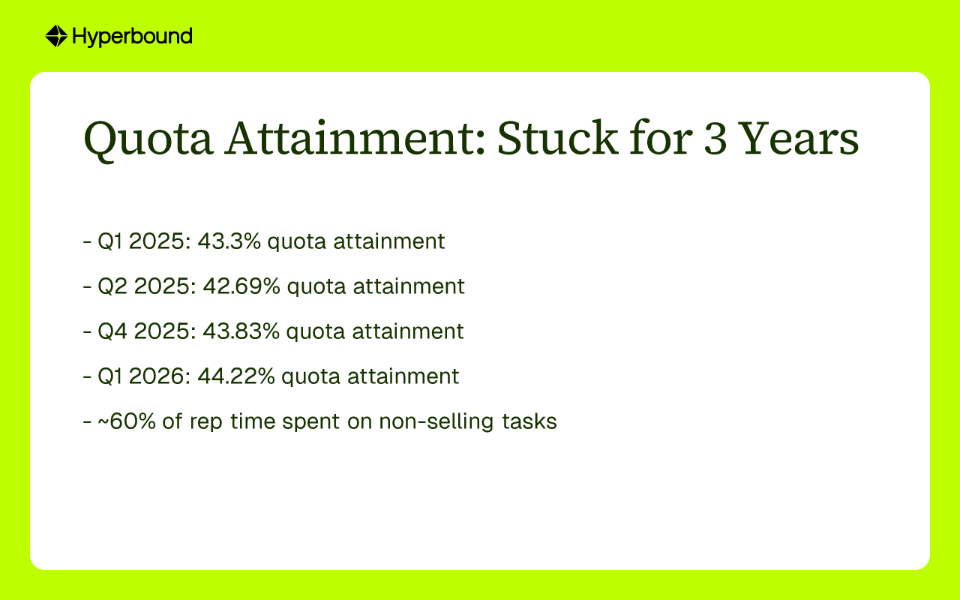
That fractional improvement in Q1 2026 should not be mistaken for recovery. A market where approximately 4 in 10 sellers hit quota is not experiencing a temporary dip. It is operating on a broken model.
And it gets worse when you layer in what's happening to the time of the very reps expected to drive those numbers. Salesforce's State of Sales research reports that sellers spend roughly 60% of their time on non-selling tasks — data entry, internal coordination, research, admin, and tool-switching. Before a rep ever opens a sales conversation, most of their week is already gone.
So we have a market where only 4 in 10 sellers hit quota, and the average seller spends more than half their week not actually selling.
The usual explanations pile up quickly: cautious buyers, longer cycles, more stakeholders, tighter budgets, AI-informed procurement. These are real pressures. But they describe the environment, not the operating model failure underneath it.
The real question is: why can't modern revenue teams adapt to these pressures faster?
Here's the uncomfortable truth for every RevOps leader reading this: the last decade of investment in revenue technology created a powerful system for seeing problems. It did not create an equally powerful system for solving them.
Count the layers your organization has built:
Highspot's 2025 State of Sales Enablement report, which surveyed 350 GTM professionals, frames AI as central to this evolving layer. Gong's State of Revenue AI 2026 report, drawing from 3,000+ revenue leaders and 7.1 million opportunities, paints a similar picture: we have unprecedented signal volume flowing through modern revenue stacks.
But here's the distinction that the tech stack doesn't make:
Observation is not intervention.
A dashboard can show that late-stage deals are slipping. It cannot make a rep practice pricing objections before the next call.
A call recording can reveal weak discovery. It cannot guarantee that a manager coaches the rep within 24 hours — or at all.
A forecast tool can flag deal risk. It cannot ensure the seller changes behavior before the champion meeting.
Your organization knows more than it ever has. But the rep often acts the same as before.
That is the Intervention Gap in its simplest form — and it's the structural flaw that no amount of additional dashboards will fix.
The Intervention Gap is the time and friction between four moments:
Most revenue teams measure moments one and two very well. Almost none measure moments three and four.
The Intervention Gap is the delay between revenue insight and behavior change.
This gap shows up in predictable places:
As Sai Guduguntla wrote in Revenue Operations Alliance, the problem is precise: "Your insights are dying in dashboards." The data exists. The signal is there. But the system was never architected to close the loop.
The result: a revenue organization that is rich in diagnosis and poor in treatment.

Understanding where the Intervention Gap lives is only half the picture. To close it, you need to understand the four structural reasons it opens in the first place.
When Salesforce reports that reps spend ~60% of their time on non-selling work, it's describing more than an efficiency issue. It's describing a workflow that crowds out the very behaviors — preparation, practice, reflection — that compound over time into performance improvement.
A rep who might benefit enormously from a focused 20-minute roleplay before tomorrow's pricing conversation doesn't have 20 minutes. They're updating CRM, attending pipeline reviews, responding to internal Slack threads, and hunting for the right deck to send.
Coaching becomes one more thing competing for a calendar that has no slack left in it.
Modern sales managers are expected to forecast, inspect pipeline, run deal reviews, hire, coach, review calls, enforce process, and report to leadership — often simultaneously, often without dedicated time blocks for any of it.
The math is unforgiving: if each rep on a team of eight produces multiple calls, several email threads, CRM updates, and opportunity changes every week, no manager can manually review all of it and still run a clean forecast process.
Internal data from Hyperbound shows that managers typically coach in roughly 5–8% of their total working time, and listen to less than 1% of recorded calls. (For a deeper look at where AI sales coaching platforms fit in this equation, see our full review.) Coaching becomes reactive — reserved for the most visible failures, the loudest problems, or the upcoming big deal.
The reps who are quietly underperforming in subtle, consistent ways? They don't make the cut.
Traditional enablement does its best work at specific, structured moments: onboarding, SKOs, product launches, certification programs. These are high-fidelity, high-investment moments of skill transfer.
But live deal execution does not wait for scheduled moments.
A rep needs to handle a pricing objection in 18 hours. A new competitor just appeared in an active late-stage deal. A champion is asking for an ROI case before the next meeting. A discovery call revealed a vertical-specific objection the rep has never encountered before.
The Ebbinghaus forgetting curve is worth citing here: research consistently shows that roughly 80% of new information is forgotten within 30 days of training without reinforcement. Hyperbound's own B2B Sales Performance Benchmark puts this in commercial context. Quarterly training cycles produce quarterly forgetting cycles. The skills that would help reps in this week's deals weren't reinforced this week. They were reinforced last quarter.
Enablement measures completion far more easily than it measures in-deal behavior change. And completion, as it turns out, does not predict performance.
This is the one that stings for RevOps leaders specifically.
RevOps often knows about problems first:
But knowing is not the same as intervening. RevOps can report the issue. They can escalate it. They can redesign the process. What they typically cannot do is change what happens in the rep's next conversation.
This is why the Intervention Gap is, at its core, a RevOps problem. RevOps is accountable for the truth of the revenue system — but not yet fully equipped to change the behaviors producing that truth.
The language of the industry is shifting to reflect this gap between insight and action.
At Hyperbound, we coined the term Revenue Activation to describe what happens when teams stop just analyzing sales data and start using it to change outcomes. It's a new category of technology focused on closing the loop between insight and action.
This matters because it reflects something the market already knows: the old frame of "enablement" (equipping the rep) is no longer sufficient. Buyers want proof that sales technology changes outcomes.
The new question that revenue teams, vendors, and analysts are all asking:
Does this system merely observe revenue work — or does it activate better revenue behavior?
Sales enablement equips the rep.
Revenue activation changes what the rep does in the moments that matter.
The distinction is not semantic. It is the difference between a system that ends at the dashboard and a system that closes the loop. For a side-by-side look at how sales training frameworks have evolved toward this model, see our comparison guide.
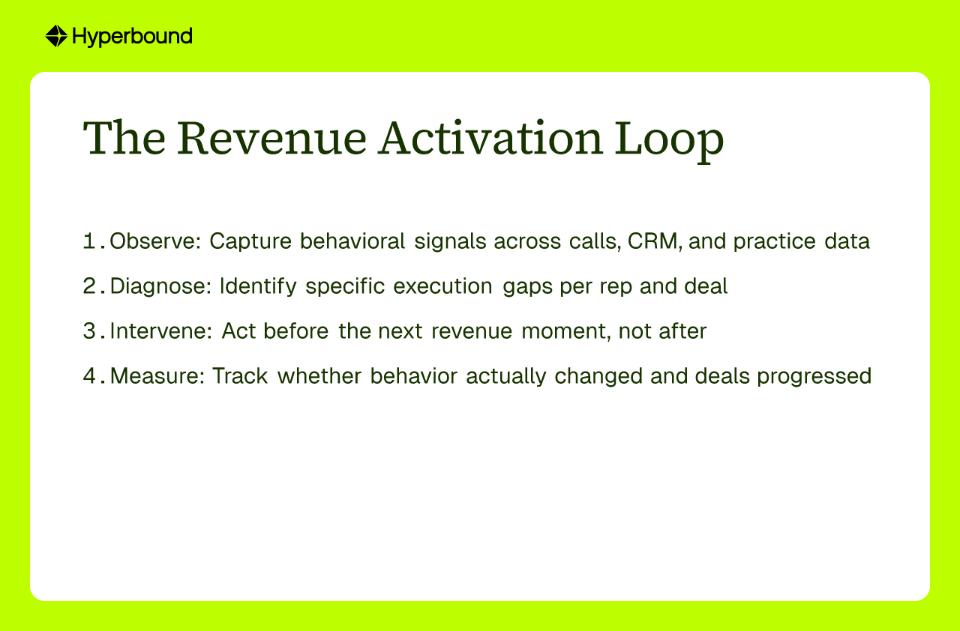
Closing the Intervention Gap requires more than better tools. It requires a fundamentally different operating loop — one where insight is not the endpoint, but the trigger.
Here is the framework:
Capture the signals that matter most — not just activity metrics, but behavioral signals:
The last two signals are the ones most organizations are not yet logging.
Turn raw signals into specific, actionable execution gaps:
This step requires moving beyond "this deal looks risky" to "this rep is consistently struggling with X, and here's the evidence."
This is where most revenue systems break down. Interventions need to happen before the next call, not after the deal is already lost.
Interventions can include:
The timing is not cosmetic. A coaching conversation that happens two days after a failed call is far less valuable than a 10-minute targeted practice session the night before the follow-up.
This is the step that separates the closed loop from the dashboard cycle.
Did the rep practice the specific scenario? Did their next call show improved objection handling? Did the opportunity progress after the intervention? Did win rate in that deal stage improve over a quarter?
This is how customers like Vanta have achieved a 60% reduction in ramp time — not through more reporting, but through a closed loop that connects practice to performance to pipeline outcome. See how the 30-60-90 day ramp framework maps to each stage of this loop.
If your organization wants to start quantifying the Intervention Gap, these are the five metrics to begin tracking (for a broader framework of RevOps KPIs that matter in 2026, Landbase's dashboard breakdown is a useful companion read):
.png)
Of these five, Intervention Coverage Rate is the most important starting point — and the most sobering.
Most organizations that attempt to measure this will find that the vast majority of detected risks never receive a structured response. They are seen. They are logged. They are discussed in a pipeline review. And then the next deal arrives, and the pattern repeats.
That is the scale of the gap.

RevOps has historically been asked to answer three questions:
The next mandate is more direct:
The State of RevOps 2025 report found that RevOps leaders increasingly see their role expanding beyond reporting into active revenue influence — but most teams still lack the tooling and workflows to act on that mandate.
This is the evolution that the Intervention Gap makes possible — and necessary. RevOps teams that can quantify the gap between insight and action are no longer just reporting on performance. They are improving it.
Practically, this means RevOps can:
The best RevOps teams will not just maintain dashboards. They will architect the loop between insight and action.
The Intervention Gap cannot be closed at scale through human effort alone. There are not enough manager hours, not enough enablement bandwidth, and not enough rep attention to manually execute timely interventions across every deal, for every rep, every week.
This is where AI agents become genuinely strategic — not as generic assistants, but as the layer that makes the loop run at speed.
Gong's State of Revenue AI 2026 report reflects the market's growing recognition of AI's role in revenue execution. But the most valuable AI use cases are not the ones that create more summaries — they are the ones that compress the time between signal and intervention.
AI can:
When AI becomes the activation layer — not just the documentation layer — it compresses the Intervention Gap from days to hours, or hours to minutes.
That compression is where quota attainment starts to move.
Depending on your role, the Intervention Gap surfaces differently. Here is where to start:
If you're a CRO:
How quickly does our organization turn deal risk into changed seller behavior? What is our average time from signal to intervention?
If you're leading RevOps:
What percentage of the pipeline risks we detect actually receive a timely, structured intervention? Are we measuring that?
If you're running Enablement:
Can we show that our training changed what reps did in a live revenue moment — not just that they completed a module?
If you're a frontline manager:
Which of my reps needs an intervention before their next call — not after their next one-on-one?
These are not rhetorical questions. They are the metrics that separate revenue organizations that are merely observant from those that are genuinely adaptive.
Quota attainment has been stuck near 43% for nearly three years — not because revenue teams lack information, but because they lack a reliable operating system for turning information into seller behavior change.
The last decade of revenue technology gave GTM teams unprecedented visibility. The next decade will be defined by speed of response.
The companies that build a closed loop — Observe → Diagnose → Intervene → Measure — will not just have better dashboards. They will have faster-learning revenue teams. And in a market where only about 4 in 10 sellers hit quota, the ability to intervene faster will become the defining competitive advantage.
The Intervention Gap is real, measurable, and closeable.
The question is which organizations will close it first.
The Intervention Gap is the delay between when a revenue insight (like deal risk) is identified in your systems and when a seller's behavior actually changes as a result. This gap exists because while tools are excellent at observing problems—like a stalled deal or poor discovery on a call—they don't automatically trigger a timely and effective intervention. Closing this gap means moving from simply seeing a problem to actively fixing it before the next crucial buyer interaction.
More sales data isn't improving quota attainment because most organizations have only built an observation system, not an intervention system. Data is effective at identifying problems, but it doesn't automatically change a seller's behavior. The modern revenue stack creates dashboards that show where things are going wrong, but this information often dies there. The real challenge is translating those insights into the timely coaching, practice, and behavior change that directly impacts deal outcomes.
Sales Enablement focuses on equipping reps with skills and content, typically through structured training events like SKOs or onboarding. Revenue Activation focuses on changing a rep's behavior in the specific moments that matter during a live deal cycle. While Enablement is often event-based, Revenue Activation is workflow-based, triggered by real-time deal signals (like a competitor mention or pricing objection). It aims to close the loop between insight and action immediately, ensuring the right behavior happens on the next call.
The first step is to begin tracking your "Intervention Coverage Rate"—the percentage of identified deal risks that actually receive a structured intervention. This metric reveals how often insights lead to action. From there, you can adopt the "Observe → Diagnose → Intervene → Measure" operating model. This involves diagnosing specific execution gaps from behavioral signals, implementing timely interventions (like AI-powered roleplays), and measuring whether the seller's behavior actually changed as a result.
AI acts as a scaling mechanism to close the Intervention Gap by compressing the time between a signal and a corrective action. It automates timely, personalized interventions that humans alone cannot deliver at scale. For example, AI can instantly surface a deal-specific roleplay for a rep to practice an objection, prompt a manager with the highest-impact coaching opportunity, or run a pipeline review in minutes. This allows AI to function as an activation layer, not just a documentation layer.
Closing the Intervention Gap is a shared responsibility, but it is fundamentally a RevOps mandate to architect the system that makes it possible. RevOps is uniquely positioned to design the "Observe → Diagnose → Intervene → Measure" loop that connects data signals to intervention mechanisms. However, execution requires everyone: CROs must champion the strategy, managers must execute timely coaching, and reps must engage with the interventions to change their behavior. RevOps builds the engine, but the entire revenue team drives it.










Use Cases
Legal