
You've spent hours crafting the perfect sales demo. Your slides are beautiful, your talk track is polished, and you've practiced your delivery until you could recite it in your sleep. But when the big moment arrives, you're met with blank stares, multitasking prospects, and that dreaded phrase: "This is interesting, but can you show us how it specifically helps with our unique situation?"
Traditional sales demos are failing modern B2B buyers. Static presentations overload customers with information rather than focusing on their specific needs. One-size-fits-all approaches lead to disengagement, while the lack of tracking mechanisms leaves sales teams blind to what actually resonates with prospects.
As one frustrated sales leader put it on Reddit, "Lack of engagement during demos leads to wasted time and missed connections." Another lamented, "It's difficult knowing what to present if customers don't communicate their needs."
The good news? A new generation of interactive sales tools is emerging to solve these exact problems. Whether you need to practice your pitch to perfection, automate personalized demos at scale, or gain deeper insights into buyer engagement, there's a solution designed to help your team close more deals in 2026 and beyond.
Let's dive into 12 of the most promising interactive sales tools, categorized by function, to help you choose the right solution for your specific needs.
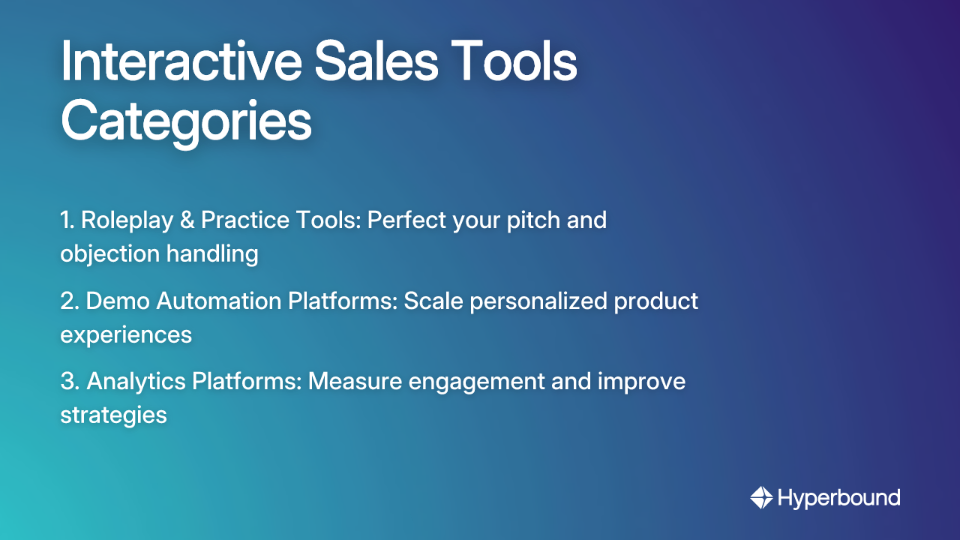
Before any demo happens, your reps need to be prepared. These tools help sales teams practice their talk tracks, handle objections, and master their demo flow in a risk-free environment.
Type: AI Sales Coaching Platform
Description: Hyperbound is an advanced AI platform designed to transform sales readiness by enabling reps to practice critical conversations in hyper-realistic simulations. It tackles the core challenge of scaling effective coaching by providing unlimited, on-demand practice opportunities that traditional methods and other tools lack.
Key Features & How It Solves Problems:
Hyperbound's unique advantage lies in offering unlimited, risk-free practice for sales reps across diverse scenarios, effectively scaling coaching beyond manager availability and ensuring consistent message delivery across the entire team.
Type: AI-powered sales coaching and simulation
Description: Second Nature offers AI-driven roleplay simulations for sales teams, with a notable feature of analyzing video calls to provide feedback on body language and presentation effectiveness.
Key Features: Industry-specific training modules, strong LMS capabilities for structured learning paths, and video analysis for non-verbal cues.
Benefits: Helps reps improve not just what they say, but how they say it.
Learn more about Second Nature
This section covers tools that help sales and presales teams create, personalize, and share interactive product demos at scale. They solve the problem of "feature fatigue" and the need for "demo customization" by allowing buyers to explore products on their own terms.
Type: AI-Powered Demo Automation Platform
Description: A leading platform that allows presales teams to create a library of on-demand video demos and interactive product tours. It enables buyers to self-educate 24/7.
Key Features: Automated, personalized demo journeys; interactive product tours; integrated CTAs; and detailed analytics on viewer engagement.
Benefits: Significantly scales presales capacity, reduces the number of unqualified demos, and can increase close rates.
Pricing: Starter plan at $600/month, Pro at $1250/month.
Type: Interactive Demo Platform
Description: Walnut enables teams to create interactive, customized product demos without any code. It captures your product's front-end for easy editing and personalization.
Key Features: No-code demo capture and editing, integrated analytics to track viewer engagement, and organization of demos by funnel stage.
Benefits: Allows for incredibly fast demo personalization and easy sharing.
Pricing: Ignite plan starts at $750/month.
Type: Interactive Demo Platform
Description: Storylane helps create guided demos and sandbox solutions, allowing prospects to experience the product firsthand.
Key Features: AI-generated content and intentions tracking, customizable demo flows, and detailed analytics.
Benefits: Excellent for creating both guided demos for marketing and interactive sandboxes for sales.
Pricing: Ignite plan starts at $750/month.
Type: Demo Creation Platform
Description: Reprise offers a comprehensive platform for creating live demos, interactive product tours, and application clones.
Key Features: Custom workflows, data-driven personalization, and robust control over the demo environment.
Benefits: Provides flexibility for creating various types of demo experiences, from simple tours to complex live environments.
Type: Demo Automation for B2B Software
Description: Demoboost helps sales teams deliver consistent and effective demos through guided tours and digital sales rooms.
Key Features: Guided product tours, centralized demo library, and analytics on demo usage.
Benefits: Helps enforce demo delivery consistency and quality across the entire sales team.
Pricing: Custom pricing based on the number of users.
Type: AI-Enhanced Interactive Demo Creator
Description: Supademo allows for the rapid creation of interactive demos, often via a simple Chrome extension that captures screen clicks and actions.
Key Features: Chrome extension for fast capture, AI features for personalization and text generation.
Benefits: Extremely fast demo creation process, making it ideal for quick, one-off demos or support documentation.
Pricing: Free tier available, with paid plans starting from $27/month.
Type: Video Messaging Platform
Description: While not a dedicated demo platform, Loom is widely used for creating quick, shareable screen-recording demos.
Key Features: Simple screen recording, AI enhancements for titles and summaries, and easy sharing via link.
Benefits: Excellent for asynchronous communication and sending quick, personalized video walkthroughs to prospects.
Cons: Limited interactivity compared to specialized platforms.
Pricing: Free starter plan available.
These tools address the pain of having "no tracking," which makes it impossible to gauge buyer interest or improve strategies. They analyze sales conversations and demo engagement to provide actionable insights.
Type: Revenue Intelligence Platform
Description: Gong captures and analyzes every customer interaction—calls, emails, meetings—and uses AI to provide insights that drive revenue.
Key Features: Automatic activity capture, real-time pipeline visualization, AI-powered insights and recommendations, and customizable reporting dashboards.
Benefits: Unifies fragmented data into a single source of truth, accelerates decision-making, and enables precise, data-driven coaching. Gong claims it can improve revenue predictability by up to 300%.
Learn more about Gong's Sales Analytics Software
Type: Live Demo & Sandbox Environment
Description: TestBox allows buyers to test products in a live, fully-functional sandbox environment, often using AI-generated synthetic data.
Key Features: AI auto-population of sandboxes, guided walkthroughs, and user simulation for realistic testing.
Benefits: Provides a highly realistic demo environment where prospects can truly test capabilities without needing a separate instance.
Pricing: Starts at $44,750/year for 15 users.
Before diving into a full purchase, consider these implementation best practices to ensure adoption and ROI:
.png)
To justify investment in these tools, track these key metrics:
Time Saved & Productivity Gained
Improved Sales Velocity & Close Rates
Reduced Ramp Time for New Hires
Lead Conversion & Engagement
The era of the static, one-way sales demo is over. To win in 2026, sales teams must adopt interactive, personalized, and data-driven approaches. The tools we've covered—spanning practice, automation, and analytics—provide a comprehensive toolkit to enhance engagement, scale personalized experiences, and ultimately drive predictable revenue growth.
Take time to evaluate your current demo process, identify your biggest bottleneck, and begin exploring the interactive sales tool that best addresses that specific challenge. Your prospects will thank you with their engagement, and your bottom line will reflect the difference.
Interactive sales tools are software solutions designed to move beyond static presentations and create engaging, personalized, and buyer-centric demo experiences. They enable prospects to actively explore a product through guided tours, sandboxes, or customized video journeys, transforming a passive pitch into an active conversation and providing sales teams with valuable data on buyer engagement.
Traditional sales demos are no longer effective because they are typically one-size-fits-all, failing to address the specific pain points of modern B2B buyers. This leads to prospect disengagement, information overload with irrelevant features, and a lack of data on what truly resonates. Interactive tools solve this by personalizing the experience to each buyer's unique needs.
To choose the right tool, first identify your primary sales bottleneck. If your reps lack confidence or consistency, start with a roleplay and practice tool like Hyperbound. If you need to scale demo delivery and qualify leads, look into demo automation platforms like Consensus or Walnut. If you lack visibility into what works, an analytics platform like Gong is your best bet. Always prioritize tools that integrate with your existing CRM.
The main benefit of a demo automation platform is the ability to scale the creation and delivery of personalized product demos. These platforms allow sales and marketing teams to quickly create interactive product tours that prospects can explore on their own time. This frees up valuable presales and sales resources from repetitive, unqualified demos and allows buyers to self-educate 24/7.
AI roleplay tools improve demo skills by providing a safe, scalable, and on-demand environment for reps to practice. Platforms like Hyperbound allow sales reps to rehearse their talk tracks, handle tough objections, and master their demo flow against realistic AI buyer personas. This builds muscle memory and confidence before they ever face a live prospect, ensuring they deliver a consistent and compelling message every time.
You can measure the ROI of interactive sales tools by tracking several key business metrics. The most important ones include improvements in sales cycle length, increases in demo-to-close conversion rates, reductions in new hire ramp time, and time saved by automating manual demo creation. By comparing these metrics before and after implementation, you can calculate the direct financial impact on your revenue and productivity.










Use Cases
Legal