
Your name is sitting at the bottom of the leaderboard. Your win rate is a single digit while your colleagues are posting 15%, 25%, even 40%. As one rep on Reddit put it, "It's a bit embarrassing to be exposed like that."
If that resonates, here's the first thing you need to hear: a stagnant win rate is almost never a rep problem. It's a systemic execution problem.
Think about it. Frontline managers spend just 5–8% of their time on coaching — and that's the first thing cut when the quarter gets busy. Sales enablement leaders are stretched thin, serving 50–100 reps with limited bandwidth. And 80% of training content is forgotten within 30 days. By the time a manager listens to a call, the deal is already lost.
Before you can fix your win rate, you need to diagnose why it's broken in the first place.
Win Rate Formula: Wins ÷ Total Closed Opportunities × 100
For context, SaaS industry benchmarks by segment look like this:
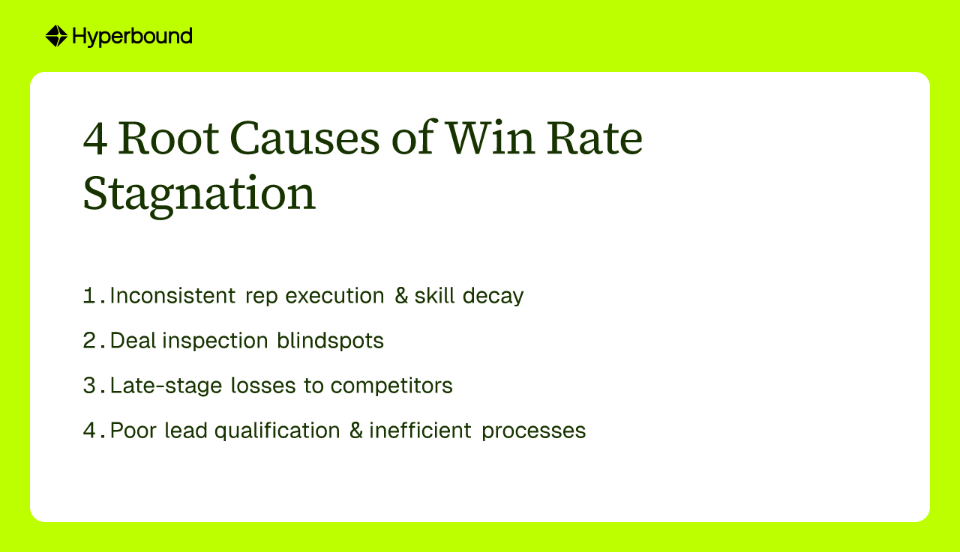
The root causes of win rate stagnation typically fall into four buckets:
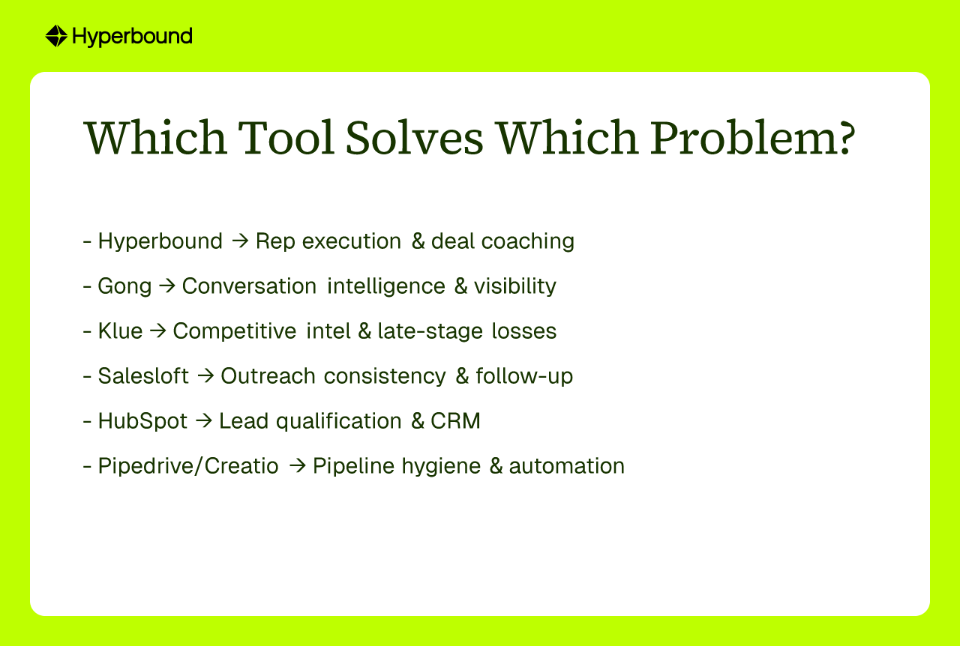
The seven tools below are organized by the root cause they solve. Each is a category-leading piece of sales win rate improvement software — but the right one for your team depends entirely on your diagnosis.
Root Cause Solved: Inconsistent Rep Execution, Skill Decay, and Deal Inspection Blindspots
When win rates stagnate, the usual response is to look at more data — more call recordings, more pipeline reviews, more dashboards. But data alone doesn't change behavior. What changes behavior is practice, feedback, and accountability in the moments that matter.
That's the gap Hyperbound was built to close. The company coined the "Revenue Activation" category to describe what happens when teams stop just analyzing call data and start using it to change outcomes. Reps who don't get enough at-bats see their skills decay. Generic training doesn't stick. And managers are listening to less than 1% of recorded calls — which means most deal risk goes undetected until it's too late to act.
Hyperbound's three-product platform forms a continuous improvement loop: analyze real deal behavior → identify skill gaps → practice hyper-realistic scenarios → perform better in live calls.
Hyperbound Practice gives reps a risk-free, repeatable environment to sharpen the skills that move deals forward — cold calls, discovery, objection handling, demos, renewals, and multi-stakeholder conversations.
The AI buyer personas are trained on 2M+ hours of real B2B sales conversations, which means they push back the way real buyers do — not like ChatGPT, which (as one Reddit user pointed out) "just agrees and tells me why I'm right." Hyperbound builds digital twins of specific buyers using LinkedIn profiles and voice cloning, so practice mirrors the actual person a rep is about to call.
Key features:
Hyperbound Perform solves the question every manager asks: "Should I listen to every single call, or is there one part worth reviewing more than anything else?" Perform answers by automatically surfacing what's helping or hurting a deal across all touchpoints — not just individual calls in isolation.
Unlike call-level tools that analyze conversations one at a time, Perform connects insights across every email, call, and stakeholder interaction in a deal to surface early risk signals and recommend the next best action before it's too late.
Kota sits above Practice and Perform, acting as an AI Revenue Analyst inside Slack or Teams. It analyzes your entire pipeline at once — surfacing patterns like which competitor is winning deals this quarter — and then automatically assigns a personalized Bite-Sized Roleplay or coaching intervention to the rep who needs it, right where they work.
Proof Points:
Best for: B2B SaaS teams whose win rate problem is rooted in how reps execute in live conversations, and who want to move beyond passive analysis to actively changing deal outcomes.
Root Cause Solved: Deal Inspection Blindspots
Gong is a widely-used conversation intelligence platform in B2B sales. It records, transcribes, and analyzes every customer-facing interaction — calls, meetings, emails — to give managers a reality-based view of pipeline health and rep behavior.
Where most pipeline reviews are hours of optimistic guesswork, Gong grounds deal inspection in actual buyer signals: what topics came up, who's doing most of the talking, whether key stakeholders have been engaged. It also provides a library of recorded calls useful for onboarding reference.
One important note: Gong excels at showing you what's happening and what happened in past deals. The gap it leaves — the one Hyperbound is built to fill — is turning those insights into changed behavior. As Hyperbound's founders put it, Gong gives you "a giant library of data." But data alone doesn't close deals.
Best for: Organizations that need foundational visibility into customer conversations and want to identify winning patterns from historical deal data.
Root Cause Solved: Late-Stage Objection Loss to Competitors
If your reps are consistently losing deals in late stages when a competitor gets introduced, the problem isn't rep skill — it's intel. Klue automatically aggregates competitor information from public and internal sources (websites, Gong calls, CRM notes, Slack) and delivers it to reps in the tools they already use.
One product marketer on Reddit put it well: it's not just about knowing a competitor dropped pricing by 10% — it's understanding "how that drop changed the implicit price perception of your product." That's the level of actionable insight Klue is built to surface.
Proof Point: Klue helped Blackbaud boost competitive win rates by 28% against their top competitors.
Best for: Teams in crowded markets where competitive differentiation is the deciding factor between winning and losing deals.
Root Cause Solved: Inconsistent Outreach and Lost Deal Momentum
As one rep on Reddit noted, one of the simplest drivers of improved win rates is "timely follow-ups — same day or first thing in the AM." That's easier said than done when reps are managing dozens of deals simultaneously.
Salesloft solves this by automating and sequencing multi-channel outreach — emails, calls, social touches — so that the right follow-up happens at the right time, every time. It brings process rigor to top-of-funnel and mid-funnel engagement, reducing the revenue lost to dropped threads and inconsistent touchpoints.
Best for: Sales teams that need to improve the consistency and velocity of outreach to build and maintain deal momentum.
Root Cause Solved: Poor Lead Qualification and Disconnected Data
"Get rid of the tire kickers and fence sitters and your win rate will increase." That Reddit comment cuts to the heart of what HubSpot Sales Hub is built to solve. By connecting sales activity with marketing data in a single CRM, Sales Hub gives reps the context they need to qualify hard and early — and to stop wasting cycles on prospects who were never going to buy.
Key capabilities: Lead scoring, email templates and tracking, meeting scheduling, pipeline views, and a fully integrated CRM that keeps every rep working from the same data.
Best for: Businesses with strong inbound motion that need a unified platform for lead management, qualification, and rep activity tracking.
Root Cause Solved: Disorganized Pipeline and Dropped Deals
For SMB sales teams, the win rate problem is often simpler than it looks: deals fall through the cracks because there's no clear, shared view of what's happening. Pipedrive's Kanban-style pipeline is designed to fix exactly that — giving reps an at-a-glance view of every deal, where it stands, and what the next step is.
Best for: Small to mid-sized teams that need a sales-first, easy-to-adopt CRM focused squarely on deal tracking and pipeline hygiene.
Root Cause Solved: Manual Tasks and Administrative Burden on Reps
Every minute a rep spends on data entry or quote generation is a minute not spent selling. Creatio is a no-code CRM and process automation platform that uses AI agents to handle repetitive administrative tasks — freeing reps to focus on conversations and deals that actually move the needle.
Creatio users have reported a 61% reduction in lead response time and a 17% reduction in manual data entry — directly translating to more time in front of buyers.
Best for: Mid-market to enterprise teams with complex, high-volume sales processes that need to be automated to reduce rep overhead.
.png)
Every B2B sales team knows their win rate needs to improve. The hard part is knowing why it's where it is — and then deploying the right tool for that specific root cause.
If your pipeline hygiene is weak, Pipedrive or HubSpot will help. If competitors are killing you late in the cycle, Klue gives your reps the intel to fight back. If outreach consistency is the gap, Salesloft brings the process discipline to close it.
But if your honest diagnosis is that reps aren't executing consistently in live conversations — discovery is shallow, objections catch them off guard, deal momentum stalls because managers can't inspect every deal — that's a revenue activation problem.
And that's exactly what Hyperbound was built to solve. Not by giving you more data to look at, but by turning the data you already have into better execution in the moments that matter most.
Ready to fix the root cause? Book a Hyperbound demo and see how teams like Nivoda (2x revenue YoY) and Vanta (60% ramp reduction) turned rep execution into their biggest competitive advantage.
A good sales win rate varies by industry and market segment, but for B2B SaaS, it typically ranges from 20% to 40%. Industry benchmarks suggest a 20-25% win rate for Enterprise deals, 25-35% for Mid-Market, and 30-40% for SMB. Ultimately, a "good" rate is one that is consistently improving based on your team's efforts.
You calculate your sales win rate by dividing the number of deals won by the total number of closed opportunities (both won and lost), then multiplying by 100. The formula is: Wins ÷ Total Closed Opportunities × 100.
A low sales win rate is typically a systemic issue, not just an individual rep's fault. The four most common root causes are: 1) inconsistent rep execution and skill decay, 2) blind spots in deal inspection, 3) losing deals to competitors late in the sales cycle, and 4) inefficient processes or poor lead qualification.
The first step to improving your sales win rate is to diagnose the root cause of the problem. Instead of guessing, analyze your deals to determine if the primary issue is inconsistent rep execution, competitor losses, poor lead qualification, or deal inspection blindspots. Once you've identified the core problem, you can select the right tools and strategies to address it.
Hyperbound and Gong address different parts of the win rate problem. Gong provides visibility into what happened on past calls (conversation intelligence), helping you analyze performance. Hyperbound focuses on actively changing future outcomes by turning those insights into practice, providing reps with AI roleplays and real-time coaching to improve their execution in live deals. In short, Gong helps you find the problem; Hyperbound helps you fix it.
AI sales coaching software is not designed to replace human managers but to augment them. Tools like Hyperbound give managers superpowers by handling the repetitive parts of coaching, like providing reps with unlimited practice on core skills and flagging at-risk deals automatically. This frees up managers to focus on high-impact strategic coaching, making them more effective, not obsolete.
The right software depends entirely on the root cause of your win rate problem. Start by diagnosing your biggest challenge. If it's rep skill and execution, look at Hyperbound. For deal visibility, consider Gong. If competitor intel is the issue, Klue is a strong choice. For process and outreach consistency, tools like Salesloft or HubSpot are ideal. Use the comparison matrix in the article to match your problem to the right solution.









Use Cases
Legal