Now in private preview, Hyperbound's Agentic Enablement connects strategic initiatives to targeted practice, real-call performance, and measurable behavior change.
New competitive messaging goes out at the start of the quarter. The team gets trained. By the end of the first week, eighty three percent are certified, and that number goes in the deck.
Three weeks later someone asks how it is actually landing on calls. There is no number for that. Certification measured whether a rep could do it once, in a roleplay, on a day when nothing was at stake. It did not measure whether they do it on a Tuesday with a real deal in front of them.
You can report completion. You cannot report adoption.
The only honest way to find out is to pull calls and listen for it yourself, which does not scale past about a dozen calls a week. Most teams run thousands.
Today we're introducing Agentic Enablement, a new autonomous behavior change system within Hyperbound, connecting real-call performance, targeted practice, and continuous measurement to turn enablement into measurable behavior change.
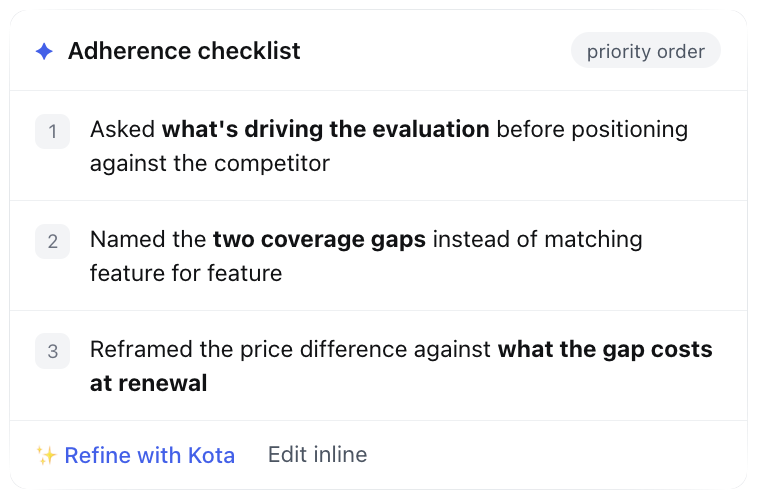
You upload the material behind your rollout. The battlecard, the messaging guide, the launch brief. You describe the behavior you want to see from reps on their real calls. Kota turns that into an adherence checklist, and you put the criteria in the order that matters most to you.
From there it runs on its own.
Every real call gets monitored and assessed against those criteria. Reps who are already doing it are left alone. Reps who miss a criterion get a roleplay built from the call where they missed it, and they stay in the practice loop until they hit all of it on a real call.
That is the whole product. This is a behavior you asked for, checked continuously, with practice assigned automatically to whoever is not doing it yet.
.png)
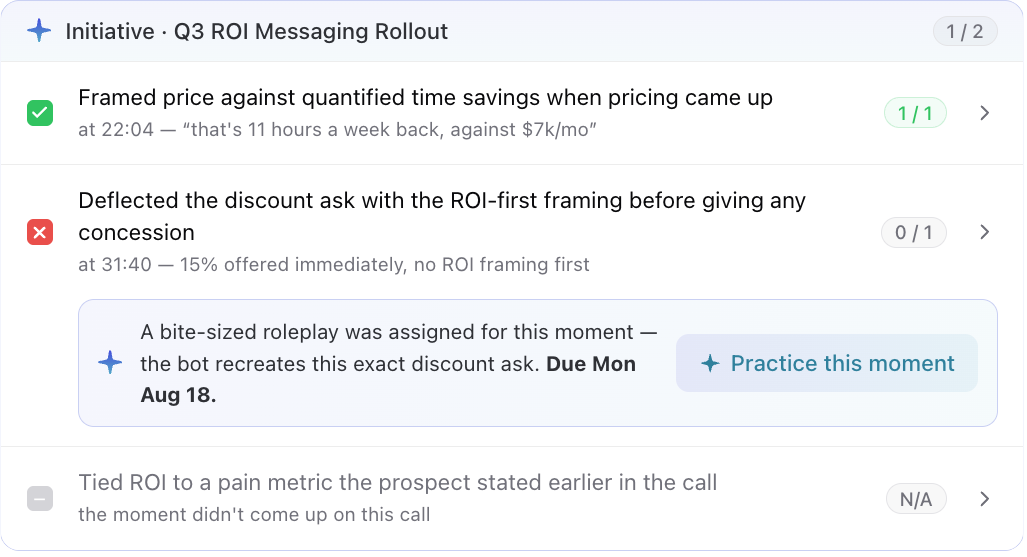
A criterion only scores when its trigger fires. That keeps the measurement honest and keeps reps from being penalized for calls where the moment never came up.
A competitive messaging rollout might look like this:
On a call where the competitor never comes up, none of it scores. On a call where the competitor comes up but price never does, the first two score and the third returns N/A. You are measuring the behavior, not the calendar.
Before any of it reaches a single rep, you see it run against your own calls from the last month, so you can check the criteria are catching what you meant them to catch.
This is the part that makes the loop close.
When a rep misses a criterion, the call they missed it on becomes their roleplay. Same competitor, same objection, same deal they are still working, same stakeholder they were actually talking to, and the exact moment they fumbled marked inside it. It is a scenario they lived four days ago, not a generic buyer persona somebody wrote several quarters back.
That is what gets a rep out of the loop quickly. A generic roleplay asks someone to take an abstract lesson and find it again, live, weeks later. This hands back the conversation they already lost while it is still fresh, on a deal that is still open. The next time that objection comes up, the right way to handle it is already in their head.
The roleplay is not the goal. Nailing it on the next real call is. Finishing practice does not move a rep out of the loop. Hitting the criteria on a real call does.
The same rollout looks completely different depending on the rep, and neither version needs anything from you.
Marcus misses, practices, and misses something else.
On his first eligible call, a prospect brings up the competitor and Marcus asks what is driving the evaluation, then goes line by line on features. Criterion one, hit. Criterion two, missed. Price never comes up, so criterion three returns N/A.
That night he has a roleplay waiting, built from that call. Same prospect, same comparison, the exact moment he started matching features. He runs it Thursday morning.
His next eligible call comes Friday. He asks what is driving the evaluation, and this time he names both coverage gaps rather than going feature by feature. Then the prospect says the other tool is cheaper and Marcus lets it sit. Criteria one and two, hit. Criterion three, missed.
So he gets a second roleplay, built only from the price reframe. Not the whole call again, just the part he is still getting wrong.
He practices it over the weekend. On Monday the competitor comes up again and all three land. Marcus is out of the loop.
Priya never needed any of it, until week five.
On Priya's first eligible call she hits all three criteria, so nothing is assigned to her. No notification, no roleplay, no reminder. She is out of the loop from the first call scored.
Her calls keep getting checked anyway. Weeks two, three, and four pass with Priya continuing to nail all the criteria across her calls.
In week five she runs a call at the end of a long day, matches features for twenty minutes, and never names the gaps. Criterion two, missed. Priya is back in the loop that same day, with a roleplay built from that call.
She runs it, hits all three on her next call, and is out again.
Nobody wants their team circling in a practice loop. The goal is to empty the practice loop quickly.
Reps who already exhibit the behavior are auto-exempted on day one and never assigned anything. Reps who miss get one bite-sized roleplay at a time, targeted at the highest priority criterion they are missing, so nobody gets buried. When they clear it on a real call, they are out.
Their calls keep getting checked after that. Exiting in week one does not exempt anyone from week five. A rep who quietly drops the messaging halfway through the quarter re-enters the loop that week, with a roleplay from that call, aimed at getting them back out before their next one.
Certification cannot do anything in week five. This can.
Halfway through the quarter, you know where every rep stands. Who is adhering. Who is still in the practice loop and which criterion they keep missing. Who was exempted from the start. Adherence now against the baseline at launch, with the calls behind every verdict.
And you are not chasing anyone to get there. The system is running underneath, turning the reps who are not doing it into reps who consistently are.
Conversation intelligence watches real calls and stops. It can show you the moment a rep missed the message, and then the most it can do is flag it.
Roleplay tools generate practice, but they have no idea what happened on a real call. Success gets measured inside the simulator, which is the same problem certification has.
Both approaches hand the connecting step to the rep. Notice you did badly, decide to practice, pick the right thing to practice, do it. Reps do not do that, and it was never reasonable to expect them to.
The system closes the loop. The miss produces the practice, the practice is built from the miss, and the next real call decides whether it worked.
If you're interested in autonomously closing the loop on behavior change, chat with our team to get a private preview!
.png)










Use Cases
Legal