
Before you sign a contract for a new ai sales training platform for b2b saas, you want to know one thing: will reps actually use it, and will it move a number that matters?
Here's what two real customers saw. ALKU, a staffing firm with 300+ reps, cut their average time to first deal from six months down to three. Nivoda, a B2B diamond marketplace, saw a 50% reduction in ramp time and a 150% increase in demo rates. Rob Rangel, their Head of Sales Enablement, credits Hyperbound as the turning point. Both of these outcomes were visible within the first quarter. Neither team ran a six-month pilot. Neither required a heavy IT lift.
This article is not a marketing pitch. It's a week-by-week account of what the first 30 days actually looks like when you onboard Hyperbound as a Head of Enablement. The decisions you'll make, the things you'll build, and the coaching loops you'll run.
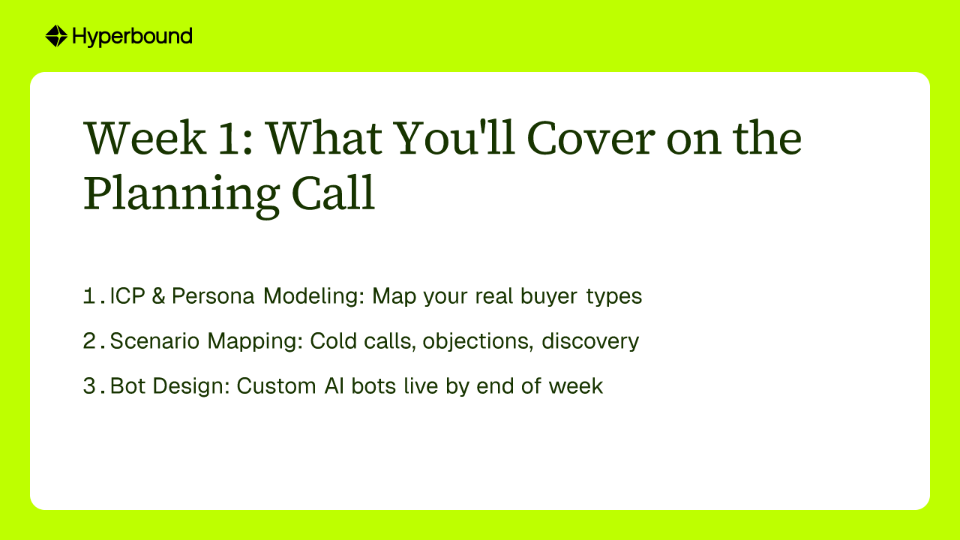
Your first week does not start with software. It starts with a conversation.
Hyperbound schedules a planning call with your team in the first few days. The goal is to learn your business before building anything. This is worth slowing down for, because what you share here determines the quality of every AI persona your reps will practice against.
On that call, you'll cover three things:
ICP and Persona Modeling. You walk through who your reps actually sell to. Not generic personas from a PDF. The real ones. The skeptical CFO who has seen three vendors this quarter. The enthusiastic end-user champion who has no budget authority. The gatekeeper who will shut the call down in 45 seconds if your rep doesn't earn the next minute. Hyperbound maps these into AI buyer personas that carry those specific traits into every roleplay.
Selling Scenario Mapping. You identify the conversations that make or break your pipeline. Cold call openers. Pricing objections. Competitive mentions. Discovery calls where reps over-talk and under-listen. Each scenario becomes a dedicated practice environment. This directly solves the complaint you've probably heard before: "Once you ask them to handle nuanced objections or pricing conversations, things fall apart fast." Hyperbound's bots are built to push back, not fold.
AI Roleplay Bot Design. With your personas and scenarios mapped, Hyperbound begins building your custom bots. The first bot can be live in under 10 minutes. By end of week one, you have a working set of AI practice environments shaped around your actual ICP, your actual objections, and your actual sales motion. Not a generic demo. Yours.
This is what revenue activation looks like in week one: building the infrastructure that converts practice into pipeline readiness.
Week two is about defining what "good" looks like on your team.
Out of the box, Hyperbound's AI scores every practice session. But the real value comes when those scorecards reflect your methodology. In week two, you configure them.
Scorecard Configuration. You select the behaviors you want to reinforce. Talk-to-listen ratio. How cleanly a rep handles a pricing pushback. Whether they ask a qualifying question before pitching. Whether they acknowledge a competitor by name or dodge it. Each criterion becomes a scored data point on every rep's session. The feedback is immediate, private, and specific. This is what makes reps feel like they're actually improving rather than just going through a training exercise.
Rep Introduction and Launch Prep. This step is often underestimated. How you introduce Hyperbound to your team shapes how much they use it. The framing matters.
Position it as a flight simulator. A place where reps can fail safely, try new approaches, and build muscle memory before a real deal is on the line. Be explicit that scorecard data is for development, not for a performance improvement plan. One of the most consistent complaints about sales tools is that they feel designed for the manager's dashboard, not the rep's growth. CRMs like Salesforce are often seen as more for the employer's metrics than the rep's benefit. The way you frame Hyperbound in that first internal communication will determine whether reps see it as surveillance or as a competitive advantage.
By the end of week two, your scorecards are live, your reps have access, and you've sent a short walkthrough so they know exactly how to start their first session. No IT ticket required. No dedicated technical resource needed. The setup is managed entirely by enablement.
Week three is when reps start practicing.
The first thing most teams notice is the volume. A rep can run ten cold call practice sessions in thirty minutes and get detailed scorecard feedback after each one. That volume of deliberate repetition is what drove ALKU's result. It's not that their reps were suddenly smarter. It's that they got more at-bats in a week than they previously got in a month.
Early usage patterns tend to split along experience lines. New hires gravitate toward opening pitches and basic objection handling. They need the reps. Tenured reps tend to use Hyperbound more tactically. They'll jump in before a high-stakes discovery call, or after getting stumped by a competitor mention they didn't handle well. On-demand, in the moment, without needing a manager to schedule a practice session.
Within the first few days of launch, you'll start seeing which scenarios are getting the most traffic. That itself is useful data. If every rep is drilling the pricing objection scenario, that tells you something about where confidence is lowest on your team.
Collect informal feedback at the end of week three. What objections are the bots not handling the way real prospects do? Are there scenarios that feel too easy? Too far from the actual conversation? This input feeds directly into your refinement cycle, and it gives reps ownership in the process, which drives continued engagement.
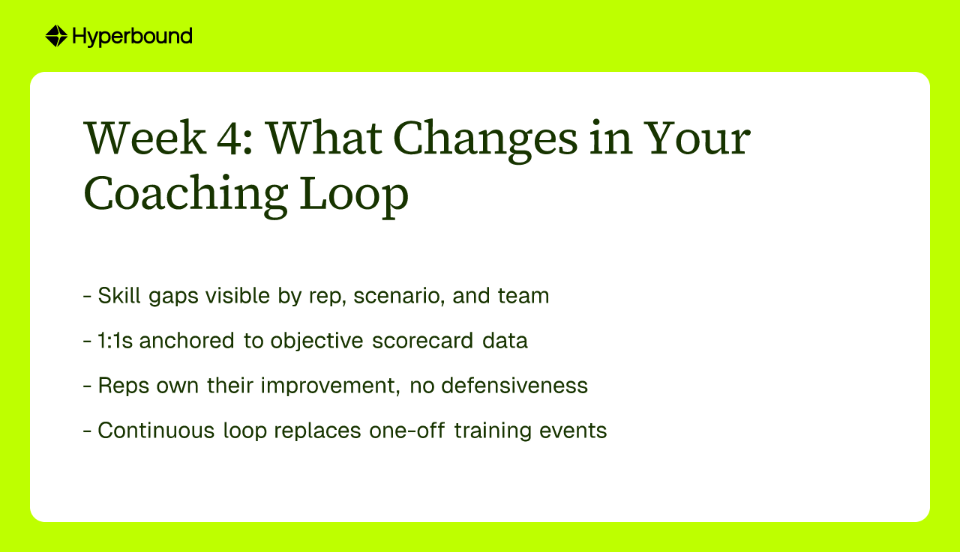
This is the week that changes how you run 1:1s.
By week four, every rep has completed multiple sessions. You have scorecard data across your team. You can see skill gaps that were invisible before. Not because you got better at observing, but because you now have a structured, repeatable dataset to look at.
What managers see. You open the analytics dashboard and you're looking at performance broken down by skill, by rep, and by scenario. You can see that your entire team drops on talk-to-listen ratio when the deal hits pricing. You can see one rep who is consistently strong on cold openers but falls apart during discovery. You can see which reps have been practicing daily and which ones have not logged in since launch.
How 1:1s run differently. The conversation changes completely. Instead of opening with "how are your calls going?" you open with "I noticed your talk-to-listen ratio improved four points this week, but your scores on handling the competitor question are still low. Let's work through that." The coaching becomes specific. The rep knows exactly what's being discussed and why. There's no defensiveness when the data is objective and the rep generated it themselves.
This is the foundation of a continuous improvement cycle. The first coaching loop in week four is not the last. It's the template for every 1:1 going forward.
ALKU came into Hyperbound with a scaling problem. They had 300+ reps to train and a small enablement team that couldn't multiply itself. Live roleplay sessions couldn't keep pace with hiring. New reps were waiting too long to get the practice volume they needed to close their first deal with confidence.
Within the first 30 days, ALKU's enablement team had deployed custom AI bots across the rep population. Reps were getting unlimited practice reps without requiring manager time or scheduling. The training output scaled without adding headcount.
The downstream result: average time to first deal dropped from six months to three. A 50% reduction in time to first deal, driven by repetition that simply wasn't possible before.
Read the full ALKU case study to see how they structured the rollout.
Nivoda's challenge was different. They weren't struggling to scale training volume. They were struggling to convert it into pipeline outcomes. Reps were getting trained, but demo booking rates weren't reflecting it.
Rob Rangel, Head of Sales Enablement at Nivoda, implemented Hyperbound with a focus on cold call and demo request scenarios. The bots were built around Nivoda's specific buyer types in the B2B diamond trade market.
By the end of month one, demo bookings had increased 30%. Ramp time for new hires dropped 50%. Year-over-year, Nivoda doubled their revenue. Rob attributed the 150% increase in demo rates directly to the improvement in rep confidence and conversational quality coming out of Hyperbound sessions.
Read the full Nivoda case study for the complete breakdown.
An AI sales training platform is a tool that uses artificial intelligence to create realistic practice scenarios for sales representatives. It allows them to rehearse calls, handle objections, and refine their pitch against AI-powered buyer personas without risking live deals.
Hyperbound improves rep performance within 30 days by providing a high volume of deliberate practice through AI roleplays. In the first month, enablement teams build custom bots based on their ICPs, configure scorecards to their methodology, and launch the platform, allowing reps to immediately start building muscle memory and confidence in key selling scenarios.
Hyperbound is designed primarily for B2B SaaS sales teams, particularly for Heads of Sales Enablement, Sales Managers, and individual sales representatives (SDRs/BDRs and AEs). It's valuable for both new hires needing to ramp up quickly and tenured reps looking to refine skills for specific high-stakes calls.
Hyperbound differs from traditional roleplay by being on-demand, scalable, and providing objective, data-driven feedback. Unlike manager-led sessions which are time-consuming to schedule, reps can practice anytime, get instant scorecard feedback on every session, and managers can analyze team-wide skill gaps without having to sit in on every call.
You can practice a wide range of B2B sales scenarios tailored to your specific sales motion. Common examples include cold call openers, handling specific objections (e.g., pricing, competitors, "send me an email"), discovery calls, and navigating conversations with different buyer personas like skeptical CFOs or enthusiastic but powerless champions.
The ROI of Hyperbound is measured through direct improvements in key sales metrics. Customers typically track metrics like reduced ramp time for new hires, increased demo booking rates, shorter time-to-first-deal, and overall pipeline and revenue growth. The platform's analytics provide data on skill improvement, which correlates to these business outcomes.
Yes, reps adopt Hyperbound because it is designed for their growth, not just for management oversight. The platform provides a safe, private space to practice and fail without judgment. The immediate, specific feedback helps them improve quickly, and framing it as a "flight simulator" for sales has proven to drive high engagement and voluntary usage.
The implementation process is fast and requires no IT resources. Week 1 involves a planning call to map your ICPs and scenarios. Week 2 focuses on building scorecards. By Week 3, the platform is launched to reps, and by Week 4, managers are using data from practice sessions to run their first data-anchored coaching 1:1s.
By day 31, Hyperbound is not a new tool. It's part of how your team operates.
Your custom AI bots are live and tuned to your ICP. Your scorecards reflect your methodology. Your reps have a private, always-available practice environment they can use on their own schedule. Your managers walked into this week's 1:1s with actual data.
You have a quantitative baseline for your team's skills. You know where the gaps are. You know who is coachable and actively working on it. You know which scenarios need more attention at the team level versus the individual level.
The first 30 days are not about finishing an implementation. They're about starting a new operating rhythm where every rep has a clear, measurable path to improvement and every manager has the data to coach around it. That's what revenue activation actually means in practice: converting training activity into pipeline performance, with evidence to show it's working.
Explore more on the Hyperbound success stories page or review how the onboarding and certification workflow is structured before your first planning call.









Use Cases
Legal