You've likely heard the buzz about using ChatGPT to practice sales conversations. It's accessible, it's free, and it seems like a convenient way to hone your pitch. But if you've actually tried it, you've probably encountered a frustrating reality that one sales rep on Reddit described perfectly: "Although it helped at practicing our responses to basic objections, it still couldn't replicate realistic responses to what we say. It just agrees and tells me why I'm right."
This fundamental flaw highlights why generic AI tools fall short for serious B2B sales training. Another sales professional noted that prospects often "ask unexpected questions or take conversations in different directions, which [ChatGPT] doesn't really handle well." These aren't minor inconveniences—they're deal-breaking limitations that can create a false sense of preparedness.
In today's competitive landscape, sales leaders need training tools that actually prepare their teams for the complexities of real buyer conversations. While generic AI has revolutionized many aspects of our work, it's simply the wrong tool for developing elite sales talent.
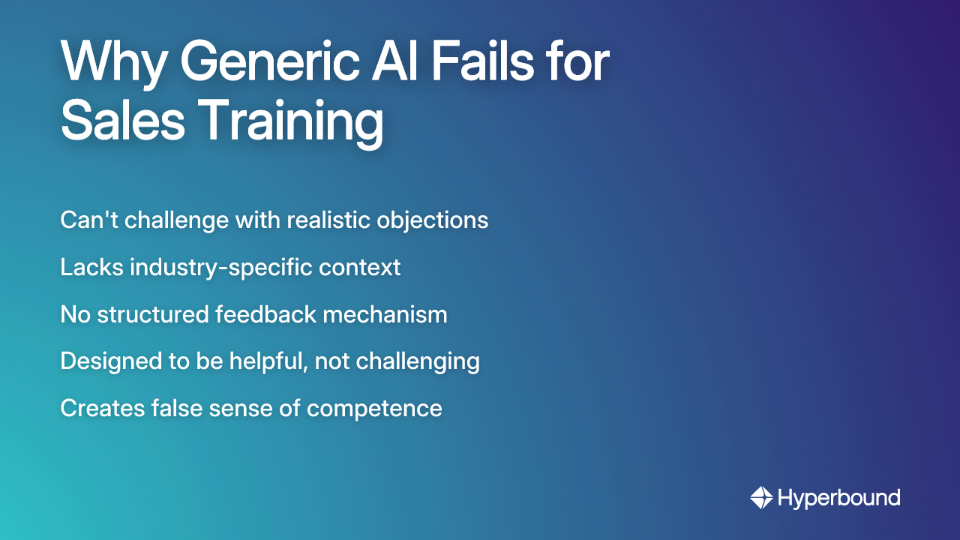
When you use ChatGPT for sales role-play, you're running into what we call the "Agreeable Assistant" problem. Large language models like ChatGPT are fundamentally designed to be helpful and compliant—the exact opposite of what you need for effective sales training. Real prospects are skeptical, emotional, and sometimes downright difficult. They don't neatly follow conversational scripts, and they certainly don't exist to make your life easier.
This design limitation creates several critical problems:
ChatGPT's primary function is to be helpful, not to push back with realistic objections or emotional resistance. This creates a false sense of competence. As one Reddit user put it, "it just agrees and tells me why I'm right." But in real sales conversations, people "buy with emotion and justify with logic"—a dynamic that generic AI simply cannot replicate.
Generic AI has no knowledge of your:
Without this crucial context, the tool can only generate generic responses that fail to mimic the nuanced objections and concerns of your actual prospects.
A conversation with ChatGPT is just that—a conversation. There's no mechanism for objective evaluation. You can't get data on your talk-to-listen ratio, track how well you handled key objections, or receive an unbiased score on your performance. It's practice without analysis, which severely limits real learning.
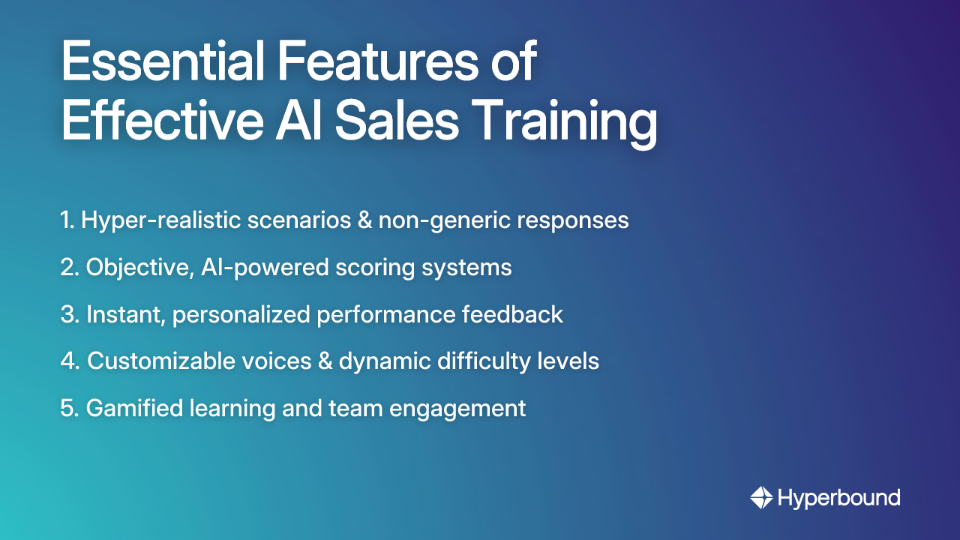
In contrast to generic AI, purpose-built sales training platforms offer features specifically designed to develop practical selling skills. Here are the non-negotiable capabilities that drive real skill development:
Specialized platforms like Hyperbound are built to simulate real-world sales calls across the entire cycle. They allow you to create customizable AI scenarios tailored to your specific ICPs, products, and sales methodologies.
Unlike ChatGPT, these tools let you practice everything from cold calls and discovery to handling pricing objections and renewal conversations. The key difference, as one sales rep noted, is that specialized platforms are "a lot more realistic than ChatGPT because [they don't] give generic answers."
Whether you're focused on inbound sales qualification or complex outbound sales scenarios, these tools provide the realistic practice environment needed to build confidence and competence.
Instead of guessing how you performed, specialized tools use AI-powered scorecards to provide instant, objective feedback. These scorecards automatically evaluate your interactions against your custom methodology, tracking critical metrics such as:
This automated performance tracking allows for immediate coaching, a stark contrast to waiting for delayed managerial feedback or having no feedback at all. These objective evaluation systems can identify patterns in performance that human coaches might miss, providing a deeper layer of insight.
The learning loop with specialized platforms is immediate. After each role-play, the AI delivers personalized coaching that's tailored to your company's specific sales playbook and talk tracks.
This isn't generic advice. Hyperbound's AI Coaching pinpoints missed opportunities, weak responses, or moments where you went off-script. This empowers reps with a continuous learning tool, allowing them to self-correct and improve without waiting for manager availability.
As one sales enablement leader put it, "The AI feedback is like having a coach in your pocket 24/7."
Realism in role-play extends to the details. Many specialized platforms offer voice customization and the ability to simulate different prospect personalities, industries, and even accents.
But perhaps more importantly, these tools adjust the complexity of scenarios based on skill level. A new SDR can start with basic qualification calls, while a seasoned AE can tackle a multi-threaded enterprise deal with a highly skeptical executive buyer.
One Reddit user highlighted this advantage: "It's a lot more customizable. Switching up the voices and difficulty level or steering the conversation helped." This adaptability ensures that the training is always challenging but never overwhelming, creating an optimal learning environment.
Let's face it—practice can feel like a chore. The best platforms transform it into a competition that sales reps (who tend to be naturally competitive) actually enjoy.
Platforms like Hyperbound incorporate gamified learning with leaderboards that motivate reps by tapping into their competitive nature. This fosters a culture of continuous improvement and accelerates skill development across the team.
A sales manager noted in a G2 review: "The leaderboard has transformed our practice from something reps avoided to something they compete at."
Features are important, but leaders invest in results. Here's how specialized AI training translates to measurable improvements in sales performance:
Organizations using structured, real-time AI coaching have seen new hire ramp-up times reduced by as much as 30%. This is possible because new reps get unlimited, risk-free "at-bats" to master messaging and handle objections before ever speaking to a live prospect.
When you compare this to traditional shadowing and role-play methods, the efficiency gains are dramatic. New hires become quota-ready faster, shortening the time to ROI for each sales hire.
The data speaks for itself. Sales teams utilizing specialized AI coaching tools that provide instant feedback have reported:
These improvements aren't mysterious. Consistent, high-quality practice on realistic scenarios directly leads to better execution on live calls, resulting in more booked meetings and higher close rates.
Mollie B., a Business Development Representative, praises Hyperbound's realism in her G2 review: "The bot creation tool is spectacular, I love being able to fill in specific details about the prospect to make the conversations as realistic as possible." This level of realism is what drives real-world improvement.
Yes, specialized platforms like Hyperbound are a subscription-based investment, unlike the "free" tier of some generic tools. However, the focus should be on ROI, not cost.
Consider the financial impact:
For most B2B sales organizations, these improvements will generate returns that far outweigh the subscription fee. As one sales leader put it, "The cost of bad practice or no practice is much higher than the cost of good practice."
Implementing any new technology requires thoughtful change management. Here are proven strategies for ensuring your team embraces a specialized AI coach:
To reduce friction, ensure the tool integrates with your existing tech stack. Hyperbound, for example, integrates with popular call recording systems and sales engagement platforms, making it part of the existing workflow rather than yet another platform to learn.
Frame the platform as a tool for the entire revenue team's lifecycle:
Use the platform's leaderboards and share top-performing examples to encourage continuous, self-directed learning. When practice becomes part of your team's culture, adoption follows naturally.
The allure of a free, generic tool like ChatGPT for sales training is understandable, but it's a classic case of using the wrong tool for the job. Generic AI creates a false sense of preparedness by failing to replicate the pressure, specificity, and feedback mechanisms of real-world selling.
True sales readiness comes from specialized AI platforms that offer:
When your team handles objections from challenging AI personas, gets scored on their performance, and receives targeted feedback—all in an environment that simulates actual B2B sales conversations—they develop skills that directly translate to success with real prospects.
Stop letting your team practice in an unrealistic echo chamber. It's time to invest in a training solution that prepares them for the conversations that actually close deals. If you're ready to move from generic chats to data-driven coaching, explore a specialized platform like Hyperbound that's purpose-built for sales excellence.
After all, you wouldn't train Olympic swimmers in a kiddie pool—so why prepare your sales team with tools that can't challenge them to improve?
ChatGPT is not effective for sales role-play because it is designed to be helpful and agreeable, which is the opposite of a real, skeptical prospect. This "Agreeable Assistant" problem means it fails to provide realistic objections, lacks specific knowledge of your industry or sales process, and cannot offer structured, data-driven feedback on your performance. This can create a false sense of competence.
A specialized AI sales coach is purpose-built for sales training, offering hyper-realistic scenarios, objective performance scoring, and instant, personalized feedback tailored to your sales methodology. Unlike generic tools, these platforms allow you to customize AI personas, scenarios, and difficulty levels. They track key metrics like talk-to-listen ratio and objection handling, providing data-driven insights that help reps improve specific skills.
An AI sales coach provides feedback through an automated, objective scorecard that evaluates a user's performance immediately after a role-play session. This scorecard analyzes the conversation against your custom playbook, tracking metrics like the quality of discovery questions, use of key talk tracks, and overall structure. It pinpoints specific areas for improvement, acting as a 24/7 coach to guide self-correction.
The ROI of a specialized AI sales training platform is demonstrated through significant improvements in core sales metrics, such as a 30% reduction in new hire ramp time and a 20% increase in win rates. By providing unlimited, risk-free practice, teams can book up to 40% more meetings from cold calls and see a 15% improvement in average deal size. The financial gains from faster onboarding and better performance far outweigh the subscription cost.
Everyone on the revenue team can benefit, from new hires in onboarding to experienced reps and even post-sales teams. The platform can be used for hiring assessments to screen candidates, accelerating ramp time for new SDRs, helping seasoned AEs master new product messaging, and enabling Customer Success Managers (CSMs) to practice renewal or upsell conversations.
Specialized AI platforms create realistic scenarios by allowing you to customize the AI persona with specific details about your Ideal Customer Profile (ICP), industry, product, and sales methodology. You can tailor the AI's objections, personality (e.g., skeptical, busy, curious), and even voice. This level of customization ensures the practice conversations closely mimic the real-world challenges your sales team faces, from initial cold calls to complex pricing negotiations.








Use Cases
Legal