
You've just hired a promising new sales rep. They have the enthusiasm, the people skills, and the drive to succeed. But during their first call with a prospect, they stumble over industry acronyms, misuse technical terms, and accidentally refer to your SaaS platform as "the software thingy."
Just like that, credibility evaporates.
"I was too scared to answer the phone and only made one sale the first week," confessed one sales rep on Reddit about their early experiences. Without proper training, especially on industry language, reps risk sounding like outsiders, eroding trust before they even start their pitch.
The average ramp-up time for a new sales professional is a staggering 12 months. A significant part of this delay is mastering the nuanced language of the industry they're selling into.
This isn't just about sounding smart. It's about revenue:
As one experienced sales professional bluntly puts it, "If you just prospect, pick up a phone, do discos and meetings, with no real training, you will fail unless you're insanely lucky or have a product that doesn't require sales."
Traditionally, training on terminology involves handing a new hire a thick binder, a glossary of terms, and access to pre-recorded webinars.
This approach is fundamentally passive and ineffective for long-term retention:
To slash ramp times and boost performance, sales leaders need to move beyond traditional methods and adopt a modern, active learning framework.
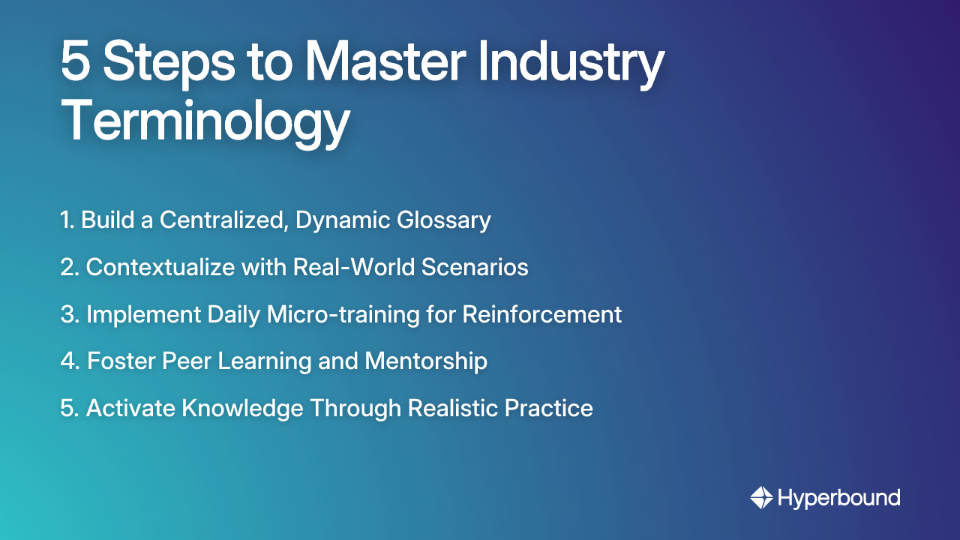
Action: Create a living, breathing internal wiki or document—not a static PDF.
What to Include:
Best Practice: Encourage the entire team, from veterans to rookies, to contribute. When a rep hears a new term on a call, they should be tasked with adding it to the glossary. This creates a culture of shared knowledge, which helps in "Sharing Institutional Sales Knowledge" as peers often influence each other more than managers.
Action: Connect the glossary terms to real sales situations.
How to Implement:
Action: Break down learning into manageable, daily exercises to combat the forgetting curve.
How to Implement:
Action: Leverage the power of your existing team to accelerate learning.
How to Implement:
The Critical Step: All the above steps build knowledge. This step builds fluency. Reps must practice using the terminology in simulated, low-stakes environments before talking to real prospects.
Traditional Method: Manager-led role-plays.
The Modern Solution: This is where technology becomes a game-changer. Reps need a way to practice on-demand, get objective feedback, and build confidence without burning manager time or risking live deals.
The Challenge with Practice: The biggest hurdle to mastering terminology is getting enough "at-bats." A manager can't spend hours every day role-playing cold calling or discovery questions with each new rep.
The AI Solution: Platforms like Hyperbound offer a scalable and effective solution. They use AI to create hyper-realistic conversational simulations, allowing reps to practice anytime, anywhere.
How AI Roleplays Accelerate Terminology Mastery:
Here's how one sales enablement leader at a SaaS company used Hyperbound to rapidly train their team on new industry terminology:
"We were entering a new vertical and our reps needed to quickly learn financial services terminology. We created custom AI roleplays in Hyperbound where the AI played a fintech buyer who used industry jargon and asked technical questions. Reps practiced daily for two weeks before our launch. Not only did they learn the terminology faster, but they developed the confidence to use it naturally in conversations. What would have taken months of trial and error happened in just a few weeks."
Training reps on industry-specific terminology is not about forcing them to memorize a dictionary. It's about building conversational fluency. The key is a blended approach:
The old adage "practice makes perfect" still holds true, but the way we practice has evolved. By leveraging AI-powered tools like Hyperbound, sales leaders can finally provide the scalable, on-demand practice environment reps need to master industry language, build unshakeable confidence, and start crushing their quota in record time.
This approach transforms training from a "checkbox activity" into a true competitive advantage.
As one sales rep on Reddit wisely noted, "Sales is a learn on the job. It has a low barrier to entry but the ramp up career wise can be hard, elitist and exhausting." With the right training framework and modern tools, we can make that ramp less steep, less exhausting, and infinitely more successful.
Mastering industry terminology is crucial for sales reps because it allows them to build credibility, establish trust, and effectively communicate value to prospects. When a salesperson speaks the same language as their customer, they are perceived as an expert and a credible partner rather than just a vendor. This understanding enables them to address specific industry needs and pain points, which is a key factor in a customer's purchasing decision. Without this fluency, reps risk sounding like outsiders, eroding trust before they can even make their pitch.
AI-powered roleplays accelerate learning by providing a safe, scalable, and on-demand environment for reps to practice using new terminology in realistic conversations without fear of failure. Platforms like Hyperbound allow sales leaders to create custom scenarios where an AI buyer uses specific industry terms and raises relevant objections. Reps receive instant, objective feedback on their performance, including their correct usage of key terms. This repeatable practice builds conversational fluency and confidence much faster than traditional, manager-led role-playing.
An effective sales terminology glossary should be a dynamic, centralized resource that includes not just definitions, but also context on why a term matters to the customer and examples of its use in conversation. To be truly useful, a glossary should contain: the term/acronym, a simple definition, an explanation of its relevance to the customer's business, a sample sentence for a sales call, and common misconceptions to avoid. It should be a living document, like a wiki, where the entire team can contribute new terms as they encounter them.
Traditional training methods fail because they are passive and lack the context, application, and feedback necessary for long-term retention and practical use. Handing a new rep a glossary or having them watch a pre-recorded webinar often leads to cognitive overload and rote memorization without true understanding. Reps don't get the chance to apply the terms in a conversational context or receive feedback on their usage, making it nearly impossible to translate that knowledge into a real, high-pressure sales call.
The most critical step is activating knowledge through consistent, realistic, and safe practice in simulated environments. While building a glossary and providing context are important foundational steps, true fluency only comes from practice. Reps must have the opportunity to use terminology in low-stakes situations before engaging with actual prospects. This is where modern solutions like AI-powered roleplays become a game-changer, providing the scalable practice needed to build confidence and conversational skill.
The average ramp-up time for a new sales professional can be as long as 12 months, with a significant portion of that time dedicated to mastering industry and product language. This lengthy ramp-up period represents a significant cost in lost revenue and training resources. However, by implementing a modern, active learning framework that includes AI-powered practice, companies can significantly shorten this timeline. Platforms like Hyperbound, for example, have been shown to reduce new hire ramp time by up to 50%.











Use Cases
Legal