
You've spent months perfecting your product. Your engineering team has built innovative features that solve real customer problems. Your product marketing team has crafted compelling messaging. But now comes the moment of truth: training your sales team to effectively communicate these complex features to prospects.
Unfortunately, this is where many companies fall short. As one sales leader described it to us: "We spend all this time on product development, then just throw our reps into the lions' den with nothing but spec sheets and hope for the best."
Sound familiar?
In today's B2B landscape, the stakes couldn't be higher. According to Forrester, up to 65% of B2B buyers conduct independent research before ever speaking to a rep, and each sale may involve up to 11 decision-makers. Your sales team isn't just sharing product information—they're navigating a complex buying journey that requires them to be strategic consultants, not just feature evangelists.
This article provides a comprehensive framework for training sales reps to master complex product features in a way that actually drives results. We'll move beyond traditional product dumps to build a system that combines deep product knowledge with practical application and continuous coaching.
Before diving into the solution, let's understand why the standard approach to product training often falls flat.
For complex products, the days of transactional selling are long gone. Today's enterprise sales require reps to think and act strategically—understanding not just what buttons to push in a demo, but how those features solve specific business challenges for different stakeholders.
As noted in research from The Brooks Group, successful reps in complex sales environments must transition from tactical feature-pitchers to strategic advisors. This means:
When training focuses only on features without this strategic context, reps struggle to articulate value in a way that resonates with buyers.
In complex sales, your rep isn't just a product expert—they're a business consultant who happens to have a solution. They need to demonstrate business acumen that extends beyond your product's feature set to include industry knowledge, competitive insights, and strategic thinking.
This is where traditional training often falls short. As one sales rep noted on Reddit: "Training often lacks depth, focusing too much on product knowledge without strategic application."
Before diving into how to deliver training, let's establish what comprehensive product training should include:
.png)
Now that we've established what to teach, let's focus on how to deliver training that sticks. Here's a 5-step framework that combines knowledge transfer with practical application:
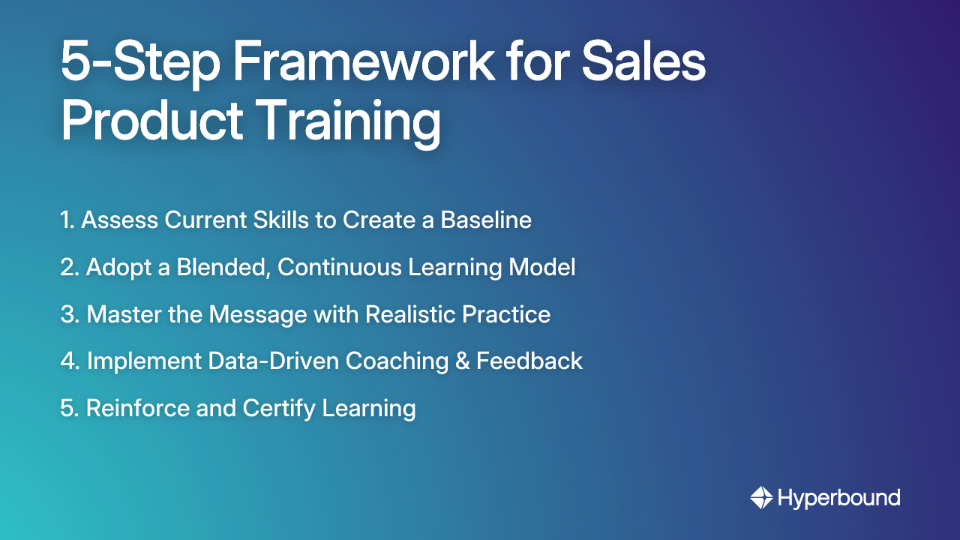
Don't assume all reps need the same training. Start with a skills assessment to identify specific gaps in product knowledge, objection handling, or discovery skills.
You can use The Brooks Group's Positioning Questionnaire for Complex Selling as a starting point to evaluate how your team is currently perceived by customers.
This assessment should cover:
The results will help you customize training to address specific weaknesses rather than taking a one-size-fits-all approach.
Effective training isn't a one-time event—it's an ongoing process that combines multiple learning modalities:
According to LearnExperts, microlearning is particularly effective for complex products because it allows reps to focus on mastering one feature or concept at a time without overwhelming them.
Rather than inundating reps with information in a single training session, schedule regular "feature focus" sessions that deep-dive into specific capabilities, with plenty of time for questions and discussion.
This is where knowledge transforms into skill. As our user research confirmed, "practical experience in sales is essential for true understanding and proficiency."
Traditional role-playing with managers is valuable but has limitations:
This is where technology can help. Platforms like Hyperbound offer AI-powered sales roleplays that allow reps to practice critical conversations with AI buyer personas that respond dynamically and realistically.
These tools provide a safe, repeatable environment for reps to practice:
The key benefit is that reps can fail privately and learn from mistakes without risking actual customer relationships. They can practice the same scenario multiple times until they've mastered it, building confidence and muscle memory before engaging with real prospects.
Our research showed that sales reps crave "constant and personalized feedback after each deal, win or lose." Yet most organizations struggle to provide this consistently due to manager bandwidth limitations.
While reviewing call recordings is standard practice, it often relies heavily on manager availability and lacks scalability. AI coaching tools can help scale personalized feedback:
The best platforms deliver instant, personalized coaching feedback after each interaction, helping reps identify and correct mistakes without waiting for manager review. This creates the "step by step, clear guide" that reps desire for improving their skills.
The final step is ensuring that new knowledge and skills stick. This requires:
Training on complex product features works best when supported by a cohesive sales tech stack. The key components include:
Solutions like Hyperbound combine AI-powered practice, coaching, and analytics in a single platform that integrates with your existing systems. This creates a seamless workflow where reps can learn about features, practice discussing them, and receive coaching—all in one environment.
The platform's ability to analyze thousands of your actual sales calls helps identify which talk tracks and positioning strategies are most effective for your specific products and buyer personas. These insights can then be incorporated into your training materials and practice scenarios, creating a continuous improvement loop.
Training sales reps on complex product features isn't just about transferring information—it's about transforming your team from feature evangelists into strategic business advisors who can:
By implementing the 5-step framework outlined in this article, you can:
The result? Reduced ramp time for new hires, more consistent performance across your team, and sales conversations that focus on business value rather than feature checklists.
Remember: In complex B2B sales, your product's features matter—but your rep's ability to position those features as solutions to specific business challenges matters even more. Invest in training that develops both product knowledge and strategic selling skills, and you'll build a sales team that consistently outperforms the competition.
Traditional product training often fails because it focuses too heavily on product features rather than on the strategic business value those features provide to customers. It doesn't equip reps to act as strategic advisors who can connect product capabilities to specific business outcomes, navigate complex buying committees, and position effectively against competitors. This leads to reps who can list features but struggle to articulate why a prospect should care.
The most crucial element is connecting every product feature to its specific business value and the tangible outcomes it delivers for the customer. While technical details and competitive positioning are important, reps must first be able to answer the "so what?" for every feature. This includes defining the problem it solves, the ROI it can generate, and which specific personas within a buying committee benefit most from it.
Sales teams can practice selling complex products in a risk-free environment using AI-powered sales roleplay platforms. These platforms, like Hyperbound, allow reps to engage in realistic conversations with AI buyer personas that are programmed with specific objections, questions, and industry knowledge. This provides a scalable, consistent, and safe space for reps to master messaging, practice objection handling, and build confidence before talking to actual prospects.
The 5-step framework for effective sales product training is: 1) Assess current skills, 2) Adopt a blended, continuous learning model, 3) Master the message with realistic practice, 4) Implement data-driven coaching, and 5) Reinforce and certify learning. This framework moves beyond one-time training events to create a continuous improvement cycle that builds and maintains skills over time.
AI can scale sales coaching by automatically analyzing both practice sessions and real customer calls to provide instant, personalized, and data-driven feedback without relying solely on limited manager bandwidth. AI coaching tools can score calls against a defined methodology, identify key moments for improvement (e.g., poor objection handling, weak value proposition), and pinpoint best practices from top performers. This allows every rep to receive consistent coaching on every call, accelerating their development.
The effectiveness of a new sales training program is measured through a combination of leading and lagging indicators, including skill certification rates, rep confidence scores, time to ramp, sales cycle length, deal size, and win rates. Leading indicators, like proficiency scores in AI roleplays, show if reps are absorbing the knowledge. Lagging indicators, such as improved conversion rates, demonstrate the training's direct impact on business results.
Looking to transform how your sales team learns, practices, and performs with complex products? Hyperbound's AI Sales Coaching platform helps sales teams master complex product features through AI-powered roleplays, personalized coaching, and data-driven insights. Request a demo to see how it works.










Use Cases
Legal