You've got your script ready. You know your product inside out. But the moment you dial that number, something changes. Your voice goes up an octave, your natural rhythm disappears, and suddenly you're trapped in what your manager calls "sounding salesy" - that dreaded robotic tone that screams "I'm reading off a script!"
If your mentors keep telling you to "relax and just have a conversation" but you're struggling to make that leap, you're not alone. The truth is, 70% of clients for sales professionals result from cold calls, yet many of us still battle with sounding like actual humans when making them.
The problem with traditional scripts isn't the content—it's how they transform you into a passive reader rather than an active participant. When you're reading word-for-word, you're not really present. You're not listening. You're just waiting for your turn to speak the next memorized line.
One of the most effective techniques for sounding more natural is to deconstruct your script into a sequence of dot points instead of full written sentences. This simple change creates space for your natural voice to emerge.
For example, instead of:
"Hello, my name is John Smith from ABC Solutions. I noticed your company recently expanded into the European market, which is why I'm calling today. Our software has helped similar companies increase international sales by 30% in the first quarter."
Try a dot-point framework:

This approach gives you the structure and reminders of key points without forcing unnatural phrasing. It allows your brain to formulate the actual words in real-time, just like in a normal conversation.
Stop thinking of your script as something to read and start seeing it as a conversation to bring to life. This mental shift is about internalizing the intent behind your points rather than memorizing exact words.
A quick fellow in sales once told me, "Pretend you're calling a friend!" This simple mindset trick immediately lowers the stakes and helps you snap out of that formal, salesy tone. When you call friends, you don't read from a script—you have points you want to make, but you deliver them conversationally.
Remember, your goal isn't perfect recitation; it's meaningful connection. With dot points guiding you instead of constraining you, you can focus on what the other person is saying and adapt accordingly.
Here's something fascinating: research shows that 55% of communication is body language, 38% is vocal tone, and only 7% is the actual words spoken. But wait—if they can't see you on a phone call, why does body language matter?
Because your physical state directly impacts your voice. Your posture affects your diaphragm, which controls your breathing, which in turn shapes your vocal quality. The trick is to pretend the caller can actually see you.
Nervousness is the enemy of natural conversation. The quickest way to regain control is through your breath:
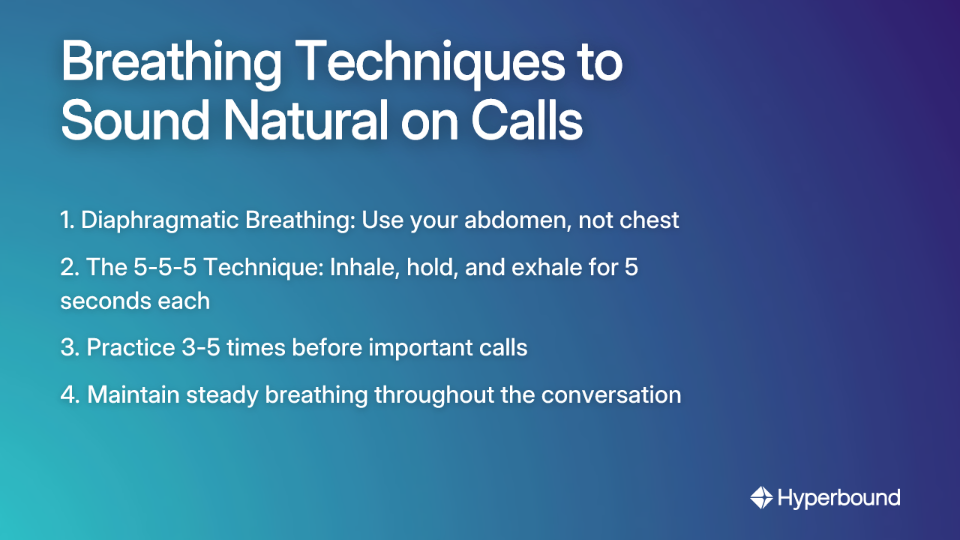
When your breathing slows, your heart rate follows, and your voice naturally becomes more steady and authoritative—essential qualities for building rapport with C-level appointments.
Voice modulation—the art of varying your pitch, pace, and volume—is what separates robotic script-readers from engaging conversationalists. Here are practical exercises to develop a more dynamic, natural speaking voice:
These exercises help you break out of script autopilot and bring those words to life in a way that sounds authentic and engaging.

The bridge between theory and mastery is deliberate practice. Here's how to integrate everything we've covered:
This step is non-negotiable if you want to improve. While recording yourself practicing your dot-point framework is a great start, AI-powered tools can supercharge your progress.
Platforms like Hyperbound's AI Sales Roleplays provide a safe, repeatable environment to practice against realistic AI buyers. Instead of just listening back on your own, these systems offer objective feedback on:
This deliberate practice is the fastest way to build muscle memory for natural, effective conversations.
Your dot points should follow a clear structure:
This structure helps you get to the point quick while still sounding conversational.
Sounding natural is a two-way street. The most authentic-sounding salespeople are excellent listeners:
This approach helps you handle objections with confidence because you're truly engaging with the prospect's concerns rather than jumping to the next bullet point.
Take 60 seconds after each call to ask yourself:
The irony of "sounding natural" is that it requires practice and preparation. But with the right approach—transforming scripts into adaptable dot points, using your body and breath to project confidence, and regularly practicing vocal exercises—you create the foundation for authentic conversations.
Remember, people don't buy from salespeople who sound salesy. They buy from people they connect with. When you speak with your authentic voice, maintain a big smile, and genuinely listen, you're not just making a call—you're building a relationship. And in sales, that makes all the difference.
By mastering these techniques, you'll transform from someone reading a script to someone guiding a conversation—someone who sounds like a trusted advisor rather than just another salesperson trying to make a quick commitment. So take a deep breath, stand up, smile, and let your natural voice lead the way to your next successful cold call.

You likely sound robotic because you are focusing on reading a script word-for-word instead of guiding a natural conversation. This focus on recitation removes your authentic vocal tone and rhythm, making you sound rehearsed. The solution is to internalize your key points and deliver them conversationally, rather than just reading lines.
The most effective method is to transform your full-sentence script into a dot-point framework. This provides the key talking points—like your introduction, value proposition, and questions—without locking you into unnatural phrasing. This structure allows you to formulate sentences in real-time, adapting to the flow of the conversation.
Yes, your body language directly impacts your vocal tone and quality, even when you're not on video. Your posture affects your breathing, which controls the power and confidence in your voice. Standing up, using a headset to free your hands for gestures, and even smiling can create a more energetic, warm, and approachable tone that listeners can clearly hear.
The best techniques are Diaphragmatic Breathing and the 5-5-5 Technique, as they slow your heart rate and steady your voice. For Diaphragmatic Breathing, breathe deeply using your abdomen, not your chest. For the 5-5-5 Technique, simply inhale for five seconds, hold your breath for five seconds, and exhale for five seconds. Repeating this 3-5 times before a call can significantly reduce nervousness.
The best way to practice is by recording yourself and analyzing your performance, ideally using a safe environment like an AI roleplay tool. Recording your calls helps you identify where you sound robotic or rushed. AI sales roleplay platforms provide a space to practice against realistic buyer personas and receive objective feedback on your pace, tone, and engagement without risking real customer relationships.
Standing is often recommended because it helps project a more confident and energetic tone. When you stand, your posture improves, allowing for better breath support from your diaphragm, which leads to a stronger voice. Pacing can also help maintain energy. If you must sit, ensure you sit up straight to avoid constricting your voice.
The strategic use of the pause is one of the most powerful vocal techniques for sounding engaging and authoritative. Pausing for 2-3 seconds after making a key point or asking a question demonstrates confidence and gives the listener time to process information. It prevents you from rushing—a common sign of nervousness—and makes your delivery more thoughtful.










Use Cases
Legal