
You've built a successful sales training agency through expert-led workshops, role-playing sessions, and one-on-one coaching. But as your client roster grows, you're hitting a wall - there are only so many trainers to go around, only so many hours in the day, and only so much personalized attention you can provide. Meanwhile, your clients are demanding more consistent results across larger teams in less time.
Sound familiar? You're experiencing the scaling crisis that's reshaping the sales training industry.
Sales training has evolved dramatically over decades - from the direct salesmanship tactics of the 1950s to the process-driven Predictable Revenue models of the 2000s. But in 2025, we're facing a fundamental shift that threatens to leave traditional training agencies behind.
According to Forrester's latest analysis, modern B2B buyers now complete 60-80% of their journey digitally before engaging with sales. These buyers, increasingly Millennials and Gen Z, expect self-service options and resist traditional sales approaches. One-off training events simply don't cut it anymore.
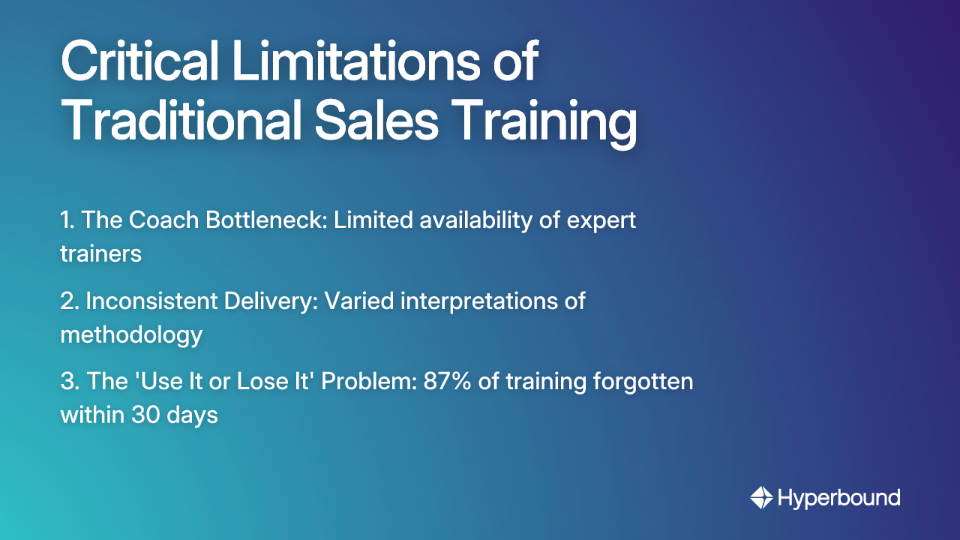
The hard truth? The manual methods that built your agency face three critical limitations:
As one agency owner told us, "We were delivering great training, but our clients couldn't scale it internally. Their reps would attend our workshop, get excited, then gradually revert to old habits because there wasn't enough reinforcement."
This is where advanced AI roleplay technology enters the picture - not as a replacement for your expertise, but as a force multiplier that can transform how you deliver value.
The latest generation of AI roleplay platforms isn't just about chatbots regurgitating scripts. They're sophisticated simulation environments that can fundamentally change your business model.
The most immediate benefit is breaking the link between trainer time and practice opportunities. Your clients' reps can practice handling objections or pitching a new product on their own schedule, as many times as needed.
"We went from conducting maybe 2-3 roleplay sessions per rep per month to our clients' teams averaging 15-20 AI roleplays weekly," explains the founder of a midwest sales training firm. "The repetition builds muscle memory in a way that occasional live practice never could."
With AI roleplays, you can encode your exact methodology, preferred talk tracks, and best practices into every scenario. This guarantees that all your clients' reps, regardless of location or manager, practice the same approach.
This addresses a common frustration voiced by sales leaders: "We paid for training, but it was implemented inconsistently across teams." With AI, your methodology becomes programmatically enforced.
Traditional roleplays often suffer from what one Reddit user described as a lack of "real stakes" that diminishes their value. Advanced AI platforms solve this by providing immediate, objective scoring against your defined criteria.
"The analytics changed everything," notes a training director at a SaaS-focused agency. "We can show clients exactly how their teams are progressing on specific skills, with hard data backing our claims. It's transformed our quarterly business reviews from subjective discussions to data-driven strategy sessions."
Perhaps most exciting for agency owners is the opportunity to transform your business model. Rather than relying exclusively on time-based billing for workshops and coaching, you can package your expertise into customizable AI roleplay scenarios and sell access as a subscription service.
This creates predictable, recurring revenue while allowing you to serve more clients without proportionally increasing your headcount. Your margins improve as you scale, rather than compress.
Not all AI roleplay solutions are created equal. Based on our research with leading sales training agencies, here are the critical features your platform must have:
.png)
The most common complaint about early AI tools is that they're too "robotic" and scenarios feel unrealistic. As one user put it, tools like ChatGPT "just agree and tell me why I'm right" instead of challenging like a real prospect would.
Look for platforms with AI personas that can:
Hyperbound addresses this with AI personas trained on thousands of actual sales calls, enabling them to respond appropriately to a wide range of approaches and unexpected turns in conversation.
According to Forrester, top training providers design tailored learning experiences based on their clients' unique situations. Your platform must allow you to create realistic scenarios based on:
The ability to customize AI roleplay scenarios to your clients' exact needs is what transforms generic training into high-impact, sticky learning experiences.
Training shouldn't be limited to cold calls or discovery. Look for a platform that supports diverse scenarios across the entire revenue journey:
This comprehensive approach allows your agency to provide value across your client's entire revenue organization, from SDRs to account executives to customer success managers.
For maximum impact, look beyond simple scoring to platforms that provide immediate, personalized coaching feedback. This addresses the common complaint that traditional roleplay lacks effective feedback mechanisms to track improvement.
Hyperbound's AI Coaching delivers methodology-aligned feedback instantly after each call, identifying missed opportunities and suggesting better approaches. This empowers reps to self-correct and accelerates their learning curve, freeing up your trainers for high-level strategic coaching.
The ultimate test of training effectiveness is performance on live calls. A platform that connects practice to reality provides unprecedented value.
Look for solutions with real call scoring capabilities that can analyze actual customer conversations against the same scorecard used in roleplays. This allows you to prove that the skills being practiced are translating into improved real-world performance, creating a compelling ROI story for your clients.
.png)
Ready to integrate AI roleplays into your agency's offerings? Here's a practical roadmap:
Evaluate where your training programs struggle to scale. Common pain points include:
These high-repetition, practice-intensive areas are where AI can have the biggest initial impact.
Choose one key client or one specific training module to pilot the AI roleplay platform. Successful AI implementation typically starts with focused use cases rather than wholesale transformation.
Measure results meticulously to build a case study for wider implementation.
Work with your clients to define what "good" looks like. Use recordings of their top reps to build your AI personas and scenarios.
According to Forrester, the most effective training providers shadow high-performers to design learning experiences. AI makes this approach scalable by encoding those best practices into repeatable scenarios.
AI roleplays should augment, not replace, your expert trainers. Create a blended approach where:
This maximizes the impact of your team's time while ensuring consistent skill development between live sessions.
Use the platform's analytics to track rep progress on key competencies. Correlate this data with your client's business metrics (e.g., ramp time, quota attainment, conversion rates) to provide concrete, data-backed proof of your agency's value.
Traditional, manual training methods are hitting a scalability wall. The agencies that thrive in 2025 will be those that leverage technology to deliver better results more efficiently.
Adopting AI roleplays allows your agency to differentiate itself, move beyond one-off workshops, and become a long-term strategic partner to your clients. It transforms roleplaying from what one CEO called a "burdensome requirement" into an engaging, continuous development tool that drives real performance.
The future of sales training isn't about replacing human expertise with AI—it's about amplifying your expertise through technology to create more impact for more clients. The agencies that embrace this approach now will be the market leaders of tomorrow.
AI roleplay for sales training is a technology that uses artificial intelligence to simulate realistic sales conversations, allowing sales representatives to practice their skills in a safe, on-demand environment. Unlike traditional roleplaying with peers or managers, AI-powered platforms provide unlimited practice opportunities, consistent scenarios based on your specific methodology, and immediate, data-driven feedback on performance without needing a human trainer present for every session.
AI roleplay helps sales training agencies scale by breaking the dependency on the limited availability of expert trainers, allowing them to serve more clients and reps simultaneously. It achieves this by providing unlimited, on-demand practice for clients' teams, ensuring consistent delivery of the agency's methodology, and creating new recurring revenue streams through subscription-based access to customized training scenarios.
Traditional sales training is facing a scaling crisis due to three main limitations: the coach bottleneck, inconsistent delivery, and the rapid forgetting of learned material. Expert trainers have limited availability, which creates practice delays. Different coaches may interpret and deliver methodology inconsistently. Furthermore, without continuous reinforcement, reps forget up to 87% of what they learn within a month, making it difficult to deliver consistent, lasting results.
No, AI roleplay platforms are not designed to replace human trainers but to augment their capabilities and make them more efficient. The most effective approach is a blended learning model where AI handles the repetitive, foundational practice, and expert human trainers focus on higher-value activities like strategic coaching, complex deal reviews, and personalized feedback.
The most important features of an effective AI roleplay platform are hyper-realistic AI personas, deep scenario customization, full sales-cycle coverage, instant AI coaching, and integration with real call analysis. A strong platform should simulate dynamic conversations, be tailored to a client's specific products and buyers, cover scenarios from prospecting to closing, provide immediate feedback, and connect practice performance to real-world results.
The best way to start is by identifying a specific, high-impact area in your current offerings and running a small pilot program with a key client. Begin by assessing which parts of your training (like objection handling or new hire onboarding) would benefit most from repetitive practice. Then, launch a pilot to measure results and gradually integrate the AI tool into a blended learning model that combines technology with your expert coaching.
Ready to build a more scalable and effective training agency? Discover how Hyperbound's AI Sales Coaching platform can help you deliver next-generation training programs and drive unprecedented client success.











Use Cases
Legal