
A competitive messaging rollout succeeds when the field can name three or four specific things a rep does differently on a call and someone can check, on a real call, whether they did them. It fails when the rollout is a document. The solution is a sequence: build the card, define what good sounds like as checkable behaviors, train those behaviors out loud, verify them on real calls, and route the misses back into practice.
That sequence matters because the industry-wide data on battlecard adoption is an adoption problem, not a content problem. Competitive intelligence teams have become effective at producing battlecards. According to Crayon, 78% of competitive intelligence professionals provide them to the field, yet only 65% are satisfied with current adoption levels. Given that 68% of sales opportunities are competitive, that gap is material. It determines whether messaging shows up in live conversations or remains in a shared drive.
The two most common reasons a battlecard goes unused are staleness and inaccessibility. A rep who gets caught on a call with outdated positioning stops trusting the asset entirely, and stops opening it for future calls. A battlecard buried three folders deep in a shared drive gets abandoned mid-conversation, because no rep searches for a file while a prospect is talking. These are process failures rather than content failures, and they are fixable independently of the quality of the messaging itself.
This distinction matters for where enablement leaders allocate effort. Rewriting the card again will not fix a trust problem caused by staleness, and adding more detail will not fix an accessibility problem. Organizations that solve the adoption problem rather than the content problem see measurable upside. Crayon research finds 71% of businesses using battlecards report increased win rates, with some organizations reporting up to 30% gains. The rollout described below is built to solve adoption first, because that is where the failure sits.
The battlecard itself should stay narrow: what the competitor is telling prospects, where that story breaks down, and the two or three proof points that hold up under pressure. If you are starting from scratch, how to build a sales battlecard reps actually use covers the card itself; this article covers the rollout that follows it. Keeping the card current is the prerequisite for everything downstream, since staleness is one of the two adoption killers named above. A card that is right but hard to find fails for the same reason as a card that is wrong: reps stop reaching for it.
The card is not the finish line. It is raw material for the next step, where most rollouts break down.
This is the step most competitive rollouts skip, and it is the reason most of them fail. "Position against the competitor" is not a checkable instruction. Nobody can listen to a call and confirm whether a rep did it, because it describes an outcome, not an action. "Ask what is driving the evaluation before positioning" is checkable. A manager, or a scoring system, can listen to the first two minutes of a discovery call and answer yes or no.
The definition of good must be concrete and measurable. A strong scorecard measures specific, observable behaviors tied to the sales methodology and deal outcomes, rather than the presence of a keyword. That is the difference between a rollout that changes what happens on calls and a rollout that changes what reps say they will do. The checkable behaviors handed to reps are the same material covered in extracting winning talk tracks from your top performers.
For a competitive rollout specifically, three or four behaviors are enough. More than that turns the scorecard into a checklist nobody follows.
Vague instructionCheckable behaviorPosition well against the competitorAsk what is driving the evaluation before introducing any positioningKnow the competitor's weaknessesName the one area where the competitor's approach breaks down for this buyer's stated use case, without promptingHandle objections confidentlyWhen the competitor is raised, ask a clarifying question before responding, rather than launching into a rebuttalBuild a compelling caseTie at least one proof point directly to a pain the prospect named earlier in the call
Each row on the right side of that table is something a listener can score as present or absent. That is the entire test for whether a behavior belongs in a rollout: can a manager, or a scoring system, mark it done. The same scoring discipline applies to the objection handling training that turns these behaviors into practiced responses.
Manager-observed mastery, rather than course completion, is the correct gate for calling a rollout finished, and that requires managers to be certified on the message themselves before they can observe it in the field. If a manager cannot recognize a rep asking about the evaluation driver before positioning, that manager cannot coach it, and the fourth stage of the rollout will fail regardless of how well the first three went.
This gate was built directly into onboarding: reps completed a cold call certification with the VP of Sales and CRO before they were permitted to learn any other tool. The certification came first, and everything else, including tool ramp, came after. That ordering is deliberate. Certification is a gate a rep has to clear before going live, rather than an optional milestone somewhere in week two.
A rollout that stops at delivery, where the enablement team hands over "a great learning experience" and calls it done, never reaches the field. The missing piece is a structured progression from learning the message to remembering it, practicing it out loud, applying it on a real call, and eventually mastering it under observation. Skipping straight from a slide deck to live calls is the most common reason a competitive rollout fails within thirty days.
Reps need to hear the new positioning spoken out loud before they will use it under pressure, which is why live roleplay of the new competitive scenario belongs in the rollout instead of a read-through of the card. Klaviyo's enablement team took this approach directly: when new competitive and narrative messaging was ready, it went out as a custom practice scenario delivered at the GTM kickoff, so reps could rehearse the message without waiting on a manager to run a roleplay session. That change removed the manager-dependency bottleneck that stalls most rollouts, since the same enablement team saved five to seven hours per manager per week once reps had a way to practice independently.
The mechanics of building that scenario matter as well. Turning a new competitive narrative into a practice roleplay used to take an enablement team weeks. Klaviyo cut that down to roughly five minutes using Kota, Hyperbound's orchestration layer, which means a competitive messaging change that lands mid-quarter does not have to wait for the next scheduled training cycle. Build speed is what makes it possible to roll out messaging the same week a competitor makes a move in the field, rather than a quarter later.
A message rehearsed once in a training session and never reinforced decays the same way any other unpracticed skill does. What holds it in place is repetition compressed into a short, recurring habit rather than a single event. Staff Domain built this into a non-negotiable daily morning warm-up that every rep ran before starting calls, refreshed weekly, and used it to identify where reps' handling of the message was breaking down in four weeks instead of the ninety days a traditional ramp cycle would normally take.
Vanta took a similar approach for its broader onboarding, moving from episodic, calendar-driven training to a model where reps practiced daily, before calls, between calls, and in direct response to what was happening in the field. Framing rehearsal as a daily ritual rather than an occasional exercise is what keeps a competitive message current between the initial training session and the next full enablement refresh, and it gives managers a lightweight way to hear the message before it reaches a live prospect.
The card alone teaches the words. A live session should cover what the competitor's own reps are telling prospects, how a rep can tell which competitor is in the deal from early signals, and where the competitor's product performs well, since reps lose credibility fast if their competitive story ignores something the prospect already knows to be true. This session demonstrates the checkable behaviors from the earlier step against realistic pushback rather than describing them. It should also decode what a pricing objection is actually signaling, rather than handing reps a lower number to concede.
ALKU used this kind of concentrated practice to compress what would normally take months of live-call exposure into a single structured session, cutting the time to a rep's first closed deal from six months to three. The value lies in a single, well-built practice session substituting for the slow accumulation of real deal exposure that a live-only rollout depends on, rather than in the volume of roleplay completed.
This is the step that determines whether the rollout worked, and it is the one most competitive rollout articles omit. A completion report tells enablement that reps sat through training. It says nothing about whether a rep asked what was driving the evaluation on their next live call.
The scale problem is real: only 47% of sales managers spend even thirty minutes a week coaching each rep, and managers manually review under 1% of recorded calls. "Have managers listen to every call and check for the behaviors" describes a workload no organization has, not a plan. That is the reason most competitive rollouts never get verified past the training room. Structured, calibrated scoring against the same behaviors defined earlier in the rollout is associated with materially better outcomes. RAIN Group research pegs formal, structured coaching at up to 28% higher win rates and 91% quota attainment, versus teams that coach against an impression.
Closing this loop is where Hyperbound's coaching architecture is purpose-built for the gap described in this article. Hyperbound's Perform product scores real calls against the checkable behaviors defined in a scorecard, surfaces which reps are and are not asking what is driving the evaluation before positioning, and routes the misses back into targeted practice, rather than leaving verification as a one-time report. The full loop runs as score real calls, identify the gap, send the rep back into practice, and score again, which turns "verify on real calls" from an audit into a feedback mechanism that keeps running after training concludes. Nivoda ran certification-before-live as part of its broader enablement program, moving demo-to-decision-maker conversion from 20% to 50%, a 150% increase. That is the kind of outcome a completion report alone cannot produce.
Hyperbound is building Agentic Enablement, its autonomous behavior change system, a concept still in development and in private preview, designed around this exact idea: connecting the practice a rep does in roleplay to what they do on their next real call, so a rollout is designed to end with proof of behavior change rather than a completion report. The system tracks the state of every rep against the criteria enablement sets, and triggers targeted practice when a rep fumbles one, but nothing is built or demonstrable yet; Hyperbound has not published any outcome figures for it. If you're interested in making your behavior change autonomous, talk to our team. In the meantime, Live Call Coaching, now available in Hyperbound Perform, runs as a silent, read-only side panel that surfaces the key points to hit on the call itself.

Training and verification have limited value if the card itself is buried where reps cannot reach it mid-call. Inaccessibility is one of the two adoption killers identified earlier, alongside staleness, so just-in-time access, through a Slack lookup or a CRM-embedded reference rather than a shared drive, is a prerequisite for adoption rather than an optional layer added afterward. The rollout should be timed to when reps need it: a competitive messaging update has the most impact when it addresses a threat currently sitting in open pipeline, not on a generic quarterly training calendar.
Letting reps contribute field-level detail, phrasing that worked, an objection they heard that is not on the card yet, gives them a stake in keeping the asset current, which directly addresses the staleness problem named earlier. That input should feed into a controlled update process rather than an open document anyone can rewrite, since a battlecard with inconsistent claims creates the same trust problem as one that is simply out of date.
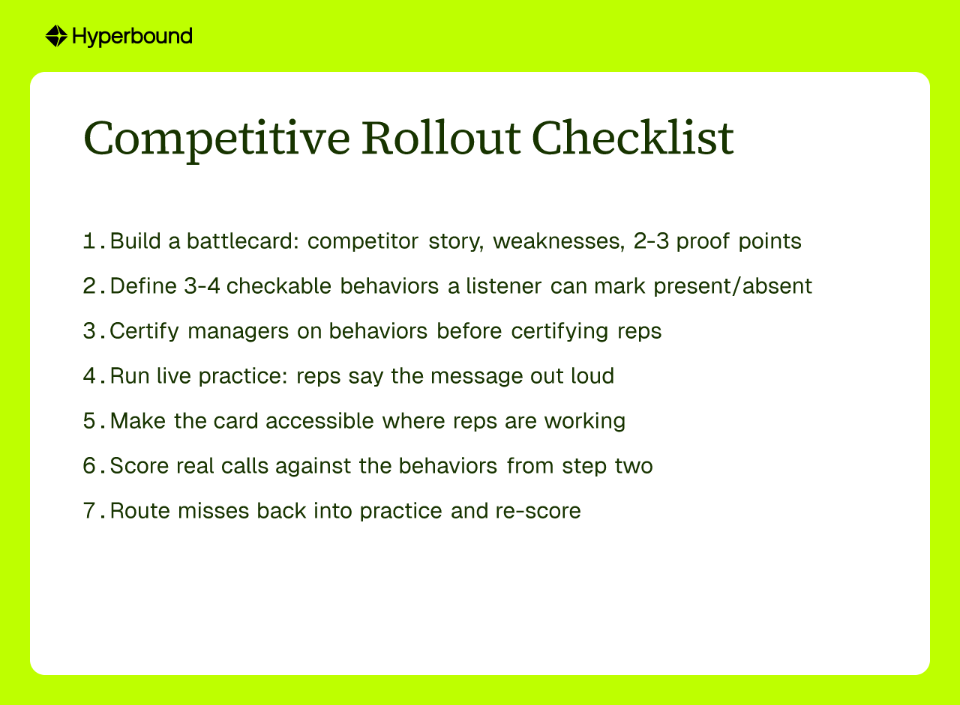
A rollout stalls when the card gets rewritten but the behaviors never get defined, so managers keep coaching to impression rather than to a specific action. It stalls when managers are trained on the message but never certified on recognizing the behaviors, so the fourth step above has no one qualified to run it. It also stalls when verification depends entirely on manager bandwidth, since 47% of managers already spend under thirty minutes a week coaching and cannot absorb a new scoring requirement without a mechanism to scale it. Not every adoption failure is a training problem; some are process, incentive, or tooling gaps, and forcing more training onto a tooling gap wastes the rollout's momentum without fixing the underlying cause.
A competitive messaging rollout can be completed in as little as two to four weeks from finalized card to manager certification and initial live training. Ongoing verification continues beyond the initial launch, with periodic re-checking as competitive situations evolve.
The initial rollout, which includes defining checkable behaviors, certifying managers, running live practice sessions, and making the card accessible, usually fits within a few weeks. However, verified adoption is not a one-time event. It requires continuous scoring of real calls and routing of misses back into practice, which should run as a feedback loop for as long as the messaging remains current.
The two most common causes are staleness and inaccessibility. If a rep gets caught on a call with outdated positioning or cannot find the card when they need it, they will stop trusting and using the asset.
A battlecard that is accurate but buried in a shared drive fails for the same reason as one that is out of date: reps will not search for a file while a prospect is talking. Additionally, if the card is not updated regularly, reps lose confidence in the accuracy of the entire enablement library, not just that single card.
Checkable behaviors are specific, observable actions a sales rep takes on a call, such as asking what is driving the evaluation before introducing positioning. They matter because vague instructions like "position well" cannot be verified, while a listener can mark a specific behavior present or absent.
Defining three or four checkable behaviors turns a subjective coaching conversation into a measurable one. This is the step that most competitive rollouts skip, and it is the reason they fail to change anything on real calls. Without these behaviors, managers coach to impression rather than to a concrete action.
Managers verify by scoring recorded calls against the same three or four checkable behaviors defined in the rollout. Structured, calibrated scoring against a weighted scorecard is associated with up to 28% higher win rates and 91% quota attainment, per RAIN Group.
Manual review is a workload problem: sales managers review under 1% of recorded calls on average. To scale verification, teams can use conversation intelligence or coaching platforms that score calls automatically and route reps who miss behaviors back into targeted practice. This turns verification from an audit into a continuous feedback mechanism.
Live practice is where reps say the new competitive message out loud before using it under pressure. A structured progression from learning the message to applying it on a real call prevents rollouts from failing within thirty days after delivery.
Reps need to hear the positioning spoken, not just read it. Custom practice scenarios delivered at the GTM kickoff remove the manager-dependency bottleneck and allow reps to rehearse independently. Daily warm-ups and peer champion rituals help reinforce the message between initial training and the next full refresh.
The best time is when a competitor is actively appearing in open pipeline, not on a generic quarterly training calendar. A rollout that addresses a current threat is more likely to be adopted immediately by reps facing that competitor.
Timing the rollout to real deal exposure increases relevance and urgency. If a competitor makes a move mid-quarter, teams with fast practice-build capabilities can roll out messaging the same week, rather than waiting for the next scheduled training cycle. Delaying until the threat is stale wastes the effort and reduces adoption.
Frontline sales managers should be certified on the message and the checkable behaviors before reps are trained. Manager-observed mastery, rather than course completion, is the correct gate for a finished rollout.
If a manager cannot recognize a rep asking about the evaluation driver before positioning, they cannot coach it or verify it later. Certifying managers first ensures that every stage of the rollout after the initial training is supported by someone qualified to observe and reinforce the behavior.
Allow reps to contribute field-level detail, such as phrasing that worked or a new objection heard, through a controlled update process. This keeps the card current and gives the field a stake in its accuracy.
Staleness is one of the two adoption killers. Reps stop opening an asset after being caught with outdated information. A structured feedback loop where reps can submit updates, combined with regular review by enablement or product marketing, keeps the card reliable without becoming an open document that anyone can edit inconsistently.










Use Cases
Legal