
You've been there before: sitting in a conference room, awkwardly pretending to sell to your colleague who's throwing you softball objections while your manager watches. The whole exercise feels like "cheesy office improv" that bears little resemblance to actual sales calls.
"It blows my mind how many sales people advocate for roleplaying. It's just so inorganic and resembles nothing of my real life interactions," shared one sales professional on Reddit.
If this resonates with you, you're not alone. Many sales professionals view roleplaying as an outdated, ineffective training method. But here's the truth: the problem isn't roleplay itself—it's generic roleplay that fails to simulate conversations with your actual buyers.
When done correctly, roleplay transforms from a dreaded exercise into your most powerful tool for preparation. The key? Focusing on your Ideal Customer Profiles (ICPs).
Before you can create effective roleplay scenarios, you need to deeply understand who you're selling to. This is why starting with your ICPs is non-negotiable.
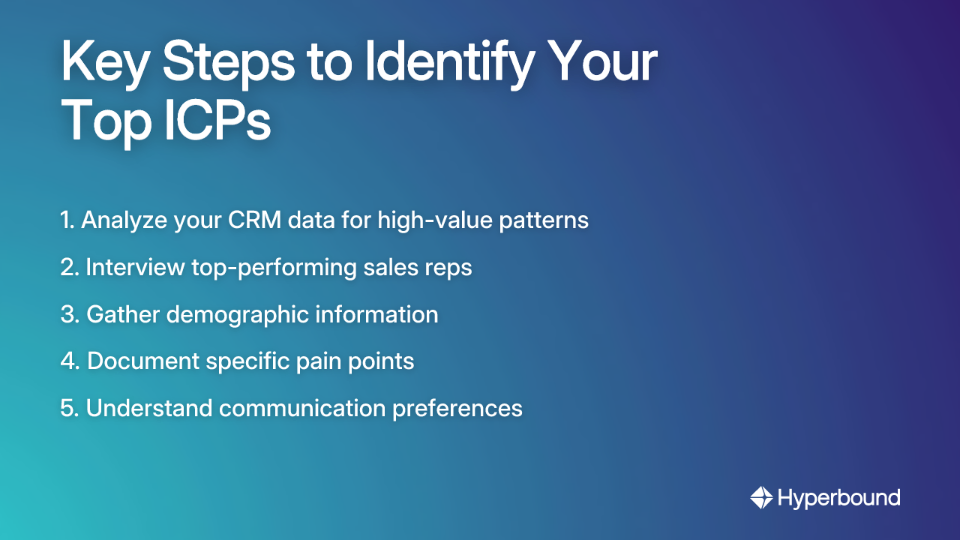
Creating effective roleplay scenarios starts with a deep understanding of who you're selling to. Without it, you're just guessing at what might resonate.
Once you've identified your top ICPs, follow these steps to create roleplay scenarios that actually prepare you for real conversations:
For each ICP, map out the most critical conversations your team needs to master:
Example:
Transform your ICP data into realistic characters that feel like actual prospects. Give them:
This level of detail makes the interaction feel more authentic and less scripted.
Using the data gathered from your ICPs, arm your "buyer" with realistic pushback. Incorporating diverse and challenging scenarios builds resilience and prepares reps for the unexpected. Consider scenarios like:
Make these objections specific to each ICP—the way a CTO questions ROI will differ dramatically from how a CMO does.
Move beyond a simple win/loss outcome. Success criteria should be specific:
As one sales professional noted, "Almost every AE scored the other as perfect or near perfect" when evaluation criteria were subjective. Clear metrics eliminate this problem.
Even with well-designed ICP scenarios, several common pitfalls can derail effective roleplay sessions:
The goal is growth, not judgment. Role-playing should never be used to berate or criticize salespeople; it's a tool for development.
Frame sessions as "practice" or "sparring," not a test. This creates psychological safety that encourages authentic participation.
Implement a structured feedback loop to combat vague or overly-positive reviews. Use a simple framework:
Role-playing shouldn't be a one-time event during onboarding. It needs to be a continuous process to create lasting change and skill development.
As one Reddit user put it, "Role playing is essential. But you also need a good role player." This brings us to our next challenge: scaling effective practice.
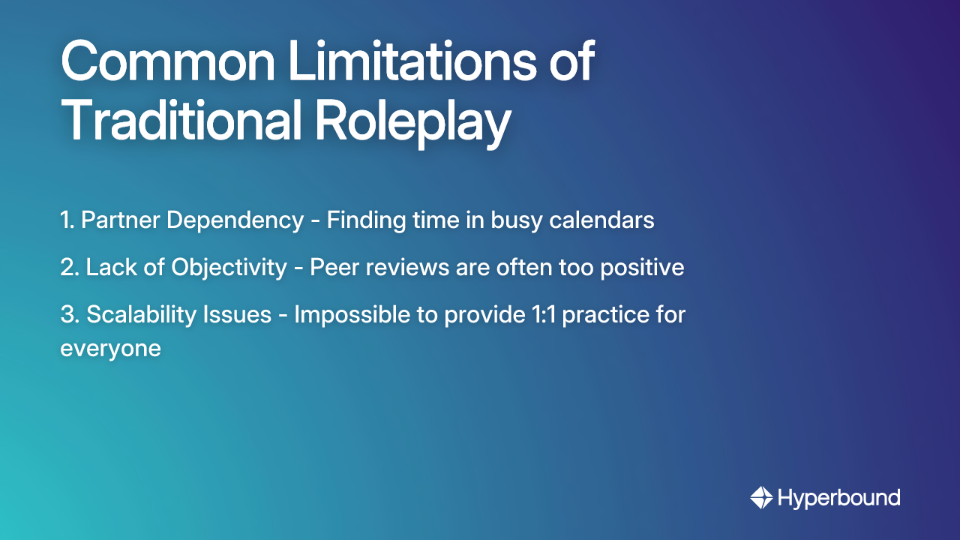
Traditional roleplay has three major limitations:
This is where AI-powered solutions come in, transforming how teams approach sales practice.
Platforms like Hyperbound allow you to build your ICPs as AI buyer personas that respond naturally and realistically during practice sessions.
Hyperbound's AI Sales Roleplays let you:
The platform also offers AI Coaching that provides real-time, personalized feedback aligned with your company's playbook, identifying missed opportunities and weak responses instantly. This allows reps to self-correct and improve continuously without waiting for manager feedback.
For teams looking to measure improvement, AI Real Call Scoring can analyze actual sales conversations, allowing you to track how roleplay practice translates to real-world performance.
The goal of roleplay isn't to become a better actor in an inorganic scenario—it's to build muscle memory for real conversations with your most important buyers.
When you focus your practice on deeply researched ICPs, whether through traditional roleplay or AI-powered tools, you'll see tangible benefits:
Ultimately, role-playing helps salespeople prepare for specific objections, negotiations, and discovery calls, enhancing their confidence in real situations.
Start by selecting just one ICP and building one realistic scenario this week. Whether you use a colleague as your roleplay partner or leverage AI tools like Hyperbound, you'll find that targeted, ICP-specific practice isn't just another training exercise—it's the most direct path to mastering your craft and closing more deals.
ICP-based sales roleplay is a training method that focuses on practicing sales conversations with personas built from your Ideal Customer Profiles (ICPs). Instead of generic scenarios, this approach uses detailed information about your best customers—their job titles, pain points, goals, and common objections—to create hyper-realistic practice sessions. This ensures that salespeople are preparing for the actual conversations they will have with high-value prospects.
Many sales roleplay exercises fail because they are generic, unrealistic, and conducted in a high-pressure, "testing" environment. Traditional roleplays often lack specificity and don't resemble real-life interactions with actual buyers. This leads to participants feeling like they're in a "cheesy office improv" session. Additionally, feedback is often subjective and unhelpful, and the exercise is treated as a one-time event rather than a continuous development tool.
To create realistic roleplay scenarios, you must base them on your top Ideal Customer Profiles (ICPs) and map out critical conversations across the sales cycle. Start by identifying your top 3 ICPs. Then, for each one, develop a detailed persona with a name, title, company details, and specific challenges. Script common objections and "curveballs" unique to that persona. Finally, define clear success metrics for the roleplay that go beyond a simple win/loss outcome.
AI improves sales roleplay by providing a scalable, objective, and safe environment for reps to practice unlimitedly. AI-powered platforms like Hyperbound solve the limitations of traditional roleplay. They eliminate dependency on a partner, allowing reps to practice anytime. AI provides instant, data-driven feedback based on pre-defined criteria, removing the subjective bias of peer reviews. This allows for consistent practice at scale, helping reps master conversations with every ICP without fear of judgment.
The primary benefits of practicing with ICP-specific scenarios are faster ramp times for new hires, increased confidence for the entire team, and improved sales performance. By preparing for the exact conversations they'll have with their most important buyers, reps build muscle memory and confidence. They learn to handle specific objections and navigate complex discussions effectively. This leads to better outcomes in real-world sales calls, shorter sales cycles, and ultimately, more closed deals.
The best way to get started is to select just one of your top Ideal Customer Profiles (ICPs) and build a single, realistic scenario this week. Don't try to boil the ocean. Begin by analyzing your CRM data and talking to top reps to define one ICP clearly. Then, outline a common scenario for that ICP, such as a cold call or handling a specific objection. You can practice with a colleague or use an AI tool like Hyperbound to get started immediately. The key is to start small and build momentum.











Use Cases
Legal