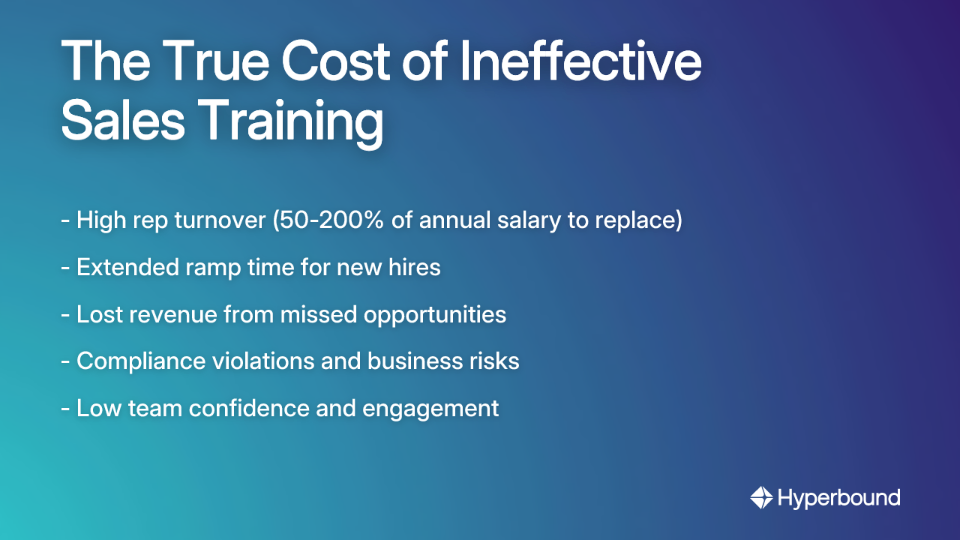
You've set up a sales training program to equip your team with the skills they need to succeed. But when you check your budget, you're shocked to see how much you're spending on training that doesn't seem to deliver results. Your reps forget most of what they learn within weeks, your new hires still take months to ramp up, and those expensive training platforms gather digital dust.
These ineffective training programs aren't just draining your budget—they're actively hurting your business by leaving your team unprepared and anxious about their performance.
The sales training software market is projected to exceed $7.82 billion by 2032, showing massive investment in this area. Yet, 84% of sales training is forgotten by reps within 90 days, and 74% of sales professionals feel they aren't achieving their full potential due to ineffective training.
The good news? Reducing the cost of sales training isn't about slashing your budget—it's about investing smarter in modern, scalable, and effective training strategies that actually stick. This article will outline proven approaches to reduce the net cost of your sales training while maximizing its impact on performance.
Before implementing new tools or technologies, focus on these core principles:
Before spending a dollar, analyze your team's current skills to focus training only where it's needed. Don't waste money on redundant programs. Talk directly with your reps to understand their perceived strengths and weaknesses.
One sales enablement leader shared on Reddit: "You need to balance training and real-world application." This starts with identifying exactly what skills your team needs to develop.
Create a single source of truth for all training materials, playbooks, and best practices using a knowledge management system. This reduces the need for repeated instructor-led sessions and gives reps instant access to information when they need it.
Leverage your internal experts. Encourage top performers to lead workshops or mentoring sessions. This is a highly cost-effective method that uses real-world experience, addressing the common complaint that "theoretical training is not practical unless applied."
AI adoption in sales training is surging for a reason. 83% of sales teams using AI experienced revenue growth versus 66% not using it. AI makes training scalable, personalized, and data-driven—exactly what you need to reduce costs while improving outcomes.
Problem: Managers are a bottleneck. They can't review every call, and feedback is often delayed. New hires struggle without "immediate and actionable feedback," as one sales leader noted on Reddit.
AI Solution: AI delivers real-time coaching and just-in-time feedback at scale. AI platforms can analyze call transcripts and interactions to provide instant, objective feedback aligned with your sales methodology.
Impact: This empowers reps to self-correct and improve continuously. AI coaching programs can lead to a 40% reduction in first-year attrition while dramatically reducing the time managers spend on repetitive coaching tasks.
Hyperbound's AI Coaching delivers personalized feedback after every practice or real call, identifying missed opportunities and reinforcing the company playbook without requiring a manager to be present. This means every rep gets consistent coaching, not just the ones who happen to have attentive managers.
Problem: Traditional role-playing is time-consuming and hard to scale. Reps fear making mistakes on live calls, which hinders their development. As one new SDR confessed on Reddit: "I have serious anxiety about making calls and fear failing without proper guidance."
AI Solution: AI simulations provide a risk-free, infinitely repeatable environment for reps to practice their pitch, discovery questions, and objection-handling.
Impact: Reps can build muscle memory and confidence before ever speaking to a real prospect, dramatically shortening their ramp time and reducing early failures that could cost you customers.
Hyperbound's AI Sales Roleplays allow teams to create hyper-realistic scenarios with AI buyer personas. Reps can practice cold calls, demos, and even difficult renewal conversations, receiving instant scores and feedback. This makes training more engaging and effective, especially for onboarding and certifying reps on new messaging.
Problem: Manual call reviews are a massive time drain for managers and are inherently subjective. This is a major hidden cost. Teams need tools that "analyze patterns across multiple calls for effective coaching," according to one sales director's Reddit post.
AI Solution: Conversational intelligence platforms automatically record, transcribe, and score real sales calls against a predefined scorecard.
Impact: This saves managers hundreds of hours, provides objective data on team performance, and surfaces key coaching moments automatically.
With solutions like Hyperbound's AI Real Call Scoring, you can QA 100% of calls, identify if reps are following the sales methodology, and generate AI Deal Summaries to save review time. The ROI comes not just from time saved, but from being able to identify and address issues before they impact revenue.
Beyond technology, how you structure and deliver your training content significantly impacts both its cost and effectiveness:
Problem: Overwhelming new hires with a mountain of content on day one is a recipe for disengagement, as numerous onboarding managers have observed.
Solution: Break down complex topics into short, bite-sized learning modules (5-10 minute videos, quick quizzes, one-pagers). This improves knowledge retention and fits easily into a busy rep's workflow.
Increase engagement and motivation by adding game-like elements to training. Leaderboards, points, and badges for completing roleplays or courses can foster healthy competition and make learning fun.
Hyperbound's AI Sales Roleplays include gamified leaderboards to motivate reps and accelerate skill development through competition. This approach addresses the common challenge that "my reps don't read books," as one frustrated sales manager put it on Reddit.
Don't reinvent the wheel for every training session. Audit your existing content—webinar recordings, blog posts, sales decks—and repurpose them into new training formats. This drastically cuts down on content creation time and cost.
Only 8% of business leaders feel confident in measuring the ROI of their training programs. This is because they often focus on lagging indicators and miss the full picture.
While traditional metrics like win rates and revenue growth are important, a modern approach also tracks leading indicators and "hidden ROI":
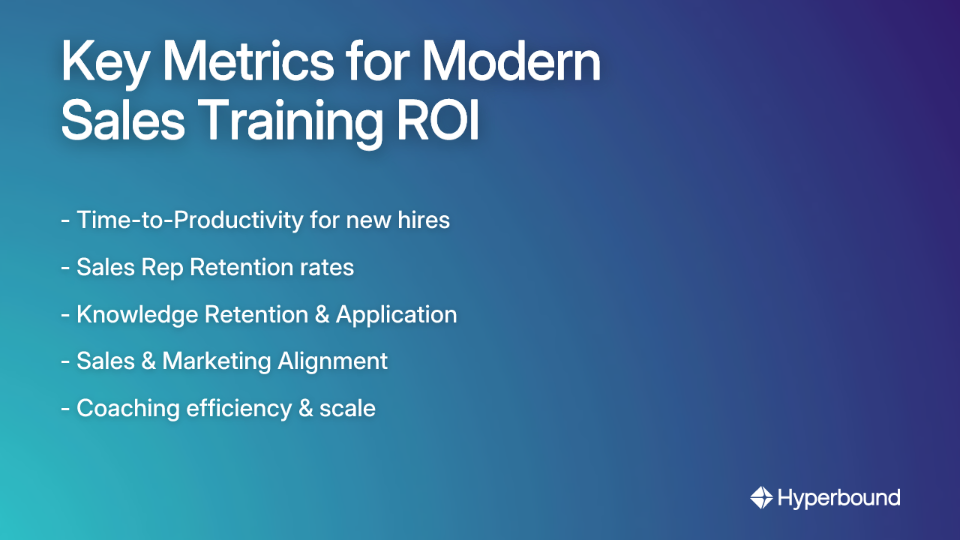
Use analytics from platforms like Hyperbound to draw a direct line between training activities (e.g., number of roleplays completed) and performance metrics (e.g., meeting booking rates). This provides the concrete data needed to prove training effectiveness and justify investment.
Reducing the cost of sales training while improving its effectiveness requires a fundamental shift in approach:
The era of expensive, infrequent, and forgettable sales training events is over. The future belongs to organizations that foster a culture of continuous learning, powered by intelligent tools. By investing in scalable platforms like Hyperbound, you not only reduce direct training costs but also unlock the "hidden ROI" of a more confident, competent, and consistent sales team.
The most cost-effective sales training isn't about spending less—it's about getting more value from every dollar you invest. When your reps can practice in risk-free environments, receive immediate feedback on every call, and access just-in-time learning resources, they'll develop skills faster and retain them longer.
This approach addresses the core pain expressed by so many sales professionals: "Theoretical training is not practical unless applied." By making application easy, frequent, and risk-free, you transform training from an expensive obligation into a powerful competitive advantage.
The most effective way to reduce sales training costs is to invest smarter, not cheaper. This means focusing on modern, scalable methods like AI-powered coaching and role-playing that lower the net cost of training by reducing hidden expenses such as high rep turnover, slow onboarding, and lost revenue from unprepared teams.
AI improves sales training ROI by making it scalable, personalized, and data-driven. AI platforms provide instant feedback on 100% of calls, offer risk-free practice environments that accelerate ramp time, and automate manual tasks like call scoring. This leads to faster skill development, higher rep confidence, and better performance outcomes that far outweigh the investment.
Traditional sales training often fails because it's treated as a one-time event rather than a continuous process. This approach lacks personalization and reinforcement, causing reps to forget up to 84% of what they learn. It also fails to bridge the gap between theoretical knowledge and practical, real-world application.
To measure training effectiveness, look beyond quota attainment. Track leading indicators like the time-to-productivity for new hires, rep retention rates, and knowledge application on live calls (which can be measured with AI call scoring). Connecting these metrics to training activities provides a clear picture of your program's true ROI.
The first step is to conduct a thorough needs analysis to identify specific knowledge and skill gaps on your team. Before investing in new tools, talk to your reps, analyze performance data, and centralize existing training resources. This ensures you focus your budget only on the areas that will have the greatest impact.
Ready to see how AI can transform your sales training and slash costs? Explore Hyperbound's AI-powered coaching and roleplay platform to discover how modern sales teams are reducing training costs while improving performance.










Use Cases
Legal