
Every plan to reduce sales ramp time eventually runs into the same wall: it needs more manager attention than the organization has. Shadowing needs a manager to schedule it. Call review needs a manager to listen. Certification needs a manager to grade it. The content is rarely the constraint. Enablement teams do not lack decks, playbooks, or call libraries. What they lack is enough manager hours to turn that content into behavior change at the pace hiring demands. That is the argument this piece makes, and it is falsifiable: if manager attention were not the binding constraint, then adding more training content would shorten ramp on its own. It does not.
The instinct when ramp time is too long is to build a better 30-60-90 day program: shadowing in the first month, call reviews in the second, a certification gate before full quota in the third. This is a reasonable structure, and it is what most enablement teams already run. The trouble is not the sequence. It is that each stage quietly draws down the same scarce resource, a manager's or a senior rep's calendar, and none of the three actually fixes the constraint underneath it.
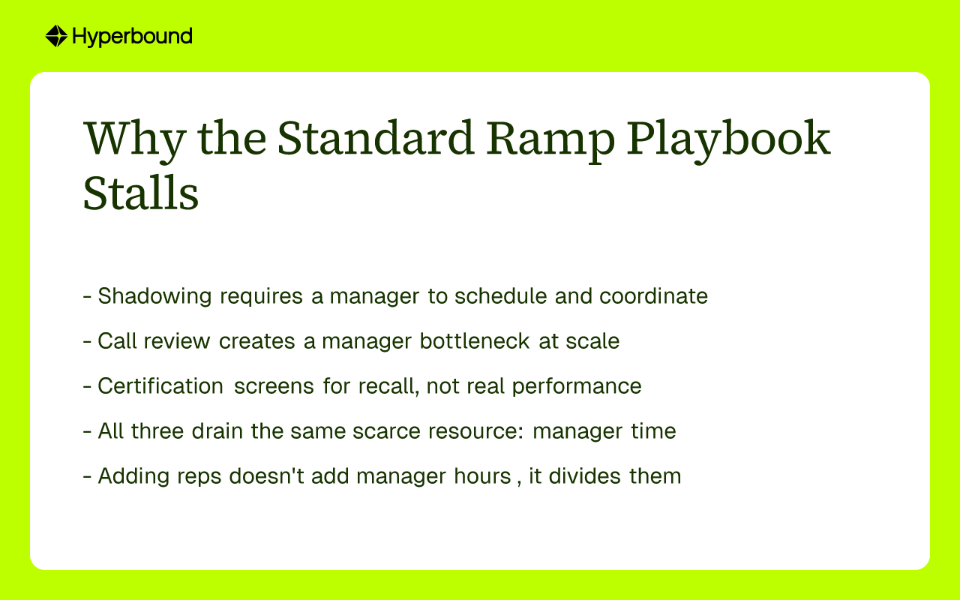
Sales coaching is, by definition, an attention-bound activity. Gartner's own framing describes it as "ongoing job-embedded interactions between a manager and a direct report," not a piece of content a rep consumes on their own time. That definition matters because it means every fix that routes through a manager's calendar inherits the calendar's limits. Hiring five new reps does not create five new hours of manager time. It divides the existing hours five ways.
Shadowing is usually the first thing a new hire does, and for good reason: it is the fastest way to expose someone to how a real deal actually sounds. But the mechanism that makes it useful also makes it non-scalable. Coordinating and dispersing shadowing evenly across a growing team is a manager-bandwidth problem before it is anything else. Someone has to schedule whose calls get shadowed and by whom.
Left unmanaged, shadowing concentrates on a handful of "role model" reps, and that concentration has a real cost: those reps lose selling time babysitting new hires, which shows up nowhere on an enablement dashboard but shows up clearly in their pipeline. Shadowing is also passive by design. A new hire can nod along for a month without absorbing anything usable, and the gaps only surface once that person is flipped into the driver's seat and observed live, which is the exact moment shadowing stops helping and coaching has to start. Ride-alongs compound the problem: they show a rep's best behavior, not their real behavior, because reps run the playbook when someone is watching and drift the moment nobody is.
Recorded-call libraries look like the scalable alternative: searchable, self-serve, no calendar required. They solve the scheduling problem shadowing has, but they trade it for a different one: they are passive, and they miss the emotional undertones that a live listener catches instantly: hesitation, tone shifts, the moment a buyer disengages. A library teaches a new hire what a good call sounds like in structure. It rarely teaches what a good call feels like to be in.
Call review, where a manager listens to a rep's actual calls and gives feedback, closes that gap, but it reintroduces the original constraint in a sharper form. When coaching depends on one person manually reviewing everything, that person becomes the bottleneck, and the math gets worse as headcount grows, not better. This is visible in the numbers: across sales organizations, managers typically observe somewhere between two and five percent of the conversations their reps actually have. Ninety-five percent or more of a new rep's calls happen with nobody watching at all, which means the "coaching" a growing team receives is really a thin, uneven sample dressed up as a program.
The third pillar, certify the rep before letting them run full quota, feels like the most rigorous of the three because it produces a pass/fail signal. But a quiz or a scripted certification call tests recall, not performance under pressure. New reps fail in a small, predictable set of live moments: presenting price, skipping a process step, not asking for the order, folding at the first objection. None of those show up on a certification checklist. They only show up in an actual selling situation, which is precisely what certification is designed to avoid putting a new hire into until they are "ready." The gate ends up screening for the wrong thing.
This is also where the difference between coaching and evaluation matters. Coaching develops current skill through frequent, forward-looking interaction; evaluation looks backward against a fixed rubric. Certification is evaluation. Ramp time is, overwhelmingly, a coaching problem, and a program built entirely on evaluation checkpoints will produce reps who can pass a test and still fold on their fifth cold call.
None of this means coaching does not work. It means coaching works and is expensive in the one currency enablement cannot print more of. Combining training with coaching is roughly four times more effective than training alone, according to CEB research, a strong argument for coaching investment. But the same body of research shows the effect is asymmetric: poor coaching hurts performance nearly twice as much as good coaching helps. The lever is not "more coaching." It is "more good coaching," and good coaching is the scarcest input a sales organization owns, held entirely by managers who are already stretched across their own pipeline, their own deals, and everyone else's morning meeting.
Put those two facts together and the standard ramp playbook's failure mode becomes obvious. Shadowing, call review, and certification are all attempts to deliver more coaching through the same fixed number of manager hours. Adding reps without adding manager hours means those hours get thinner per rep, which is exactly what enablement leaders report when ramp time stretches as headcount grows, even while the training materials stay the same or improve.

If manager attention is the ceiling, the only way to add reps without proportionally adding manager hours is to stop routing every rep-hour of practice through a manager's calendar while keeping the coaching quality that makes practice matter in the first place. That requires two things happening at once: repeated, realistic practice that does not need a manager present for every rep, and live coaching precise enough to catch the moments that predict failure, delivered while the call is still happening rather than in a review three days later.
This is the operating premise behind Hyperbound's Practice-to-Perform loop: score real calls, identify the specific skill gap, put the rep back into a targeted practice scenario built on that gap, then score again. What used to take weeks or months of live call volume to surface a pattern now happens inside a single practice session: repetition compression, not a bigger training deck.
The second half of the loop, live coaching during the call itself, not after it, is a distinct capability from anything conversation intelligence platforms offer today. Real-time coaching sits outside most call-intelligence pricing tiers entirely; category-standard platforms are built to analyze calls after they end, not to intervene while a rep is still on the line with a buyer. That gap is what Hyperbound's Live Call Coaching, launched within the Perform product line, is built to close: a desktop side panel that detects when a rep joins a call and activates automatically, silent and read-only, never visible to the prospect. It gives a new rep the equivalent of a manager sitting beside them on every call, without requiring an actual manager to sit beside them on every call, which is the only way the math of adding reps without adding manager hours works out.
Live, in-call coaching is not a purchase decision an enablement leader should make casually, and treating it as an obvious upgrade over call review understates what it actually requires.
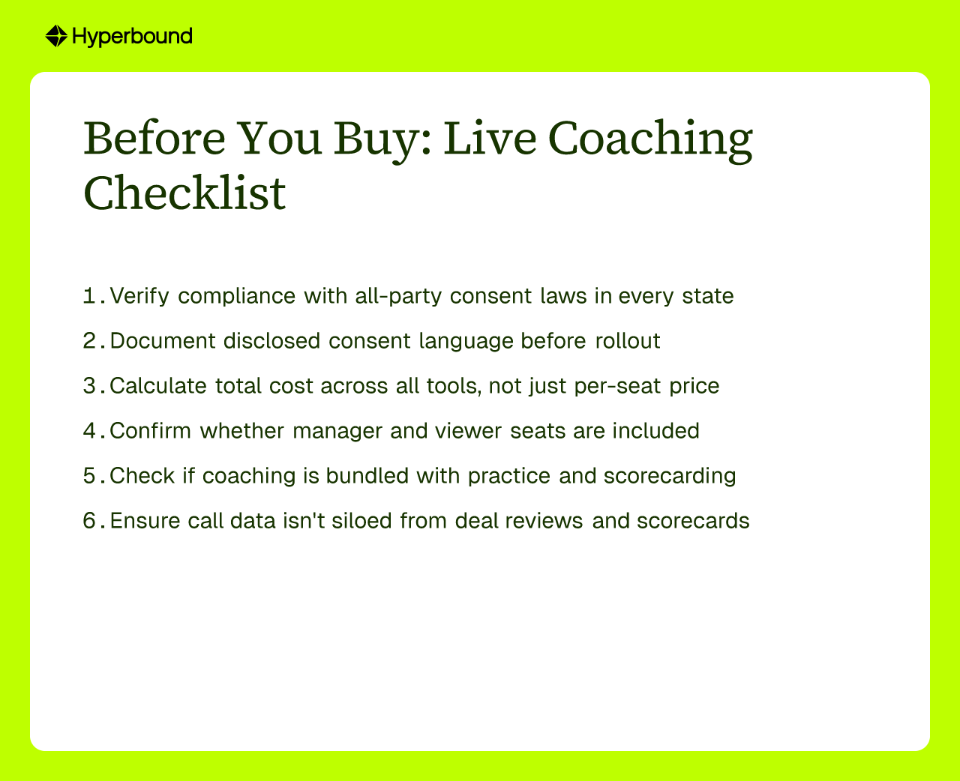
The first cost is compliance, and it is a real one, not a footnote. Real-time AI call analysis qualifies as monitoring or interception under the strictest state wiretap laws even when nothing is recorded. Access is the trigger, not storage. Federal law permits one-party consent, but several states require all-party consent for contemporaneous monitoring, and a cross-state sales team has to operate at the strictest common denominator across every call. Any live-coaching vendor also becomes a new third party with access to call audio, which has to be disclosed and controlled to preserve the buyer's own service-provider status under whatever privacy regime governs its calls. Best practice includes recorded all-party consent up front, an audible disclosure that names automated tools or third-party processors as potential participants, monitoring that starts only after that consent, and a retained record of it. It is not optional diligence. It is the first evaluation criterion, ahead of feature comparisons.
The second cost is budget scrutiny, and it deserves the same directness. Conversation intelligence pricing already runs from roughly thirty to a hundred and fifty dollars per user per month depending on tier, sometimes with a platform fee stacked on top, and a lower sticker price does not guarantee a lower total cost. A cheaper per-seat tool that still requires a separate dialer, a separate coaching platform, and a separate forecasting layer can cost more in aggregate than a single consolidated platform priced higher per seat. Enablement leaders evaluating live coaching should be asking the boring but decisive questions before signing anything: does "user" pricing cover every rep or only recorded ones, are manager and viewer seats included or billed separately, and is the coaching layer bundled with practice and deal-level scoring or does it create a second silo of call data disconnected from scorecards and deal reviews. A standalone live-coaching tool that duplicates setup work an enablement team has already done elsewhere is not solving the attention problem. It is relocating it.
These are not reasons to avoid live coaching. They are the reasons it has to be evaluated as infrastructure, with the same rigor applied to any tool that touches every rep's calendar and every prospect's conversation, rather than adopted as a feature checkbox.
If manager attention really is the ceiling, then the enablement roadmap has to change shape. The question stops being "which training program should we run next" and becomes "how much of our current coaching load can happen without a manager in the room, and how fast does live coaching catch the moment that would otherwise need one." That reframes the ramp-time metric itself: not how much content a new rep consumed, but whether that rep can answer, cold, the handful of moments that actually predict failure: presenting price, holding the process, asking for the order, handling the first objection, without a senior rep sitting next to them.
Teams that get this right are not running more shadowing shifts or writing longer certification rubrics. They are compressing the repetition a rep needs into practice sessions that do not consume a manager's calendar, then catching what practice cannot predict with live coaching the moment it happens on a real call, which is the operating model behind Hyperbound's Perform product line and the reason ramp time is, first and always, a manager-attention problem before it is a content problem.
Manager attention, not content, is the bottleneck. Enablement teams rarely lack decks, playbooks, or call libraries; they lack enough manager hours to turn that content into behavior change. As headcount grows, the same manager hours get divided across more reps, so ramp time stretches even when training materials stay the same or improve.
Manager attention is the binding constraint. Sales coaching is an attention-bound activity: it depends on ongoing, job-embedded interaction between a manager and a rep. Shadowing, call review, and certification all draw down the same scarce resource, a manager’s or senior rep’s calendar, so adding reps without adding manager hours makes coaching thinner per rep.
Each stage routes through a manager’s calendar. Shadowing requires someone to schedule and coordinate who observes which calls. Call review depends on a manager manually listening to calls and giving feedback. Certification requires a manager or senior rep to grade the rep against a rubric. All three look scalable on paper but inherit the limits of the person running them.
Coaching develops current skill through frequent, forward-looking interaction. Evaluation looks backward against a fixed rubric, like a scorecard or certification checklist. Ramp time is primarily a coaching problem, and programs built only on evaluation checkpoints tend to produce reps who can pass a test but still struggle in live selling moments.
The predictable, high-stakes live moments matter most: presenting price, holding the sales process, asking for the order, and handling the first objection. These rarely show up on certification checklists, but they determine whether a rep succeeds on a real call. Practice should compress repetition around these moments rather than add more content.
Decouple practice and in-the-moment coaching from a manager’s calendar. Give reps repeated, realistic practice that does not require a manager present for every session, and pair it with live coaching that catches the few moments that predict failure while the call is still happening. That is the pattern behind practice-to-perform loops.
It depends on where reps and prospects are located. Real-time AI call analysis can qualify as monitoring under strict state wiretap laws even when nothing is recorded. Teams operating across states should apply the strictest all-party consent standard, disclose the use of automated tools or third-party processors, and retain a record of consent before rollout.
Live call coaching intervenes while a call is still happening; conversation intelligence tools typically analyze calls after they end. That real-time capability gives a rep the equivalent of a manager sitting beside them on every call, without requiring an actual manager to join. It often sits outside standard call-intelligence pricing tiers and is the missing piece for ramping reps without adding manager hours.
Ask whether every rep counts as a billed seat or only recorded ones, whether manager and viewer access is included, and whether coaching is bundled with practice and scorecarding or sold as a standalone tool. Also verify consent and privacy compliance before comparing features, because monitoring access can create legal obligations across states.
Hyperbound scores real calls, identifies the specific skill gap behind a failed moment, puts the rep into a targeted practice scenario built on that gap, and then scores again. This compresses weeks or months of live call volume into a single practice session, so reps improve without consuming additional manager hours. Live Call Coaching then supports the rep during real calls, giving a manager-like presence without the manager actually being on the call.








Use Cases
Legal