
You're a top-performing Sales Engineer. Account Executives love working with you, and you get feedback that you're "the best they've ever worked with." But deep down, you know there's another level to reach. The question is: how do you evolve based on your past demos?
Presenting to Fortune 500 companies isn't just another meeting. These enterprise organizations demand laser focus on ROI, security, and proven solutions to complex business problems. A generic "feature dump" won't just fail; it will damage your credibility and potentially cost millions in lost revenue.
In this guide, we'll explore how to develop a systematic practice regimen focused on storytelling, deep customization, and creating a powerful feedback loop to drive continuous improvement. From self-review to leveraging AI for objective analysis, you'll learn how to structure your practice for maximum impact.
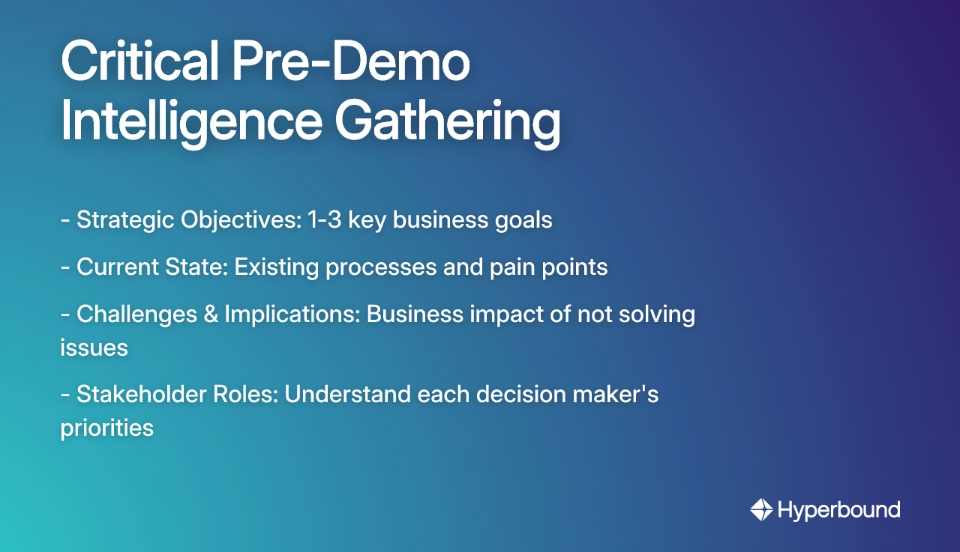
The best demos are won before they even begin. Practice is wasted effort if it's not based on deep customer insight. This moves beyond a simple discovery call to strategic intelligence gathering.
Before practicing a single slide, gather these critical insights to build a tailored demo:
Not all demos require the same level of customization. Gartner outlines a spectrum that you should decide on before practicing:
Too many SEs "feature-dump all over people," causing prospects to quickly lose interest. The solution is effective storytelling. The best demos aren't product tours; they are stories where the customer is the hero and your product is their guide.
This technique, popular at Salesforce, provides a clear framework:
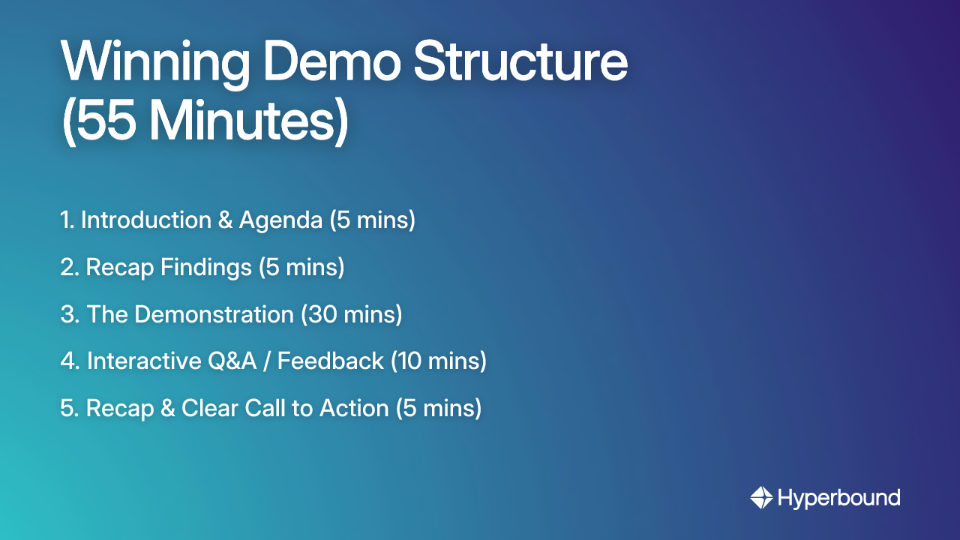
To avoid long, rambling demos that cause prospect fatigue (a key concern when "2 to 3 hours seems insane"), follow this tight agenda:
This is where the real work happens. Effective practice is active, structured, and focused on generating actionable feedback.
As one sales engineer recommended, "Record yourself doing demos. Then watch in pain and discomfort. You will learn so, so much."
Analyze your recording for:
The challenge many face is that "managers and coworkers want to just be nice." To get honest feedback, create a formal rubric for your peers. Ask them to score you on:
Go beyond simply rehearsing your standard demo. Practice for what could go wrong. Smartwinnr suggests role-playing:
Getting consistent, objective feedback at scale is a huge challenge. This is where modern tools can transform your practice.
Hyperbound's AI Sales Roleplays provide a safe, repeatable environment to master high-stakes conversations. Instead of bothering a colleague, you can practice with a hyper-realistic AI buyer persona that responds dynamically.
Crucially, you receive an AI-Powered Scorecard after each session. This provides instant, unbiased feedback on your performance, tracking talk tracks and key selling moments—solving the "peers are too nice" problem and creating a powerful feedback loop.
The ultimate goal is to learn and evolve from every single demo, not just the ones you practice. AI coaching tools can analyze your real-world performance to provide insights you would otherwise miss.
AI sales coaching is critical for scaling effective feedback, as many managers simply lack the time for deep, consistent call reviews.
Objective Call Scoring: Platforms like Hyperbound's AI Real Call Scoring can analyze your actual demo recordings. The AI automatically scores the conversation against your company's methodology, flagging where you adhered to the playbook and where you missed key opportunities.
Personalized, Instant Coaching: Instead of waiting weeks for manager feedback, Hyperbound's AI Coaching delivers actionable insights immediately after your call. It can identify weak responses or missed objection-handling opportunities, allowing you to self-correct and refine your technique continuously.

Reinforce the value you delivered. As one sales engineer correctly points out, "Post-demo followups are as important as the demo."
Hyperbound can help here too. Its AI call analysis extracts key moments, prospect objections, and defined next steps from the conversation, making it faster to draft a highly personalized and impactful follow-up email.
Moving from a good to a great demo-er requires a shift in mindset. It's not about endless rehearsal; it's about a deliberate system of intelligence gathering, narrative building, and a robust feedback loop.
The best sales professionals—the ones who consistently win Fortune 500 deals—don't leave their performance to chance. They practice with purpose, seek out objective feedback, and leverage technology to continuously refine their craft. By adopting these strategies, you can move beyond simply presenting features and start telling stories that close deals.
The most common mistake is "feature dumping"—presenting a long list of product features instead of telling a compelling story that solves the customer's specific business problem. This approach quickly disengages prospects, especially in enterprise settings where decision-makers are focused on ROI and strategic outcomes. Instead, top SEs use a storytelling framework like 'Tell-Show-Tell' to connect features directly to the prospect's challenges and goals.
You can get honest, objective feedback by using a structured peer review rubric or leveraging AI-powered coaching tools. A formal rubric forces reviewers to score specific aspects of your demo, moving beyond vague compliments. For truly unbiased and scalable feedback, AI tools analyze your practice sessions or real calls, providing a data-driven scorecard that highlights areas for improvement without human bias or time constraints.
The level of customization depends on the prospect's strategic value, but for major deals with Fortune 500 companies, a "full-custom" demo is ideal. A full-custom demo uses the prospect's data, branding, and specific use cases to demonstrate a deep understanding of their business. For other accounts, semi-custom (e.g., adding a logo) or non-custom but highly relevant demos can be effective.
The 'Tell-Show-Tell' method is a framework for structuring each segment of your demonstration to ensure your message lands effectively. It works in three steps: 1. Tell the audience what problem you're about to solve. 2. Show them the specific workflow in your product that accomplishes this. 3. Tell them what you just showed, reiterating the value and business impact.
To avoid fatigue, structure your demo around a tight, 5-part agenda, keeping the core demonstration to about 30 minutes. A proven structure for a 55-minute meeting includes: a 5-minute introduction, a 5-minute recap of discovery findings, a 30-minute demonstration on 3-5 key value points, 10 minutes for interactive Q&A, and a 5-minute recap with a clear call to action.
Pre-demo intelligence is critical because it forms the foundation of a relevant and impactful demo; without it, your presentation is based on guesswork. Before practicing, you must understand the prospect's strategic goals, current processes, and specific pain points. This allows you to tailor your narrative to address each stakeholder's individual concerns, from an IT director's focus on security to a VP's focus on ROI.
AI-powered sales role-playing tools provide a safe and repeatable environment to practice handling difficult scenarios like tough objections or technical deep-dives. These platforms allow you to practice with hyper-realistic AI buyer personas that can challenge you with common objections. After each session, the AI provides an instant, unbiased scorecard, allowing you to refine your responses and build confidence for any situation.










Use Cases
Legal